Best price Excellent
Industar-10 FED 50mm f3.5 - Leica Screw Mount - CL'a May 2022
Sold by One Of Many Cameras
€95 ≈ $102
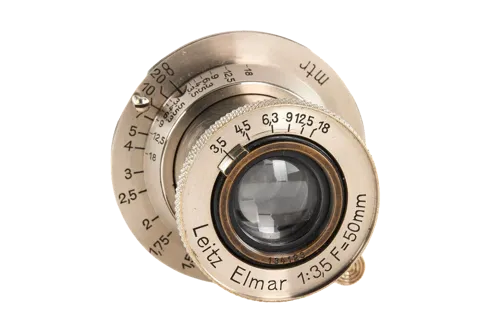
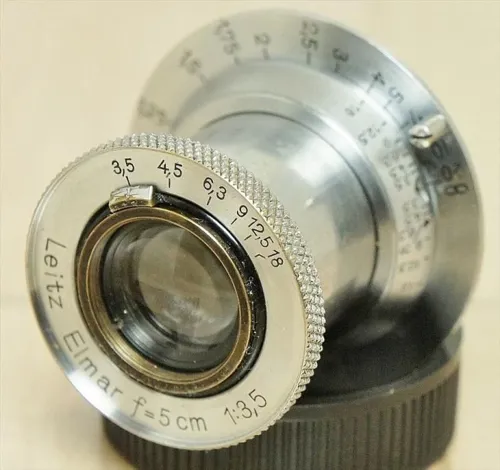
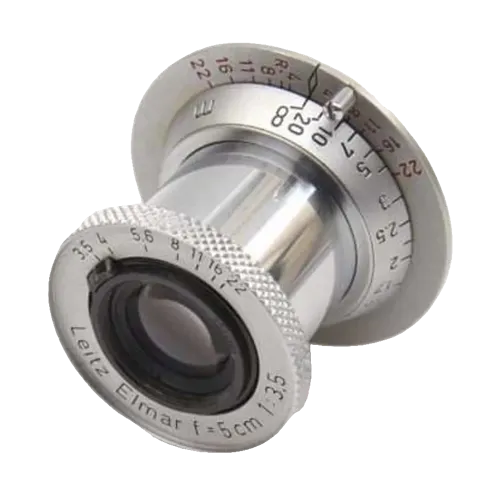
The FED Industar-10 50mm f/3.5 is an early collapsible, rangefinder-coupled LTM normal lens with four-element Tessar-type optics and eight blades.
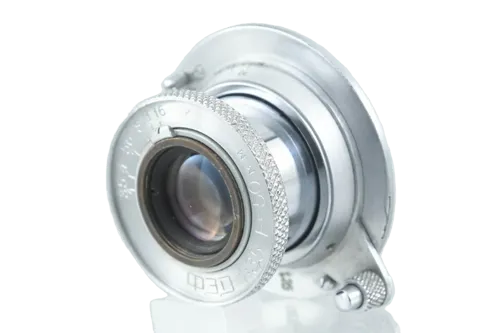
M39 mount
The FED Industar-10 50mm f/3.5 collapsible is a M39-mount lens for Leica rangefinder cameras. As of September 2026, it sells from €95 used across 2 listings, with a 30-day median of €109. Leica price index →
Measured against the 13 other 50mm M39-mount lenses in the catalogue.
The FED Industar-10 50mm f/3.5 is a collapsible Soviet normal lens made for FED and other Leica-thread-mount rangefinder cameras. It appeared with the early FED camera system in the 1930s and is one of the earliest Soviet Leica-copy standard lenses. USSRPhoto lists the FED 50mm f/3.5 from 1934 to 1956 and states that the lens was also known as the Industar-10 .
The lens uses a 4 element, 3 group Tessar-type optical formula. USSRPhoto describes the design as a Tessar-derived construction, with the rear pair cemented and the diaphragm positioned between the second and third elements. AllPhotoLenses lists the FED Industar-10 as a 35mm rangefinder lens in M39 Leica screw mount, with 50mm focal length, f/3.5 maximum aperture, f/16 minimum aperture, 8 aperture blades, 1.25m closest focusing distance, 111g weight and 38mm length .
This lens should be separated from later Soviet collapsible normal lenses such as the Industar-22 and Industar-50. USSRPhoto notes that the FED 50mm f/3.5 design was later handed over to KMZ in the late 1940s, where the Industar-22 was born. The Industar-10 name is therefore most appropriate for the FED-made 50mm f/3.5 collapsible lens from the early FED rangefinder period.
Rendering
The FED Industar-10 is a Tessar-type normal lens with a vintage prewar and early postwar rendering style. It is generally valued more for historical interest and compact collapsible handling than for modern optical correction. Rendering should be described conservatively because surviving examples vary widely in condition, coating status and mechanical adjustment.
Sharpness
A clean and properly adjusted copy can produce usable central sharpness, especially when stopped down. However, sharpness is highly copy-dependent. Early FED lenses can suffer from haze, cleaning marks, element misalignment, mechanical wear and rangefinder calibration differences, so strong claims about edge performance or modern digital sharpness should be avoided .
Contrast and coating
Early FED 50mm f/3.5 examples are often uncoated, while later examples may show different finish or coating characteristics depending on production period. Contrast is usually lower than later coated Soviet lenses such as the Industar-61 L/D. Lens condition is especially important because haze and internal reflections can reduce contrast significantly.
Bokeh and transitions
The lens has 8 aperture blades according to AllPhotoLenses. Because the maximum aperture is f/3.5 and the closest focus is around 1.25m, it is not primarily a shallow-depth-of-field lens. Its rendering is better understood as a compact vintage normal-lens look rather than a portrait-style bokeh lens.
Handling
The collapsible barrel is one of the defining features of the lens. It makes the lens very compact when collapsed, but users should verify that the lens can safely collapse on the intended camera body, especially on digital bodies or adapted mirrorless cameras. The aperture is adjusted at the front, and handling is typical of early Leica Elmar-style collapsible lenses.
Digital use
The lens can be used on Leica M bodies with an L39-to-M adapter and on mirrorless cameras with suitable adapters. However, early FED lenses may not always match later Leica-standard rangefinder calibration perfectly. Infinity focus, rangefinder coupling and safe collapse clearance should be checked before regular use.
Development and Launch
The FED Industar-10 50mm f/3.5 belongs to the first generation of Soviet Leica-copy lenses. FED production began in Kharkiv in the 1930s, and the 50mm f/3.5 collapsible lens became the standard lens for early FED rangefinder cameras. USSRPhoto gives the production period as 1934 to 1956 and identifies the lens as the FED 50mm f/3.5, also known as the Industar-10.
Production Evolution
The lens evolved through early nickel or chrome finishes and later postwar examples. Radojuva notes that FED 50mm f/3.5 lenses appeared in several forms and that early examples were strongly associated with Leica Elmar-style construction . Later Soviet standard lenses such as the Industar-22 and Industar-50 continued the collapsible Tessar-type tradition, but they should be catalogued separately because of different makers, markings and production histories.
Special Editions/Variants
No commemorative factory special edition is widely documented. Collector-relevant distinctions include early prewar FED 50mm f/3.5 examples, later postwar FED examples, nickel or chrome finish differences, engraving differences, and whether the lens is marked FED, Industar-10 or in Cyrillic. These should be documented from the exact front-ring engraving and serial number rather than inferred from seller titles.
Collector Notes
Collectors should verify the FED or Industar-10 engraving, Leica L39 / M39 screw mount, collapsible barrel operation, serial number, rangefinder coupling, infinity focus, aperture movement and optical condition. Important condition checks include haze, fungus, cleaning marks, stiff focusing, loose barrel movement, damaged threads and whether the lens safely locks in extended position. Because early FED tolerances can differ from later Leica standards, practical focus testing is important.
Good time to buy. The lowest listing is 13% below the 30-day average.
Lowest price Click a mark to open that listing · arrow keys to step, Enter to open
Price against condition for 2 listings of FED Industar-10 50mm f/3.5 collapsible, €95 to €123, median €108. Excellent: 1 at €95. Unknown: 1 at €123. The full table follows.
| Condition | Lowest | Median |
|---|---|---|
| Excellent | €95 | €95 |
| Other | €123 | €123 |
Over the last 16 weeks the median price for the FED Industar-10 50mm f/3.5 collapsible has risen, ranging from €89 to €139 (now €109).
Weekly price (EUR). Median (Good or better) and lowest (Good or better) across 16 weeks. The full figures follow in the table below.
| Week | Median | Lowest |
|---|---|---|
| Jun 1, 2026 | €89 | Unknown |
| Jun 8, 2026 | €89 | Unknown |
| Jun 15, 2026 | €114 | Unknown |
| Jun 22, 2026 | €114 | Unknown |
| Jun 29, 2026 | €139 | Unknown |
| Jul 6, 2026 | €122 | Unknown |
| Jul 13, 2026 | €122 | Unknown |
| Jul 20, 2026 | €121 | Unknown |
| Jul 27, 2026 | €122 | Unknown |
| Aug 3, 2026 | €109 | Unknown |
| Aug 10, 2026 | €109 | Unknown |
| Aug 17, 2026 | €96 | €96 |
| Aug 24, 2026 | €96 | €96 |
| Aug 31, 2026 | €96 | €96 |
| Sep 7, 2026 | €96 | €96 |
| Sep 14, 2026 | €95 | €95 |
Every shop grades differently. Leica Classic uses letters, Ffordes uses E++ and E+, German dealers write "Zustand B", Japanese dealers write A−. We map all of them onto the one ladder below. Where a shop states its own grade, we print it under ours.
As of September 2026, the FED Industar-10 50mm f/3.5 collapsible sells from €95 used, with a 30-day median of €109, across 2 active listings.
As of September 2026, the FED Industar-10 50mm f/3.5 collapsible is sold by 2 sources (2 listings), from €95 used: all compared cheapest-first on this page.
Similar lenses you might be interested in
Comments