A classic 85mm f/2 Sonnar for Contax RF, with a seven-element telephoto design, coupled external-bayonet focusing and strong portrait isolation.
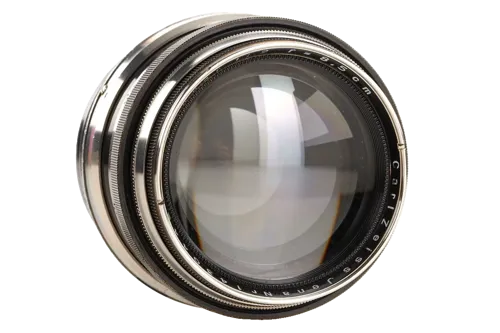
Carl Zeiss Jena Sonnar 85mm f/2
Contax RF mount
No listings tracked for this lens right now.
The Carl Zeiss Jena Sonnar 85mm f/2 is a Contax RF-mount lens for Leica rangefinder cameras. Leica price index →
Specification
About this lens
Carl Zeiss Jena Sonnar 85mm f/2
The Carl Zeiss Jena Sonnar 85mm f/2 was the original fast short telephoto for the Contax rangefinder system. Introduced in 1933, it combined a large f/2 aperture with a substantial rangefinder-coupled focusing barrel intended for portraiture, theatre, press work and photography in low light.
Unlike the internal-bayonet 50mm lenses, the 85mm Sonnar uses the external Contax bayonet. It contains its own focusing helicoid and distance scale. Movement of that helicoid operates the camera's rangefinder coupling.
The early black-and-nickel and chrome-over-brass versions are exceptionally heavy for an 85mm rangefinder lens. Documented early examples weigh around 600g. Later wartime alloy barrels can be considerably lighter, so no single weight or external dimension represents every Jena version.
Early lenses have no threaded filter rim and use slip-on accessories. Chrome versions introduced a front thread of approximately 49 to 49.5mm, with 51mm slip-on hoods and filters also documented in original Zeiss literature.
Diaphragm construction varies. Twelve-blade and fifteen-blade versions are reported, normally with continuous, clickless aperture control. Early examples stop at f/16, while later production commonly reaches f/22.
Public collector histories also document an optical recalculation during Jena production. Early lenses are described as six elements in three groups, with later examples using seven elements in three groups. Because the precise changeover is not presented consistently in public sources, both constructions are recorded within this profile.
Optical qualities
Rendering
The Sonnar 85mm f/2 was designed to provide a fast telephoto lens with relatively few air-to-glass surfaces. This helped transmission and contrast before anti-reflection coating became widely available.
At f/2, a good example can produce strong subject separation with moderate contrast and gentle transitions around the plane of focus. Residual spherical and chromatic aberrations may soften fine detail and create glow around high-contrast edges. Stopping down improves definition and contrast.
The long focal length and multi-blade diaphragm can produce rounded out-of-focus highlights, but bokeh is affected by focus distance, background structure and the exact optical version. It should not be described as uniformly smooth under every condition.
Uncoated examples are sensitive to direct backlight and benefit substantially from a deep hood. Coated late examples generally preserve more contrast, but optical condition remains decisive. Haze, separation and cleaning damage are common enough to alter rendering substantially.
History
Development and Launch
Production began in 1933. The lens quickly became one of the prestige optics of the Contax system, offering greater speed than most contemporary short telephotos.
Original Zeiss literature promoted it for distant close-ups, stage work, portraits and press photography. Its f/2 aperture was especially valuable when film speeds were low.
Production Evolution
The first versions used black paint and nickel over brass, lacked a threaded filter rim and stopped down to f/16. Smaller engraving and minor barrel revisions followed.
With the chrome Contax II and III, the lens adopted a heavy chrome finish and a threaded front rim. The minimum aperture was subsequently extended to f/22. Later pre-war production simplified parts of the exterior barrel.
Collector research records a later seven-element recalculation in place of the early six-element design. Wartime production also introduced aluminum and mixed-alloy bodies as brass and chrome became less available.
This profile covers the original Jena pre-war and wartime generation through 1945. Immediate postwar Jena production and West German Zeiss-Opton lenses should be assessed separately when their mechanical or optical specifications differ.
Special Editions/Variants
Documented production variants include early black-and-nickel bodies, heavy chrome-over-brass lenses, coated examples and lighter wartime alloy barrels.
Special fixed-focus military barrels are excluded because removing the normal focusing mechanism is a material mechanical change.
Meter and feet scales are market variants and do not by themselves justify separate lens profiles.
Collector Notes
Confirm whether an example has the early unthreaded nose or the later filter thread. Check the diaphragm count directly rather than assuming that every Jena lens has the same iris.
The large brass barrel places considerable load on the mount. Inspect the external bayonet, locking surfaces and focusing helicoid for wear or impact damage.
Optical checks should include haze, cemented-group separation, fungus, cleaning marks and coating damage. Accurate rangefinder calibration is particularly important at f/2 and near the minimum focusing distance.
Collectors should verify the engraved maker and model, native mount, focusing mechanism and rangefinder cam instead of relying on a seller title. A later conversion is not evidence of a factory variant, while cosmetic engraving changes do not automatically prove a new optical version. Serial numbers can support comparison when used with specialist records, but an isolated number does not establish a production date.
Check focusing travel, aperture action, glass condition and signs of incorrect reassembly. Rangefinder agreement should be tested at close, middle and distant settings. Caps and cases add context but do not change the identity of the lens.
Sources
- Zeiss Ikon, The Contax Camera System, 1938pacificrimcamera.com →
- Pacific Rim Camera, 85/2 Zeiss Sonnar for Contaxpacificrimcamera.com →
- Kamerastore, Carl Zeiss 8.5cm f/2 Sonnar Jenakamerastore.com →
- Leitz Photographica Auction, Carl Zeiss Jena f. Contax Sonnar 2/8.5cmleitz-auction.com →
- Fotohandel Delfshaven, Carl Zeiss Jena Sonnar 8.5cm f/2 pre-war variantfotohandeldelfshaven.nl →
Where to buy
Related lenses
Similar lenses you might be interested in
Comments