Best price Excellent
Carl Zeiss 35mm f1.4 Distagon T* ZM
Sold by Kamerastore
€1,219 ≈ $1,316
The Carl Zeiss Distagon T* 35mm f/1.4 ZM is a fast retrofocus M-mount wide-angle prized by Leica collectors as a Summilux alternative.
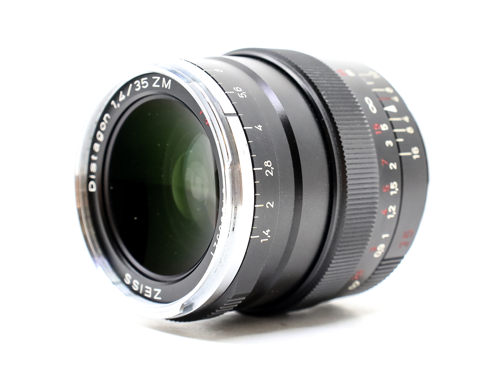
M mount
The Carl Zeiss Distagon T* 35mm f/1.4 ZM is a M-mount lens for Leica rangefinder cameras. As of October 2026, it sells from €1,219 used across 6 listings, with a 30-day median of €1,626. Leica price index →
Measured against the 76 other 35mm M-mount lenses in the catalogue.
Unusually for a rangefinder wide-angle, this lens abandons the symmetrical Biogon layout that defines most of the ZM line and instead uses a retrofocus Distagon construction, which is the reason for its large barrel and 49mm filter thread when most ZM lenses are physically shorter and accept smaller filters [1]. Introduced as the newest member of the ZM family at Photokina 2014, it pairs an f/1.4 maximum aperture with a complex optical design that incorporates two aspherical elements, three elements of anomalous partial dispersion glass, and floating elements [5]. Reviewers consistently note that it looks and feels closer to a 50mm Summilux than a typical thirty-five, with a distinctive concave front element and the cool, blue-tinged Zeiss styling [4].
The 10-element, 7-group formula is matched to a metal barrel with a 90-degree focus throw, and the focusing tab serves as a tactile reference point so a user can sense the set distance without leaving the viewfinder. The lens is rangefinder coupled and focuses to 0.7m, and its ten-bladed diaphragm contributes to the rounded out-of-focus highlights for which it is known. Build quality is regarded as on par with Leica's own optics, solidly machined from metal throughout. Zeiss stated that a design goal for the lens was to emulate the rendering of the Leica 35mm pre-ASPH Summilux rather than simply maximize measured performance.
Compared with the rest of the ZM range, the lens is identifiable by Zeiss's established aesthetic of blue engravings and a bright blue mount-location dot, where Leica and Voigtländer lenses place the traditional red dot. It carries a 2-tone finish and is not six-bit coded for Leica digital bodies. Collectors generally weigh it against the Leica 35mm Summilux-M ASPH FLE, with the Zeiss offering very similar optical quality at substantially lower cost but in a notably larger and heavier package [6].
Rendering The lens is described as rendering cleanly and immaculately, with strong color fidelity, high sharpness, and effective control of distortion and aberration, a character one reviewer summarized as cleaner than competing 35mm rangefinder lenses without that being clearly better or worse. Its overall look is modern rather than vintage.
Bokeh and transitions Out-of-focus rendering is regarded as smooth and modern, with noticeably less of the bright-edged or soap-bubble character seen in the Leica 35mm Summilux; despite using aspherical elements, it is judged smoother than the simpler Zeiss Loxia 35mm f/2. Some slight outlining and subtle structure can appear in highlight discs at high magnification.
Distortion Distortion is very low. On a full-frame digital body it shows only slight barrel distortion that is largely negligible and easily corrected with a profile.
Digital use On mirrorless bodies such as the Sony A7-series, performance wide open is affected by field curvature introduced by the thick sensor filter stack, so simultaneous peak sharpness in the center and corners at full aperture is difficult to obtain.
Development and Launch The Distagon T* 1.4/35 ZM was announced at Photokina 2014 as the latest addition to the Zeiss ZM lineup. It answered a long-standing wish among ZM wide-angle users for a faster aperture, the ZM wide-angles having previously topped out slower than f/1.4. Zeiss positioned the retrofocus Distagon design as a deliberate choice to achieve f/1.4 with controlled aberrations, and pitched its rendering as an homage to the older Leica 35mm pre-ASPH Summilux.
Collector Notes The lens is distinguished from other ZM optics by its size, its 49mm filter thread, its concave front element, and the blue Zeiss markings and location dot. Buyers comparing it to the Leica 35mm Summilux FLE should be aware that the two perform similarly but the Zeiss is larger, heavier, and far cheaper, which is central to its appeal. As with other ZM lenses it lacks Leica six-bit coding, so users of Leica digital bodies may set lens detection manually. No major factory special editions of this lens are widely documented.
Good time to buy. The lowest listing is 25% below the 30-day average.
Lowest price Click a mark to open that listing · arrow keys to step, Enter to open
Price against condition for 6 listings of Carl Zeiss Distagon T* 35mm f/1.4 ZM, €1,219 to €2,213, median €2,036. New: 4 at €1,883, €2,189, €2,213, €2,213. Excellent: 1 at €1,219. Unknown: 1 at €1,348. The full table follows.
| Condition | Lowest | Median |
|---|---|---|
| New | €1,883 | €2,201 |
| Excellent | €1,219 | €1,219 |
| Other | €1,348 | €1,348 |
Over the last 19 weeks the median price for the Carl Zeiss Distagon T* 35mm f/1.4 ZM has fallen, ranging from €1,387 to €2,213 (now €1,626).
Weekly price (EUR). Median (Good or better) and lowest (Good or better) across 19 weeks. The full figures follow in the table below.
| Week | Median | Lowest |
|---|---|---|
| Jun 1, 2026 | €1,389 | €1,389 |
| Jun 8, 2026 | €1,389 | €1,389 |
| Jun 15, 2026 | €1,389 | €1,389 |
| Jun 22, 2026 | €1,389 | €1,389 |
| Jun 29, 2026 | €1,389 | €1,389 |
| Jul 6, 2026 | €1,911 | €1,389 |
| Jul 13, 2026 | €1,906 | €1,389 |
| Jul 20, 2026 | €1,389 | €1,389 |
| Jul 27, 2026 | €1,200 | €1,010 |
| Aug 3, 2026 | €1,202 | €1,015 |
| Aug 10, 2026 | €1,658 | €1,017 |
| Aug 17, 2026 | €1,945 | €1,029 |
| Aug 24, 2026 | €2,074 | €1,389 |
| Aug 31, 2026 | €1,805 | €1,389 |
| Sep 7, 2026 | €2,068 | €1,389 |
| Sep 14, 2026 | €2,055 | €1,378 |
| Sep 21, 2026 | €2,041 | €1,372 |
| Sep 28, 2026 | €2,033 | €1,219 |
| Oct 5, 2026 | €2,189 | €1,219 |
Every shop grades differently. Leica Classic uses letters, Ffordes uses E++ and E+, German dealers write "Zustand B", Japanese dealers write A−. We map all of them onto the one ladder below. Where a shop states its own grade, we print it under ours.
As of October 2026, the Carl Zeiss Distagon T* 35mm f/1.4 ZM sells from €1,219 used, with a 30-day median of €1,626, across 6 active listings.
As of October 2026, the Carl Zeiss Distagon T* 35mm f/1.4 ZM is sold by 4 sources (6 listings), from €1,219 used: all compared cheapest-first on this page.
Similar lenses you might be interested in
Comments