Best price
Zeiss Biogon T* 35mm f/2 ZM - Leica M
Sold by Camera Tweedehands
€716 ≈ $773
The Carl Zeiss Biogon T* 35mm f/2 ZM is an M-mount rangefinder lens prized for its near-symmetrical optics, low distortion, and neutral rendering.
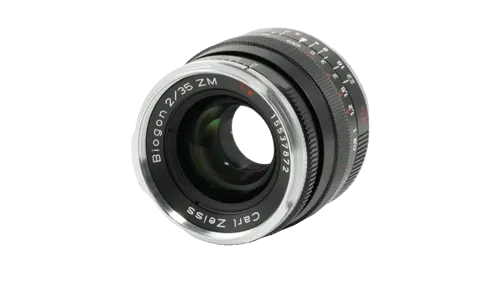
M mount
The Carl Zeiss Biogon T* 35mm f/2 ZM is a M-mount lens for Leica rangefinder cameras. As of October 2026, it sells from €716 used across 5 listings, with a 30-day median of €814. Leica price index →
Measured against the 76 other 35mm M-mount lenses in the catalogue.
The Biogon T* 35mm f/2 sits in the middle of Zeiss's M-mount (ZM) 35mm trio, between the compact f/2.8 C Biogon and the much larger f/1.4 Distagon, and it is the option most often described as the balanced "all-round" choice in the range [1]. The Biogon name reaches back to the 1930s and denotes a near-symmetrical wide-angle layout, a tradition this modern lens continues with a true rear-focusing optical design that is only practical on a mirrorless rangefinder body and could not be used on an SLR [6]. It is widely regarded by reviewers as a technically exacting 35mm with very neutral, faithful rendering rather than a "character" lens.
The optics use 9 elements, with all surfaces spherical, and the glass is multicoated with Zeiss's T* anti-reflection coating. Zeiss specifies a Biogon concept paired with an anomalous partial dispersion element so that distortion is essentially eliminated and chromatic aberration and color fringing are well controlled [3]. Like all M-mount lenses it is manual focus only and rangefinder coupled, and reviewers frequently praise the focus damping and the placement of the focusing and aperture rings as well suited to rangefinder handling [4]. The lens fits Leica M bodies as well as Voigtlander and the discontinued Zeiss Ikon ZM rangefinders, and it can be adapted to mirrorless cameras[2].
Current Zeiss ZM lenses, including this one, are manufactured by Cosina in Japan, though the optical formula is genuinely Zeiss rather than a rebadged design [5]. The lens has been offered in both black and silver finishes. Sources broadly agree that the optical design has remained unchanged since its introduction, so there are no major optical versions to track.
Rendering The Biogon is consistently characterized as neutral and technically precise, with high fidelity and very low distortion rather than an overtly stylized look. Some reviewers find this clinical or restrained in character.
Bokeh and transitions The fully spherical design is credited with producing pleasing out-of-focus rendering.
Distortion and vignetting Distortion is described as virtually eliminated by the Biogon layout. Vignetting wide open is noted by users as a visible trait of the lens.
Aberrations One detailed test attributes smeared point light sources when shooting wide open at night to sagittal oblique spherical aberration, an effect that diminishes substantially on stopping down; the same source rates overall landscape performance as competitive with the Leica 35mm f/2 Summicron-M ASPH.
Digital use On Leica digital M bodies the lens is not six-bit coded, so users select a corresponding Leica 35mm lens profile manually to apply vignetting and color-shading corrections. It is also commonly adapted to mirrorless cameras such as the Sony A7-series for general shooting.
Development and Launch The ZM line was introduced as a system around the Zeiss Ikon ZM rangefinder, where ZM denotes the Zeiss M mount, and the bodies and lenses were intended to work together while remaining compatible with other M-mount cameras. Reviewers place the 35mm f/2 Biogon's launch in the mid-2000s, around 2005.
Special editions No widely documented factory special editions of this lens are recorded; the principal catalog variation is the choice of black or silver finish.
Collector Notes Because the ZM lenses are built by Cosina, buyers should expect Japanese manufacture under the Zeiss name rather than German production, which is normal for the line and not a sign of a counterfeit. The lens uses an uncommon 43mm filter thread, which is worth verifying when sourcing filters and a hood. On digital Leica M bodies, confirm that the lens functions with manual lens-profile selection since it lacks six-bit coding. Buyers should also take care not to confuse this f/2 Biogon with the smaller f/2.8 C Biogon or the f/1.4 Distagon in the same 35mm ZM family.
Good time to buy. The lowest listing is 12% below the 30-day average.
Lowest price Click a mark to open that listing · arrow keys to step, Enter to open
Price against condition for 5 listings of Carl Zeiss Biogon T* 35mm f/2 ZM, €716 to €1,149, median €854. New: 2 at €1,149, €1,149. Mint: 2 at €814, €854. Unknown: 1 at €716. The full table follows.
| Condition | Lowest | Median |
|---|---|---|
| New | €1,149 | €1,149 |
| Mint | €814 | €834 |
| Other | €716 | €716 |
Over the last 18 weeks the median price for the Carl Zeiss Biogon T* 35mm f/2 ZM has fallen, ranging from €675 to €1,056 (now €814).
Weekly price (EUR). Median (Good or better) and lowest (Good or better) across 18 weeks. The full figures follow in the table below.
| Week | Median | Lowest |
|---|---|---|
| Jun 1, 2026 | €1,056 | €737 |
| Jun 8, 2026 | €1,056 | €737 |
| Jun 15, 2026 | €737 | €737 |
| Jun 22, 2026 | €737 | €737 |
| Jun 29, 2026 | €597 | €458 |
| Jul 6, 2026 | €740 | €417 |
| Jul 13, 2026 | €597 | €458 |
| Jul 20, 2026 | €737 | €458 |
| Jul 27, 2026 | €737 | €458 |
| Aug 3, 2026 | €598 | €458 |
| Aug 10, 2026 | €614 | €588 |
| Aug 17, 2026 | €614 | €588 |
| Aug 24, 2026 | €814 | €588 |
| Aug 31, 2026 | €1,149 | €814 |
| Sep 7, 2026 | €1,149 | €814 |
| Sep 14, 2026 | €981 | €604 |
| Sep 21, 2026 | €981 | €561 |
| Sep 28, 2026 | €1,002 | €814 |
Every shop grades differently. Leica Classic uses letters, Ffordes uses E++ and E+, German dealers write "Zustand B", Japanese dealers write A−. We map all of them onto the one ladder below. Where a shop states its own grade, we print it under ours.
As of October 2026, the Carl Zeiss Biogon T* 35mm f/2 ZM sells from €716 used, with a 30-day median of €814, across 5 active listings.
As of October 2026, the Carl Zeiss Biogon T* 35mm f/2 ZM is sold by 2 sources (5 listings), from €716 used: all compared cheapest-first on this page.
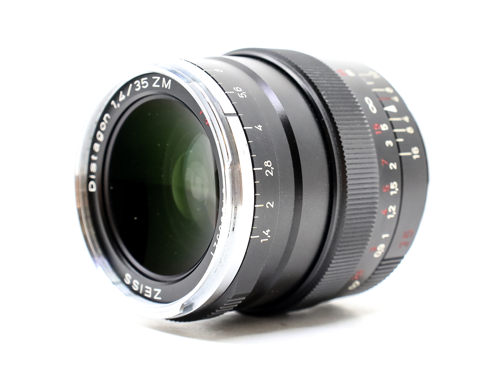
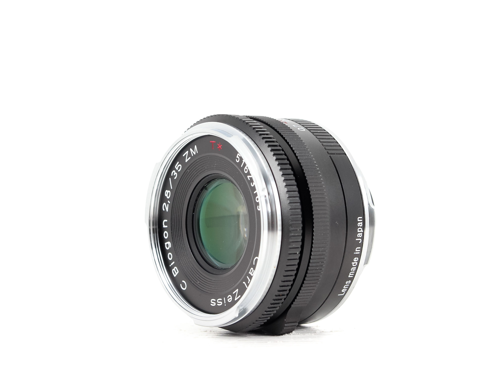
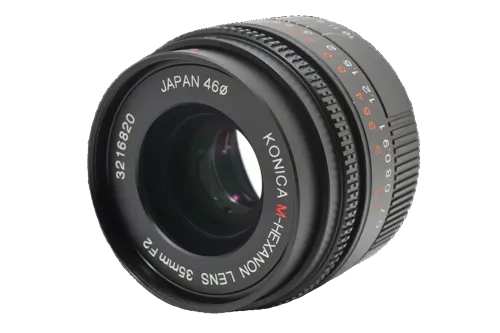
Similar lenses you might be interested in
Comments