Best price Excellent
Carl Zeiss 28mm f2.8 Biogon T* ZM
Sold by Kamerastore
€710 ≈ $766
The Carl Zeiss Biogon T* 28mm f/2.8 ZM is a compact M-mount wide-angle prized by rangefinder users for crisp, high-contrast results at a fraction of Leica prices.
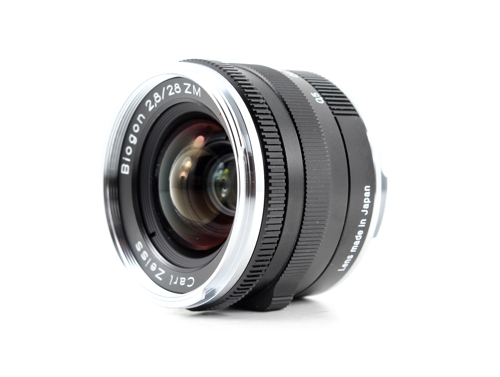
M mount
The Carl Zeiss Biogon T* 28mm f/2.8 ZM is a M-mount lens for Leica rangefinder cameras. As of October 2026, it sells from €710 used across 6 listings, with a 30-day median of €988. Leica price index →
Measured against the 37 other 28mm M-mount lenses in the catalogue.
Among M-mount wide angles, the Biogon T* 28mm f/2.8 ZM occupies a practical sweet spot: 28mm is the widest focal length whose frame lines appear in the viewfinders of most modern Leica rangefinders, which makes this lens usable without an accessory finder on a majority of bodies [1][2]. Carl Zeiss developed the lens as part of the ZM line introduced in 2004 alongside the Zeiss Ikon rangefinder, with the 28mm version reaching the market in 2005, and like the rest of the program it is manufactured by Cosina in Japan[3]. Its appeal to collectors and users rests largely on delivering optical results close to comparable Leica wide angles while typically selling well below them.
Optically the lens follows the classic Biogon principle, a roughly symmetrical wide-angle design that uses spherical elements arranged in eight elements across six groups, with Zeiss noting that the second element uses glass of anomalous partial dispersion to help control aberrations. There are no aspherical or floating elements. The barrel is all metal and glass in the usual ZM manner, with a ten-blade diaphragm for a near-circular aperture, third-stop click settings, and a focusing ring fitted with a small finger nub rather than a Leica-style tab. The lens couples to the rangefinder and focuses down to 0.5 m, although the camera rangefinder itself only follows the lens to about 0.7 m, so the closest range requires distance estimation or an electronic viewfinder. It takes common 46 mm filters and the front does not require special handling beyond the standard ZM accessory bayonet.
The lens is offered in black and silver finishes, and it is not factory six-bit coded for Leica digital bodies. On current digital M cameras color drift is reportedly minor, but on earlier digital rangefinders users sometimes apply the in-camera profile for the Leica 28mm f/2.8 ASPH (11606), accepting that it can over-correct vignetting. A bayonet lens hood is sold separately, carrying part number 000000-1365-666, and it also fits the Biogon 25mm f/2.8. Build quality is regarded as very good, though reviewers note the long-running ZM concern sometimes called the "Zeiss wobble," in which the focus ring can lose its tight connection to the internal mechanism on some, mostly older, copies, something worth checking before buying.
Rendering The Biogon 28mm is consistently described as a sharp, high-contrast lens with a clean, technically modern look rather than an overtly vintage character[4]. Reviewers note strong corner sharpness from wide open with a small improvement on stopping down, and abundant micro-contrast.
Contrast and color T* coating gives the lens high contrast and saturated, slightly warm color that some users find very pleasing, including in black and white work.
Flare resistance Flare control is regarded as excellent; one reviewer found it difficult to provoke meaningful flare even with the sun near the frame, and the optional hood helps when the sun sits just outside the image.
Distortion and vignetting Geometric distortion is very low, in keeping with the Biogon design's reputation for well-corrected lines. Vignetting is prominent at f/2.8 and eases as the lens is stopped down.
Bokeh and transitions Because a 28mm f/2.8 offers limited background separation, bokeh is a secondary concern, and reviewers describe the out-of-focus rendering as somewhat harsh or turbulent rather than creamy.
Aberrations Chromatic aberration is well controlled and rarely obvious even in backlit, high-contrast situations.
Digital use On full-frame Leica digital M cameras the lens performs well into the corners, but as a symmetrical wide-angle with a deeply set rear group it can show pronounced edge softening, color shift, and vignetting on non-Leica mirrorless bodies with thicker sensor stacks unless stopped down.
Development and Launch The ZM lens family, including this Biogon, was launched in 2004 together with the Zeiss Ikon film rangefinder, a camera that has since become a sought-after collectible while most of the lenses remained in production. The 28mm reached buyers in 2005. Within the lineup it sits between the wider Biogon 21mm and 25mm and the standard focal lengths, providing the widest angle that most Leica viewfinders frame natively.
Production Evolution Across its life the lens has remained a spherical Biogon design built by Cosina, offered in black and silver, and reviewers treat the ZM wide angles as fairly conventional formulas whose increased element counts are offset by Zeiss T* coating. By the early 2020s, commentators observed that Zeiss had largely wound down new M-mount development, leaving the existing ZM range, including the 28mm, as the surviving offering.
Special editions No widely documented factory special editions, military versions, or rare finish variants of the Biogon 28mm f/2.8 ZM beyond the standard black and silver colors are commonly reported.
Collector Notes Buyers are advised to check used copies carefully for the ZM focus-ring "wobble," which appears mainly on older examples and can progress to focusing problems. Because the lens lacks six-bit coding, those using it on older digital M bodies should be prepared to manage color drift and vignetting through profiles or software. The bayonet hood (000000-1365-666) and 46 mm caps and filters are worth confirming, as the hood is sold separately and is shared with the 25mm Biogon.
Good time to buy. The lowest listing is 28% below the 30-day average.
Lowest price Click a mark to open that listing · arrow keys to step, Enter to open
Price against condition for 6 listings of Carl Zeiss Biogon T* 28mm f/2.8 ZM, €710 to €1,260, median €1,146. New: 4 at €1,147, €1,147, €1,260, €1,260. Excellent: 1 at €710. Used: 1 at €830. The full table follows.
| Condition | Lowest | Median |
|---|---|---|
| New | €1,147 | €1,203 |
| Excellent | €710 | €710 |
| Other | €830 | €830 |
Over the last 18 weeks the median price for the Carl Zeiss Biogon T* 28mm f/2.8 ZM has risen, ranging from €670 to €1,173 (now €988).
Weekly price (EUR). Median (Good or better) and lowest (Good or better) across 18 weeks. The full figures follow in the table below.
| Week | Median | Lowest |
|---|---|---|
| Jun 1, 2026 | €720 | €427 |
| Jun 8, 2026 | €720 | €427 |
| Jun 15, 2026 | €670 | €427 |
| Jun 22, 2026 | €670 | €427 |
| Jun 29, 2026 | €715 | €625 |
| Jul 6, 2026 | €715 | €617 |
| Jul 13, 2026 | €942 | €625 |
| Jul 20, 2026 | €942 | €625 |
| Jul 27, 2026 | €942 | €625 |
| Aug 3, 2026 | €904 | €625 |
| Aug 10, 2026 | €940 | €625 |
| Aug 17, 2026 | €940 | €625 |
| Aug 24, 2026 | €1,159 | €625 |
| Aug 31, 2026 | €1,260 | €726 |
| Sep 7, 2026 | €1,173 | €725 |
| Sep 14, 2026 | €1,159 | €551 |
| Sep 21, 2026 | €1,151 | €713 |
| Sep 28, 2026 | €1,147 | €710 |
Every shop grades differently. Leica Classic uses letters, Ffordes uses E++ and E+, German dealers write "Zustand B", Japanese dealers write A−. We map all of them onto the one ladder below. Where a shop states its own grade, we print it under ours.
As of October 2026, the Carl Zeiss Biogon T* 28mm f/2.8 ZM sells from €710 used, with a 30-day median of €988, across 6 active listings.
As of October 2026, the Carl Zeiss Biogon T* 28mm f/2.8 ZM is sold by 3 sources (6 listings), from €710 used: all compared cheapest-first on this page.
Similar lenses you might be interested in
Comments