Best price Used
Zeiss 25mm f2.8 Biogon ZMT* Silver A6090202
Sold by Aperture UK
€672 ≈ $726
The Carl Zeiss Biogon T* 25mm f/2.8 ZM is a moderate wide-angle Leica M-mount lens prized for near record resolution and distortion-free symmetrical drawing.
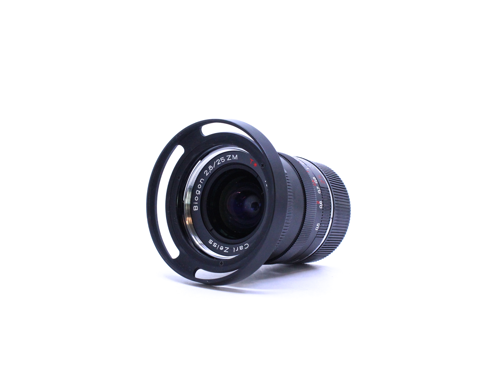
M mount
The Carl Zeiss Biogon T* 25mm f/2.8 ZM is a M-mount lens for Leica rangefinder cameras. As of October 2026, it sells from €672 used across 4 listings, with a 30-day median of €741. Leica price index →
The Biogon T* 25mm f/2.8 ZM occupies a slightly unusual spot in the rangefinder catalogue, since the 25mm focal length sits between the more common 24mm and 28mm options. Its reputation rests largely on resolution: Zeiss has reported that, in a controlled test using high-resolution film, the lens reached roughly 400 line pairs per millimetre at f/4 in the centre, a figure described as the diffraction-limited maximum theoretically possible at that aperture [1]. That result, publicised in the Zeiss Camera Lens News in early 2006, helped cement the lens as one of the sharper wide angles in the ZM line and one that Zeiss itself singled out as a showcase design.
The optical formula is a nine-element, seven-group arrangement following the broadly symmetrical Biogon tradition, with all elements spherical and treated with the company's T* anti-reflection coating [2]. The Biogon name on a Zeiss lens denotes a family of wide and ultra-wide designs rather than a single fixed formula, and this 25mm holds to the family's semi-symmetrical layout. Build quality is in line with the rest of the ZM range, with a metal barrel, a smooth and well-damped focus ring, and a ten-blade diaphragm whose detents click in third stops from f/2.8 to f/22, a step pattern that differs from Leica's half-stop convention [3]. The lens is rangefinder coupled and focuses to 0.5 m, closer than the usual 0.7 m minimum of most M lenses; on a Leica body the rangefinder patch stops moving past about 0.7 m, while on the Zeiss Ikon body it stays coupled to the full 0.5 m. The lens is designed by Zeiss and manufactured by Cosina in Japan.
The ZM lens carries no factory six-bit coding, so on digital Leica M bodies users commonly add a manual code; the value of the Leica Elmarit-M 24mm f/2.8 ASPH is often applied, though some copies bring up the 28/90 frame lines rather than 24/35 and call for a different code. The lens was offered in black and in a silver finish, and two vented hoods fit it: a round 25/28mm hood and a rectangular 21/25mm hood, the latter unusual within the ZM range.
Rendering The Biogon is consistently described as a high-contrast, high-resolution wide angle with deep, saturated colour and very little distortion. Across multiple reviews the lens shows strong definition across most of the frame even wide open, with contrast remaining high from f/2.8[4].
Sharpness Wide open the centre and most of the frame are already crisp, with the corners and edges lagging slightly. Stopping down to f/4 tightens the outer field, and f/5.6 is repeatedly cited as the optimum, where the field flattens and resolution peaks; diffraction begins to soften results around f/8 to f/11 depending on the body.
Distortion and vignetting Distortion is very well controlled for a 25mm lens, low enough to be a non-issue in everyday use even though it measures slightly higher than some other ZM lenses. Mild vignetting appears wide open, improves by f/4, and is essentially gone by f/5.6 to f/8.
Flare resistance Flare resistance is regarded as strong, consistent with the T* coating, though the relatively complex nine-element design may make it marginally easier to provoke than simpler ZM lenses. With the diaphragm closed down, the ten blades produce well-defined sunstars.
Bokeh and transitions Out-of-focus rendering is described as pleasing and slightly smoother than some other Zeiss lenses, within the limits of a moderate wide angle at f/2.8.
Digital use On the cropped-sensor Leica M8 the lens behaves as roughly a 33mm equivalent, and corner softness and vignetting are largely cropped away. On digital M bodies a manual lens code is recommended to correct colour casts and vignetting, particularly when a UV/IR filter is used.
Development and Launch The lens was introduced as part of the Zeiss ZM line for the M-mount Zeiss Ikon rangefinder system launched in 2004, and an early demonstration image shot with the 25mm Biogon for the first Zeiss Ikon brochure reportedly drew attention for its detail. The line was developed by Zeiss with production carried out by Cosina in Japan.
Collector Notes Because the lens lacks factory six-bit coding, buyers using digital M cameras should confirm whether a copy brings up the 24/35 or the 28/90 frame lines, as this determines which manual code works best. The third-stop aperture clicks differ from Leica's half-stop spacing, which is worth noting for those mixing systems. The two compatible hoods, round 25/28mm and rectangular 21/25mm, and the 46mm filter thread are accessories worth verifying before purchase, and prospective buyers should check focus smoothness and coating condition as with any used ZM lens. As a note on published figures, some review specifications list an overall length of about 71mm measured with caps attached, slightly longer than the bare-barrel figure.
Good time to buy. The lowest listing is 9% below the 30-day average.
Lowest price Click a mark to open that listing · arrow keys to step, Enter to open
Price against condition for 4 listings of Carl Zeiss Biogon T* 25mm f/2.8 ZM, €672 to €1,269, median €1,001. New: 2 at €1,260, €1,269. Excellent: 1 at €741. Used: 1 at €672. The full table follows.
| Condition | Lowest | Median |
|---|---|---|
| New | €1,260 | €1,264 |
| Excellent | €741 | €741 |
| Other | €672 | €672 |
Over the last 15 weeks the median price for the Carl Zeiss Biogon T* 25mm f/2.8 ZM has fallen, ranging from €741 to €1,260 (now €741).
Weekly price (EUR). Median (Good or better) and lowest (Good or better) across 15 weeks. The full figures follow in the table below.
| Week | Median | Lowest |
|---|---|---|
| Jun 1, 2026 | €1,168 | €1,168 |
| Jun 8, 2026 | €1,168 | €1,168 |
| Jul 6, 2026 | €986 | €682 |
| Jul 13, 2026 | €983 | €680 |
| Jul 20, 2026 | €979 | €677 |
| Jul 27, 2026 | €984 | €681 |
| Aug 3, 2026 | €988 | €684 |
| Aug 10, 2026 | €995 | €688 |
| Aug 17, 2026 | €772 | €694 |
| Aug 24, 2026 | €1,014 | €690 |
| Aug 31, 2026 | €1,014 | €767 |
| Sep 7, 2026 | €1,260 | €765 |
| Sep 14, 2026 | €1,260 | €757 |
| Sep 21, 2026 | €1,260 | €753 |
| Sep 28, 2026 | €1,260 | €741 |
Every shop grades differently. Leica Classic uses letters, Ffordes uses E++ and E+, German dealers write "Zustand B", Japanese dealers write A−. We map all of them onto the one ladder below. Where a shop states its own grade, we print it under ours.
As of October 2026, the Carl Zeiss Biogon T* 25mm f/2.8 ZM sells from €672 used, with a 30-day median of €741, across 4 active listings.
As of October 2026, the Carl Zeiss Biogon T* 25mm f/2.8 ZM is sold by 3 sources (4 listings), from €672 used: all compared cheapest-first on this page.
Similar lenses you might be interested in
Comments