The postwar West German 35mm f/2.8 Biogon for Contax RF, a compact coupled wide-angle with a seven-element symmetrical optical construction.
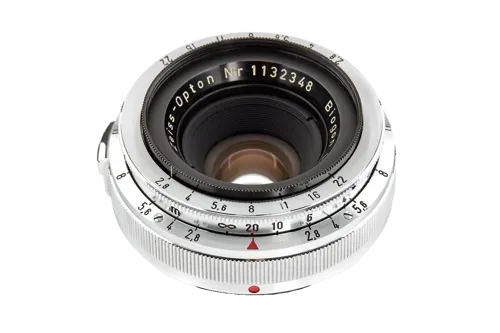
Carl Zeiss Biogon 35mm f/2.8 (Post-war)
Contax RF mount
No listings tracked for this lens right now.
The Carl Zeiss Biogon 35mm f/2.8 (Post-war) is a Contax RF-mount lens for Leica rangefinder cameras. Leica price index →
How it compares
Measured against the 8 other 35mm Contax RF-mount lenses in the catalogue.
Specification
About this lens
Carl Zeiss Biogon 35mm f/2.8 (Post-war)
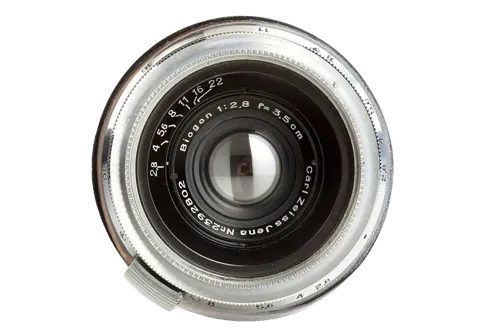
The post-war Carl Zeiss Biogon 35mm f/2.8 is a seven-element, four-group wide-angle lens developed for the Contax IIa and IIIa generation. It must not be combined with the earlier Carl Zeiss Jena Biogon, which uses a distinct six-element, four-group optical construction.
The post-war recalculation shortened the rear optical assembly to provide the clearance required by the revised shutter mechanism of the Contax IIa and IIIa. The lens uses the Contax external bayonet, incorporates its own focusing helicoid and couples to the camera rangefinder down to approximately 0.9 metres.
Optical qualities
Rendering
The post-war Biogon combines a moderately wide 35mm field of view with the low-distortion perspective characteristic of the Biogon family. Its rendering is well suited to architecture, travel, street photography and environmental portraiture.
Sharpness
The central image is well defined from f/2.8, with broader field consistency developing as the lens is stopped down. The recalculated seven-element construction maintains good detail while accommodating the mechanical requirements of the post-war Contax bodies.
Distortion and illumination
Geometric distortion is very restrained. Some illumination falloff can remain visible at the widest apertures, particularly in evenly lit scenes, but it decreases as the aperture is closed.
Contrast
Factory coating improves contrast and flare resistance compared with the original uncoated pre-war design. Contrast nevertheless remains more moderate than that of a modern multi-coated lens, especially when strong light enters the front element.
At maximum aperture
Maximum-aperture performance should be evaluated with a correctly calibrated camera. A coupled rangefinder measures distance through a mechanical cam and does not inspect the image plane directly. Small errors in the body, mount or lens can therefore shift the sharp plane. Subject movement and field curvature may also be mistaken for optical softness. A clean, properly assembled lens should be tested at several distances before conclusions are drawn.
The widest setting provides the greatest light transmission and the least depth of field available from the design. Contrast can be reduced by residual aberrations, internal reflections or aged coatings. Bright point sources may show glow or flare. These effects vary between examples and should not be presented as a fixed signature of every surviving lens.
Stopped down
Closing the diaphragm increases depth of field and generally improves consistency across the 35mm frame. Middle apertures are often the practical choice for documentary work, landscapes and architecture. The smallest aperture provides more depth but is not automatically the sharpest setting because diffraction gradually reduces fine contrast.
Aperture shape depends on blade count and mechanical condition. Oil, bent blades or an incorrectly assembled iris can change both operation and out-of-focus highlights. Published blade counts should remain tied to the exact barrel version rather than copied between mounts.
Handling and compatibility
Contax and Kiev rangefinder lenses use either the internal standard-lens bayonet or the external bayonet. These interfaces serve different mechanical purposes even though they belong to the same camera system. Similarity to Nikon S or another rangefinder mount does not guarantee correct registration, coupling or infinity focus. A suitable adapter must reproduce the required focusing mechanism and keep the rear assembly clear of internal camera parts.
Historical lenses should not be judged from one sample alone. Haze, fungus, separation, cleaning damage, displaced elements and dried lubricant can alter contrast and focus more than modest design differences. Film choice, processing, digital sensor cover glass and adapter tolerances also influence results. A hood may reduce oblique flare but cannot correct internal contamination.
History
Development and Launch
The lens appeared in 1950 as part of the renewed West German Contax system. Early production commonly carries Zeiss-Opton markings, reflecting the Oberkochen factory identity used during the immediate post-war period.
Production Evolution
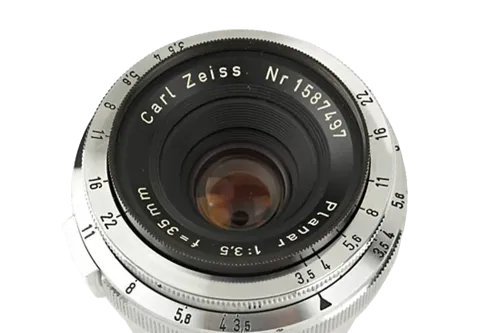
Later examples use Carl Zeiss branding while retaining the same basic seven-element optical design. The factory catalogue confirms the lens as a coupled 35mm option for the post-war Contax system, but a sufficiently reliable final production year has not been established.
Special Editions/Variants
Zeiss-Opton and Carl Zeiss inscriptions, coating symbols and minor cosmetic changes represent production evolution within this post-war profile. They should not be confused with the optically different pre-war 6/4 Biogon.
Collector Notes
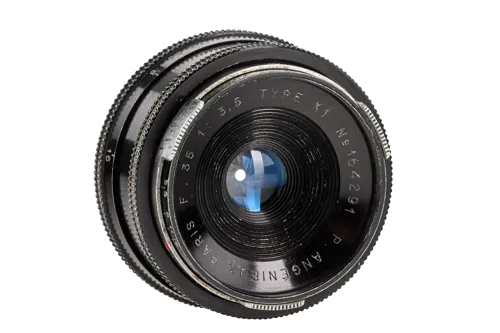
The first identification point is the post-war barrel and shortened rear assembly. Glass condition, coating marks and smooth helicoid movement are important, while rangefinder accuracy should be checked on the intended body. A matching 35mm finder may still be useful even on bodies offering approximate wide-angle framing.
Sources
Where to buy
Related lenses
Similar lenses you might be interested in

Comments