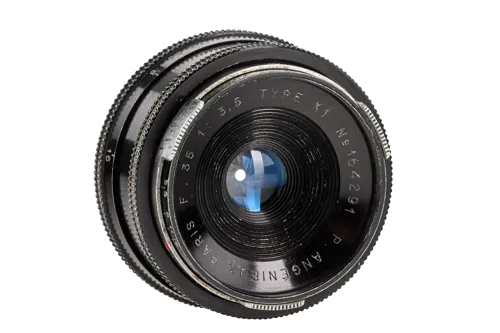
A rare coupled rangefinder version of Angénieux's pioneering 35mm f/2.5 Retrofocus R1, factory documented in Leica M39 and Contax RF mounts.

Angénieux Retrofocus Type R1 35mm f/2.5
LTM / Contax RF mount
No listings tracked for this lens right now.
The Angénieux Retrofocus Type R1 35mm f/2.5 is a LTM / Contax RF-mount lens for Leica rangefinder cameras. Leica price index →
How it compares
Measured against the 50 other 35mm lenses in the catalogue.
Specification
About this lens
Angénieux Retrofocus Type R1 35mm f/2.5
The Angénieux Retrofocus Type R1 35mm f/2.5 is the first lens associated with Pierre Angénieux's Retrofocus name. Angénieux dates the R1 to 1950 and describes its 35mm focal length and f/2.5 aperture as a landmark for the emerging retrofocus wide-angle concept. The arrangement created additional clearance behind a wide-angle optical system, an approach that became especially important for single-lens reflex cameras.
This LeicaLensList profile covers the uncommon factory rangefinder versions, not ordinary Exakta or other SLR examples later converted to a rangefinder mount. Leitz Auction documents original rangefinder-coupled Leica M39 examples and also lists a Contax Type R1. It separately records an Exakta lens professionally converted to M39, demonstrating why native manufacture and later conversion must not be treated as equivalent. The database records the six-element, five-group construction and 52mm filter size associated with this profile.
Optical qualities
Rendering
The R1 combines a moderate 35mm field of view with the relatively high f/2.5 speed of its period. Its historical importance lies primarily in the reversed-telephoto principle, rather than in a claim that every rangefinder copy behaves identically. Period coatings, complex internal reflections and sample condition can produce lower contrast in difficult light, while careful shading and a clean optical path help preserve separation of tones. The 35mm view suits streets, interiors, travel and environmental portraiture.
A historical lens should not be judged from one sample alone. Haze, separation, cleaning damage, displaced elements and inaccurate rangefinder adjustment can alter contrast and focus. This profile therefore addresses the design rather than promising identical results from every surviving copy.
Film choice, processing, digital sensor cover glass and adapter accuracy also affect the final image. A hood can reduce oblique flare, but cannot correct internal contamination or damaged coatings.
At maximum aperture
At f/2.5 the R1 offers useful low-light capability and selective focus, although depth of field is still broader than with a fast 50mm lens at the same distance. Fine detail away from the centre and strong point sources should be assessed conservatively. The combination of residual aberrations, focus accuracy and flare can give open-aperture images a gentler appearance than stopped-down work.
Maximum-aperture use demands accurate focusing. A coupled rangefinder measures distance rather than inspecting the image plane, so calibration errors and subject movement can be mistaken for softness.
Stopped down
Closing the diaphragm increases depth of field and generally makes the image more consistent across the frame. For architecture or distant detail, stopping down also reduces the practical importance of small rangefinder errors. Distortion should not be described as absent without measured data, despite the Retrofocus design's historical reputation and influence.
The smallest aperture is not automatically the sharpest. Extra depth of field can help, while diffraction gradually reduces fine contrast. Mid apertures are usually the practical choice for even detail.
Handling and compatibility
Original M39 examples use a coupled focusing mechanism suitable for Leica-standard screw-mount rangefinders, while factory Contax RF examples use their own bayonet construction. A 35mm external finder may be required on bodies without matching frame lines. The large 52mm filter size and substantial front section distinguish the lens from many compact symmetrical rangefinder wide angles.
Similar-looking rangefinder mounts are not universally interchangeable. A suitable adapter must preserve the correct register and keep the rear assembly clear of internal parts.
History
Development and Launch
Pierre Angénieux pursued a wide-angle construction that placed a negative component ahead of a positive rear system. The principle increased rear clearance and was protected in the United States by Patent 2,649,022. Angénieux identifies the 1950 R1 as the first Retrofocus lens and states that more than fifty million Retrofocus lenses were subsequently manufactured under licence, evidence of the concept's broad industrial significance.
Production Evolution
The R1 became part of a wider Angénieux Retrofocus family. Rangefinder versions were less common than SLR production, and auction evidence shows both original coupled lenses and later conversions. Mount provenance and coupling therefore matter when identifying an M39 example.
Special Editions/Variants
Documented rangefinder variants include original Leica M39 and Contax RF forms. Scale engraving and finish can vary without establishing a new optical version. Converted Exakta examples should be labelled as conversions.
Collector Notes
Collectors should verify the engraving, native mount, rangefinder cam and mechanical construction instead of relying on a seller's title. A later conversion is not evidence of a factory variant, and an isolated serial number does not establish a production year.
Check the aperture, focusing travel, haze, fungus, separation and signs of incorrect reassembly. Test rangefinder agreement at several distances. Accessories add context but do not change the lens's identity.
The most important check is whether the mount and coupling are original. Leitz Auction's separate descriptions provide a useful comparison between factory M39 lenses and an explicitly converted Exakta example. A prospective buyer should also confirm rear clearance, as a retrofocus lens may have a different rear profile from a conventional rangefinder wide angle.
Sources
Where to buy
Related lenses
Similar lenses you might be interested in
Comments