A compact French 35mm f/3.5 four-element Tessar-type wide-angle, documented in original coupled Leica M39 and Contax RF factory versions.
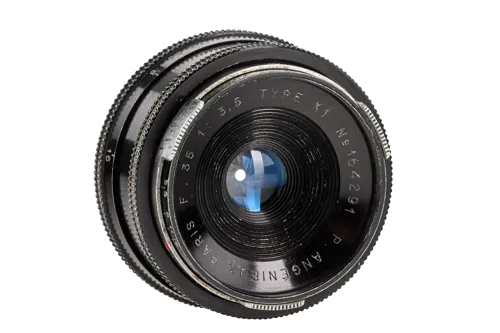
Angénieux Type X1 35mm f/3.5
LTM / Contax RF mount
No listings tracked for this lens right now.
The Angénieux Type X1 35mm f/3.5 is a LTM / Contax RF-mount lens for Leica rangefinder cameras. Leica price index →
How it compares
Measured against the 50 other 35mm lenses in the catalogue.
Specification
About this lens
P. Angénieux Type X1 35mm f/3.5
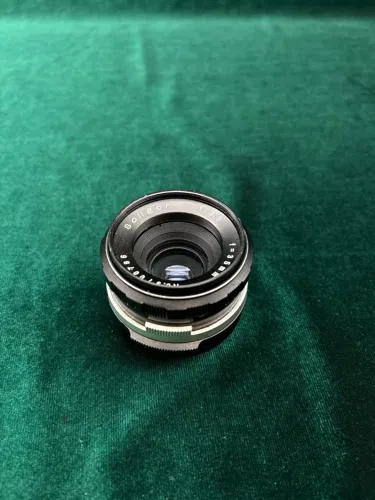
The P. Angénieux Type X1 35mm f/3.5 is a compact French wide-angle lens produced during the immediate post-war period. It uses four elements in three groups in a Tessar-type arrangement and predates the retrofocus designs for which Angénieux later became especially well known.
Original rangefinder versions were manufactured in both Leica Thread Mount and Contax RF mount. These versions share the same Type X1 optical identity and are covered by a single profile.
The M39 version is rangefinder coupled and has its own focusing helicoid. A documented LTM example weighs approximately 59g, focuses to around one metre and accepts 34mm filters. Original Contax examples use a complete factory external-bayonet focusing barrel. Their dimensions and weight should be documented separately rather than copied from the much lighter LTM barrel.
Optical qualities
Rendering
The Type X1 produces good central definition for a compact 1940s wide-angle lens. At f/3.5, the outer field can be softer and less uniform than the centre. Stopping down improves contrast and overall sharpness.
Contrast and coating
Both uncoated and coated examples are documented. Uncoated lenses produce lower contrast and are especially sensitive to strong light. Later lenses with pale blue coatings generally provide improved contrast, although coating condition and internal haze remain important.
Field performance
Surviving examples can show uneven sharpness or decentring. This may reflect age, previous servicing or element alignment rather than an inherent difference between LTM and Contax versions.
Flare resistance
The simple four-element construction limits the number of glass-to-air surfaces, but early coatings provide only modest protection against flare. A hood is useful when photographing toward a strong light source.
No reliable evidence has been found for a different optical formula in the factory Contax RF version.
History
Development and Launch
Angénieux introduced the Type X1 shortly after the Second World War as a small 35mm wide-angle for cameras without a reflex mirror. The four-element construction allowed a very compact lens because a rangefinder camera did not require the additional rear clearance needed by an SLR.
Original Leica screw-mount examples are documented from the late 1940s. Leitz Auction records an original coupled M39 lens from approximately 1949 and an original Contax-mounted example from approximately 1950.
Production Evolution
The Type X1 was produced in several camera mounts, including Leica Thread Mount, Contax and Alpa. These versions can differ substantially in barrel dimensions and weight, but the documented rangefinder lenses retain the same underlying Type X1 optical identity.
Early lenses are found without coating, while later examples have pale blue coated optics. Small differences also exist in aperture controls, engravings and focusing scales. One documented M39 example has a distinctive three-tab aperture ring.
Special Editions/Variants
No separately catalogued factory special edition is confirmed. The uncoated and coated lenses, different aperture-ring details and original LTM, Contax and Alpa mounts represent production variants rather than special editions.
Collector Notes
Collectors should confirm that the focusing barrel is an original Angénieux component. X1 optical heads from other systems have occasionally been converted to Leica M or M39 mounts.
The LTM version should be checked for accurate rangefinder coupling at infinity and close distance. Contax examples should be inspected for originality of the external bayonet, focusing mount and rangefinder mechanism.
Optical inspection should concentrate on haze, coating marks, internal separation and uneven sharpness. Because the lens is rare, an original cap or other accessory can add collector interest, but does not define a separate lens version.
Collectors should verify the engraved maker and model, native mount, focusing mechanism and rangefinder cam instead of relying on a seller title. A later conversion is not evidence of a factory variant, while cosmetic engraving changes do not automatically prove a new optical version. Serial numbers can support comparison when used with specialist records, but an isolated number does not establish a production date.
Check focusing travel, aperture action, glass condition and signs of incorrect reassembly. Rangefinder agreement should be tested at close, middle and distant settings. Caps and cases add context but do not change the identity of the lens.
Historical lenses should not be judged from one sample alone. Haze, fungus, separation, cleaning damage, displaced elements and dried lubricant can alter contrast and focus more than modest design differences. Film choice, processing, digital sensor cover glass and adapter tolerances also influence results. A hood may reduce oblique flare but cannot correct internal contamination.
Sources
Where to buy
Related lenses
Similar lenses you might be interested in

Comments