A circa-1945 Steinheil 50mm f/2.8 standard lens in an original collapsible, rangefinder-coupled Leica thread mount, distinct from rigid Triplar forms.
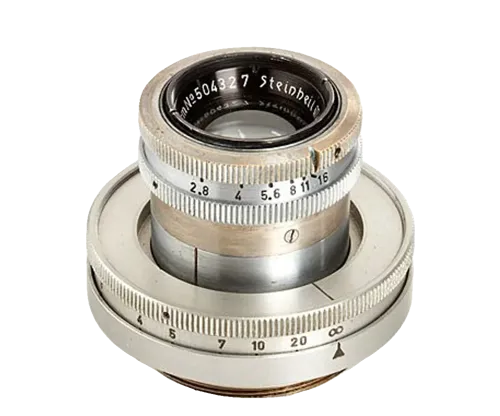
Steinheil Triplar 50mm f/2.8 (Collapsible)
LTM mount
No listings tracked for this lens right now.
The Steinheil Triplar 50mm f/2.8 (Collapsible) is a LTM-mount lens for Leica rangefinder cameras. Leica price index →
How it compares
Measured against the 108 other 50mm LTM-mount lenses in the catalogue.
Specification
About this lens
Steinheil Triplar 50mm f/2.8 (Collapsible)
The Steinheil Triplar 50mm f/2.8 is a mid-1940s standard lens documented in an original collapsible Leica M39 mount. This profile is specifically for the rangefinder-coupled retractable version dated to about 1945, not for later rigid Triplar cells, Paxette lenses or modern remounts that may share a 39mm thread.
Its metal optical tube pulls forward and locks for photography, then retracts into the camera body for storage. Focusing is performed by the lens helicoid and is mechanically coupled to a Leica-type rangefinder. Aperture setting is manual. Accessible exact-version records do not establish a reliable element and group count, diaphragm-blade count, minimum focus distance, filter fitting or universal coating specification. The Triplar name alone is not sufficient evidence for assigning a three-element formula to this particular lens.
The 50mm focal length provides the standard field of view for which classic Leica-thread cameras were designed. The lens mounts directly on compatible LTM bodies and can be fitted to Leica M cameras with a suitable 50mm adapter. Because the tube projects behind the mount when collapsed, it must not be retracted on an adapted camera until safe internal clearance has been confirmed.
The rangefinder-coupled mount is a material part of the lens's identity. Some later Steinheil lenses use a nominal 39mm thread with a different flange distance, while other Triplar cells have been installed in custom helicoids. Thread diameter alone does not prove Leica compatibility or factory origin.
Optical qualities
Rendering
Dependable sample sets or controlled tests for the exact collapsible 50mm f/2.8 M39 version have not been located. The surviving auction documentation establishes the period, original mount, coupling and retractable construction, but it does not support specific claims about sharpness, contrast, bokeh, flare or distortion.
Descriptions of later Cassar, Cassarit or rigid Triplar lenses should not be transferred to this profile. Even if another Steinheil standard lens uses a triplet formula, a shared maker and maximum aperture do not prove identical glass, spacing, coating or diaphragm construction. For the same reason, the expected behaviour of a generic Cooke triplet is not presented as measured performance for this lens.
Digital use
Mirrorless live view allows direct focusing and can reveal whether a soft result comes from the optics or from rangefinder calibration. The principal practical caution is the collapsing tube. It should remain extended unless the camera maker, adapter maker or a physical clearance check confirms that retraction is safe.
Age-related haze, cleaning damage, separated cement and a stiff extension lock can affect individual examples. Any evaluation should record the condition of the actual lens rather than treating one sample as representative of the production.
History
Development and Launch
The exact collapsible Triplar is documented at about 1945, when German optical production and distribution were heavily disrupted. Its original coupled M39 construction nevertheless shows that Steinheil produced a compact standard lens specifically usable on Leica-type rangefinder cameras during this period.
A separate auction record documents a coupled collapsible Triplar fitted to a Leica IIIa variant dated 1949. That later camera association confirms continued practical use of the lens in the Leica screw-mount system, but it does not by itself establish a new lens production date or a factory camera-and-lens package.
Production Evolution
Accessible sources do not provide a factory catalogue sequence, production total or dated set of barrel revisions for the collapsible 50mm f/2.8. The available evidence is therefore sufficient to identify the lens but not to construct a detailed chronology. No claim is made that all Triplar-marked 50mm lenses share this mount or mechanical design.
Later Steinheil standard lenses appeared in rigid barrels and in camera systems with different registers. Those developments should not be used to fill missing specifications for the earlier retractable LTM lens. Until a period instruction sheet or factory optical diagram is located, the unresolved technical fields should remain unknown.
Special Editions/Variants
No commemorative or formally named special edition has been documented. Normal engraving, scale or finish differences may exist, but the reviewed sources do not support splitting them into separate versions. The collapsible, coupled M39 construction is itself the defining variant and is retained in the profile title.
Collector Notes
Collectors should look for an original Leica-standard rear mount, a complete rangefinder cam, a functional extension-and-lock mechanism and period-consistent engravings. A custom adaptation can be a usable object, but it should not be catalogued as this factory-coupled profile without evidence of original construction.
The lens should always be extended and locked before exposure. Rangefinder agreement should be checked at several distances, and the rear tube should be inspected before use on modern bodies. Individual lens numbers are not needed to define the profile and should not appear in its generic description.
Sources
Where to buy
Related lenses
Similar lenses you might be interested in
![Chiyoda Kogaku Super Rokkor 50mm f/2.8 [C]](https://assets.leicalenslist.com/images/2065_medium.webp)
Comments