The Panomicron Bismuth 50mm f/2.8 is a rangefinder-coupled Leica M-mount anamorphic lens developed by independent Swiss designer Oscar Oweson. Its 7-element, 7-group optical system combines an Elcan-derived 50mm taking-lens concept with integrated cylindrical elements to produce an approximately 1.5x anamorphic image.
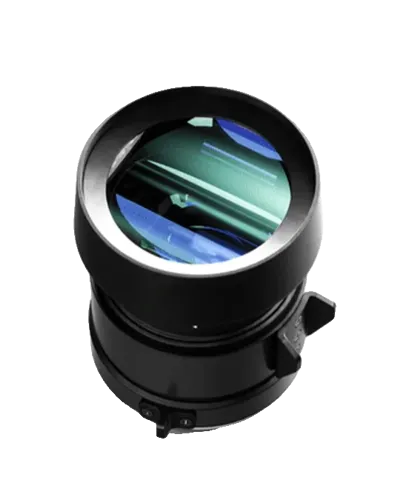
Panomicron Bismuth 50mm f/2.8 1.5x Anamorphic
M mount
No listings tracked for this lens right now.
The Panomicron Bismuth 50mm f/2.8 1.5x Anamorphic is a M-mount lens for Leica rangefinder cameras. Leica price index →
How it compares
Measured against the 76 other 50mm M-mount lenses in the catalogue.
Specification
About this lens
Panomicron Bismuth 50mm f/2.8 1.5x Anamorphic
The Panomicron Bismuth 50mm f/2.8 1.5x Anamorphic is a manually focused, rangefinder-coupled Leica M-mount lens developed by independent designer Oscar Gustaf Oweson under the Panomicron name. Conceived specifically as a compact anamorphic lens for rangefinder cameras, it combines a conventional 50mm vertical focal length with cylindrical optical elements that compress the horizontal field of view onto the image frame.
Panomicron specifies an anamorphic squeeze that varies approximately between 1.45x and 1.6x depending on focusing distance, with an average of about 1.55x over the stated range. In practical terms, the vertical field remains that of a 50mm lens while the horizontal field of view is approximately equivalent to a 33mm spherical lens. Images therefore require anamorphic de-squeezing to restore their intended proportions.
The optical system consists of seven elements in seven groups. Its spherical taking-lens section is derived from the concept of the four-element Leitz Canada ELCAN 50mm f/2 design associated with Garry Edwards, Walter Mandler and Erich Wagner. Panomicron combines this compact Sonnar-related core with two front anamorphic elements and an additional cylindrical element rotated by 90 degrees toward the rear of the optical system. The latter is intended to help control the change in anamorphic squeeze as the lens is focused closer.
Panomicron states that the optical glass is sourced from Japanese manufacturer Ohara and that the finished lens uses multicoated elements. One element is specified as anomalous partial dispersion glass. The lens covers the 36 × 24 mm full-frame image area.
Mechanically, the Bismuth differs from most conventional Leica M lenses. Focusing is performed by moving the central five optical elements while the front and rear elements remain stationary. A cam and follower mechanism controls this movement rather than a conventional simple focusing helicoid. The lens focuses from infinity to 0.7 metres and mechanically couples to the Leica M rangefinder throughout its specified focusing range.
The aperture operates from f/2.8 to f/22 and can be configured for de-clicked operation. The exact diaphragm blade count has not been reliably published. The front accepts 52mm screw-in filters.
Panomicron specifies a length of approximately 67mm measured from the lens mount and about 74mm overall. Weight and maximum external barrel diameter have not been consistently documented, so these should not be inferred from photographs or pre-production specifications.
Optical qualities
Rendering
The Bismuth is unusual within the Leica M system because its image formation is intentionally anamorphic rather than rotationally symmetrical. Its horizontal and vertical fields therefore behave differently, producing an image that must normally be de-squeezed after capture.
Panomicron publishes optical simulations, MTF information, aberration plots and sample imagery for the design. Independent testing of production examples remains limited, however, so broad claims about production-lens sharpness, contrast or flare behaviour should be treated cautiously.
Bokeh and transitions
The manufacturer's simulations show the elliptical out-of-focus rendering associated with the integrated anamorphic system. The exact appearance varies with focus distance, subject distance and aperture, and dependable independent comparison testing of production copies remains limited.
Distortion and vignetting
The optical documentation published by Panomicron includes distortion and squeeze-factor plots. A notable characteristic of the design is that its anamorphic squeeze is not completely constant, varying from approximately 1.45x to 1.6x across the focusing range rather than maintaining one fixed compression ratio.
Digital use
For digital photography and video, the compressed image normally needs to be de-squeezed in software. Panomicron recommends digital de-squeezing as the most straightforward workflow. On a full-frame 36 × 24 mm capture area, the resulting image combines the vertical perspective of a 50mm lens with a substantially wider horizontal field of view.
History
Development and Launch
Panomicron is the project and brand name used by Swiss-based designer Oscar Gustaf Oweson. Oweson's earlier photographic projects included experimental rangefinder cameras and the Alum anamorphic adapter, which preceded the development of a fully integrated anamorphic M-mount lens.
Development of the Bismuth became public in 2025. Oweson described the project as an attempt to create a compact anamorphic lens specifically around the mechanical and optical requirements of the Leica M system rather than adapting a larger cinema lens or attaching an anamorphic adapter to an existing taking lens.
The lens was financed through a Kickstarter campaign launched in late 2025. The campaign exceeded its funding target, allowing the project to move toward small-scale production. Initial schedules anticipated manufacturing and assembly during 2026.
By August 2026 Panomicron's own product page described the Bismuth as shipping, with lenses being assembled individually by Oweson. For LeicaLensList purposes, 2026 is therefore the appropriate start of production rather than the 2025 announcement and crowdfunding year.
The taking-lens concept draws upon the compact four-component ELCAN design developed at Leitz Canada by Garry Edwards, Walter Mandler and Erich Wagner around the end of the 1960s. Their four-component objective was patented with a 1969 German priority date. Panomicron does not simply reproduce that historical lens, but uses the basic compact optical concept as the spherical core of a new anamorphic design.
Production Evolution
The production Bismuth retains the 50mm f/2.8 specification established during the crowdfunding stage. Earlier development concepts explored substantially different optical arrangements, but these should not be treated as production generations of the finished lens.
The completed design uses seven individual optical elements with no cemented groups. Its central five elements move during focusing while the front and rear elements remain stationary. This arrangement allows the focusing movement and Leica M rangefinder coupling to be incorporated into the anamorphic optical system.
The manufacturer's current specification lists a 0.7m minimum focusing distance, f/2.8 to f/22 aperture range, 52mm filter thread, full-frame coverage and multicoated optics.
Special Editions/Variants
The crowdfunding campaign documented both a standard production version and a higher-priced all-brass version. Available evidence indicates that the brass construction was a material variant of the Bismuth rather than a separate optical model.
Unless later documentation establishes a materially different focusing mechanism, optical formula or other collector-relevant construction change, these versions should remain within the same LeicaLensList lens profile.
An optional external optical viewfinder was also offered. The finder is an accessory and does not constitute a separate lens version.
Collector Notes
The Bismuth should not be confused with Panomicron's Alum. The Alum is a front-mounted anamorphic adapter designed to attach to an existing taking lens, whereas the Bismuth is a complete native Leica M-mount photographic lens with its own taking optics, aperture, focusing mechanism and rangefinder coupling.
It should also not be catalogued as a modified Leica ELCAN lens. The historical ELCAN optical concept serves as the starting point for the spherical section of the Bismuth, but the Panomicron lens is a newly designed seven-element anamorphic system with additional cylindrical optics and its own mechanical construction.
The nominal focal length should remain 50mm in the LeicaLensList database. The approximately 33mm horizontal field of view results from the anamorphic compression and is not a second conventional focal-length specification.
The squeeze factor is also better recorded as approximately 1.5x rather than as an absolutely fixed 1.5x value. Panomicron documents a variation of approximately 1.45x to 1.6x with focusing distance.
The standard and all-brass versions should currently remain under one profile because a change in barrel material alone does not establish a separate collector-relevant optical generation.
Sources
- Panomicron, Bismuth 50mm f/2.8 1.5x M Mount Lenspanomicron.com →
- Panomicron, Bismuth 50mm f/2.8 1.5x M Mount Anamorphic + Viewfinderpanomicron.com →
- Panomicron, Projectspanomicron.com →
- PetaPixel, Photographer Sets Out to Build the First Anamorphic Lens for Leica M-Mountpetapixel.com →
- CineD, Panomicron Bismuth 50mm f/2.8 1.5x Anamorphic Lens Expands to the M-Mountcined.com →
- Newsshooter, Panomicron Bismuth Anamorphic Leica M mount Lensnewsshooter.com →
- Google Patents, US3649104A, Four Component Objective, Edwards, Mandler and Wagnerpatents.google.com →
Where to buy
Sample photos

Related lenses
Similar lenses you might be interested in
Componon-S 50mm f/2.8
Color-Skopar 50mm f/2.2
Xenomax 50mm f/3.5
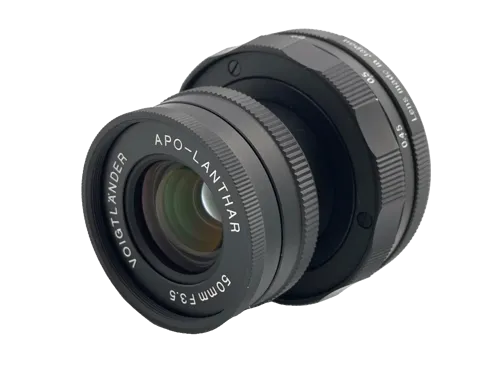
APO-LANTHAR 50mm f/3.5 Type I
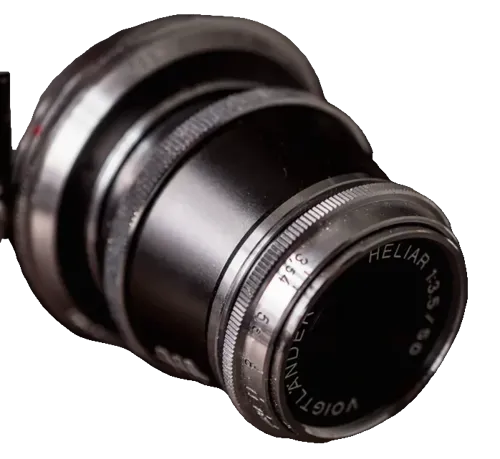
Heliar 50mm f/3.5 IV
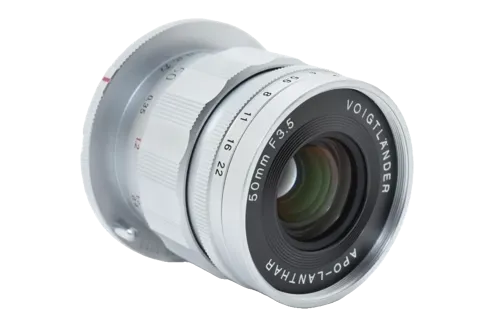
APO-LANTHAR 50mm f/3.5 Type II
Comparison
Compare the Bismuth 50mm f/2.8 1.5x Anamorphic with other 50mm lenses that have sample photos:
Comments