An American 105mm f/4.5 rangefinder-coupled LTM lens, built as a single-coated three-element triplet; sources disagree on its exact launch date.
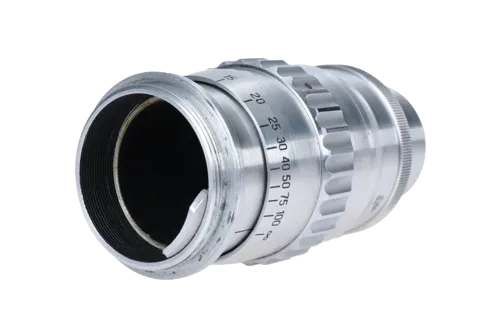
PAM Britar 105mm f/4.5
LTM mount
No listings tracked for this lens right now.
The PAM Britar 105mm f/4.5 is a LTM-mount lens for Leica rangefinder cameras. Leica price index →
How it compares
Measured against the 9 other 105mm LTM-mount lenses in the catalogue.
Specification
About this lens
PAM Britar 105mm f/4.5
The PAM Britar 105mm f/4.5 is an American manual-focus short telephoto in Leica 39mm screw mount with mechanical rangefinder coupling. Documentary sources disagree on its exact date. Leitz Auction assigns a Kardon-associated example to about 1945, while a modern historical review says Photographic Arts Mfg. formed in 1946 and released the Britar in 1950. This profile therefore leaves the precise launch year unresolved rather than selecting one account without further factory evidence.
The lens is a three-element, three-group triplet and a reviewed example is described as single coated. Its aluminium-alloy barrel focuses as one rotating assembly and uses manual aperture control. The same review records thirteen slightly curved diaphragm blades, settings from f/4.5 to f/22, a focus throw exceeding 300 degrees and a minimum distance just under six feet. These details come from one original LTM example and should be checked on another lens rather than assumed from the name alone.
The rangefinder cam permits coupled focusing on compatible screw-mount bodies. A 105mm or adjustable accessory finder gives the most accurate framing; a 90mm frame is only an approximation. The lens can be mounted on many Leica M cameras with a suitable M39-to-M adapter. Because the entire front turns while focusing, orientation-sensitive filters can be inconvenient. Live view is useful for confirming calibration and the true field.
Optical qualities
Rendering
A detailed review of one LTM Britar found strong central definition, some decline toward the corners and a smooth transition between focused and defocused areas. Those observations are useful because they concern the correct mount and focal length, but they remain results from one lens. Condition, coating damage, internal reflections and calibration may make another example behave differently.
Sharpness and contrast
The reviewed lens performed consistently at close, intermediate and distant focus, with the center stronger than the extreme corners at wide aperture. The author characterized contrast as medium and found little visible distortion. These are field observations rather than laboratory measurements. Stopping down increases depth of field and can improve edge consistency, while rangefinder accuracy and correct flange placement remain essential at 105mm.
Bokeh and separation
The triplet formula, 105mm focal length and f/4.5 aperture can separate a subject without completely erasing background context. In the reviewed example, blur ranged from smooth transitions to more outlined or bubbly highlights when the background contained bright points. That variability is scene dependent. Diaphragm shape also changes with aperture, so no single bokeh label describes all distances and settings.
Flare and color
The lens is single coated, but the review still found susceptibility to veiling flare and recommended using the dedicated hood. A defect in that individual lens complicated the first interpretation, and a later comment suggested reflection from the rangefinder tab could also contribute. This uncertainty is another reason not to present one flare pattern as universal. The reviewed example produced natural color, but film, sensor and processing remain important variables.
History
Development and Launch
PAM is expanded by the historical review as Photographic Arts Mfg., a New York company formed after the Second World War. The same account reports a 1950 release and a company-name change to Starr Corporation in 1951. Leitz Auction, however, dates a coupled Britar set to about 1945. Without a period catalogue resolving that difference, the safest conclusion is that the lens belongs to the immediate postwar American rangefinder market.
The Britar appeared when German photographic imports were difficult to obtain in the United States and domestic makers attempted to supply compatible equipment. Its simple triplet and light alloy barrel fit that context. Flints Auction independently confirms a chrome Britar in Leica 39mm rangefinder-coupled mount.
Production Evolution
The lens is often linked with the American Kardon Leica-copy system. A Leitz Auction set includes a PAM four-inch finder and describes the lens for Kardon, establishing a period association. The modern review cautions that there is no evidence the Britar was made exclusively for the Kardon, only that both were American LTM products from roughly the same period. This profile therefore treats Kardon as an association, not a proprietary mount restriction.
The short company timeline suggests limited production, but no reliable total was found. Surviving examples show coupled Leica-thread construction and dedicated accessories. Mechanical measurements from the reviewed copy are informative but not proof of a formally revised series.
Special Editions/Variants
No commemorative or factory-numbered special edition is documented. Differences in finish, distance scale, hood and caps should be recorded from the lens in hand. A later repair or rethreading should not be confused with the original coupled LTM barrel confirmed by auction records.
Collector Notes
Check the long focus travel for stiffness, verify infinity and intermediate-distance coupling, and examine the cam surface for wear or reflective paint. Inspect the single coating, element edges and internal barrel for haze, scratches or stray reflections. A dedicated hood is useful both historically and photographically.
Sources
Where to buy
Related lenses
Similar lenses you might be interested in
Comments