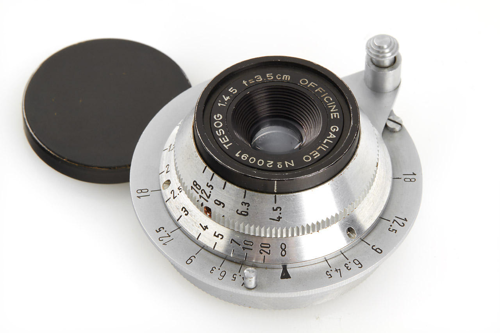
A circa-1950 Officine Galileo 35mm f/4.5 wide-angle for coupled M39 rangefinders, with four elements in three groups and coated chrome construction.
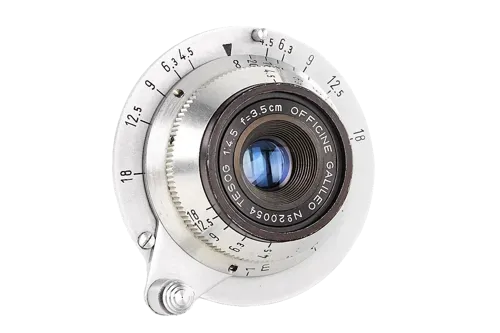
Officine Galileo Tesog 35mm f/4.5
LTM mount
No listings tracked for this lens right now.
The Officine Galileo Tesog 35mm f/4.5 is a LTM-mount lens for Leica rangefinder cameras. Leica price index →
How it compares
Measured against the 45 other 35mm LTM-mount lenses in the catalogue.
Specification
About this lens
Officine Galileo Tesog 35mm f/4.5
The Officine Galileo Tesog 35mm f/4.5 is an Italian wide-angle lens made around 1950 for Leica-standard screw-mount rangefinder cameras. Surviving documentation describes a native chrome M39 barrel with mechanical rangefinder coupling. It was produced by the Florentine optical works during the same post-war period in which the company built civilian 35mm cameras and lenses.
The optical system is documented as four elements in three groups and is described in an auction catalogue as an Elmar-type 35mm design. Specialist cataloguing gives a minimum focus of approximately 1 metre and a six-blade diaphragm. The lens is coated, focuses by its own helicoid and has fully manual aperture control. A reliable filter fitting has not been established in the sources reviewed and is therefore left unspecified.
At 35mm, the Tesog requires a suitable external finder on most screw-mount cameras. At least one documented camera outfit includes a multi-focal-length universal finder. The f/4.5 maximum aperture and one-metre close-focus limit made depth-of-field use practical for daylight snapshots, but the lens remains rangefinder coupled and should not be described as a scale-focus-only design.
The native M39 mount fits compatible Leica-thread bodies. A suitable 35mm LTM-to-M adapter can retain mechanical coupling on Leica M cameras, subject to calibration, while other mirrorless systems can focus through live view. The rigid barrel has no collapsing-tube clearance issue.
Optical qualities
Rendering
No controlled modern test or substantial exact-lens sample archive has been located for the Tesog. The four-element, three-group construction, coating and f/4.5 aperture are documented mechanical and optical facts, but they do not provide a sound basis for claims about a particular sharpness signature, colour palette, bokeh or flare pattern.
The Elmar-type description identifies the broad arrangement used in a catalogued example. It should not be expanded into a claim that the Tesog performs exactly like a Leitz Elmar. Glass choice, curvatures, spacing, coating and mechanical alignment can differ even when the element and group count is similar.
Practical use
The modest maximum aperture favours daylight or supported use compared with faster 35mm lenses of the period. Rangefinder coupling can assist focus, while the accessory finder supplies the correct field of view. A hood may be useful with any single-coated lens, but no universal flare resistance is claimed.
Condition is especially important because published records cover very few examples. Haze, coating marks, diaphragm contamination and rangefinder-cam wear can materially alter both handling and image quality.
History
Development and Launch
Officine Galileo was a long-established Florentine maker of scientific and military optical equipment. In the post-war period it entered the civilian 35mm camera market, manufacturing the Condor I rangefinder distributed by Ferrania from 1947 and later producing additional camera and lens designs.
The Tesog belongs to this short Italian rangefinder period. Two separate auction records place coupled M39 examples around 1950, and a documented 1951 Italian Sonne V outfit includes the lens with a universal finder. These records establish that the Tesog was not merely a later one-off conversion, although accessible sources do not reveal a formal launch announcement.
Production Evolution
Documented examples are chrome, coated, rangefinder-coupled M39 lenses. The reviewed records do not establish a series of barrel revisions, an optical recalculation or a definite production total. One auction catalogue speculated that a recorded lens might be a prototype because information was scarce; a second documented camera outfit confirms another example but does not settle whether production was serial, experimental or extremely limited.
The cautious conclusion is that the design existed in more than one period outfit while its manufacturing scale remains unknown. No individual lens number is needed to describe that history.
Special Editions/Variants
No formally named special edition has been documented. Association with a specific Italian camera body or the presence of a matching universal finder describes an outfit, not a different optical version. Any uncoupled or differently mounted Tesog should be verified independently before being merged with this coupled M39 profile.
Collector Notes
The Tesog engraving, 3.5cm or 35mm focal length, f/4.5 aperture, chrome M39 barrel and functional rangefinder cam are the central identification features. Collectors should distinguish it from Officine Galileo's 50mm Eliog and Esaog standards and from later custom adaptations of Italian optical cells.
Because the available historical record is thin, claims of prototype status, exact rarity ranking or production quantity should be treated as unproven. For use, test the coupling, confirm the one-metre focusing endpoint on the actual lens and use an appropriate 35mm finder.
Sources
- Leitz Photographica Auction, Officine Galileo Tesog 35mm f/4.5leitz-auction.com →
- Leitz Photographica Auction, Officine Galileo Tesog M39 Snapshot Lensleitz-auction.com →
- Leitz Photographica Auction, Sonne V with Coupled Tesogleitz-auction.com →
- The Lens DB, Officine Galileo Tesog 35mm f/4.5lens-db.com →
- Mike Eckman, Ferrania Condor Imikeeckman.com →
Where to buy
Related lenses
Similar lenses you might be interested in
Comments