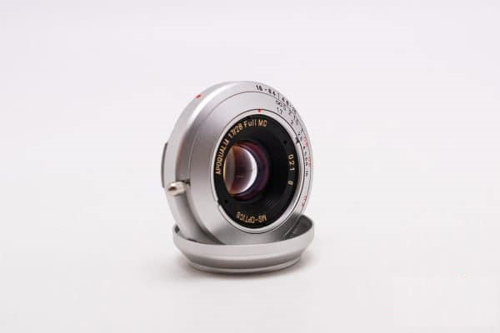
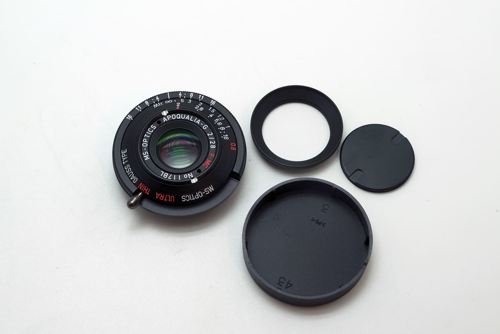
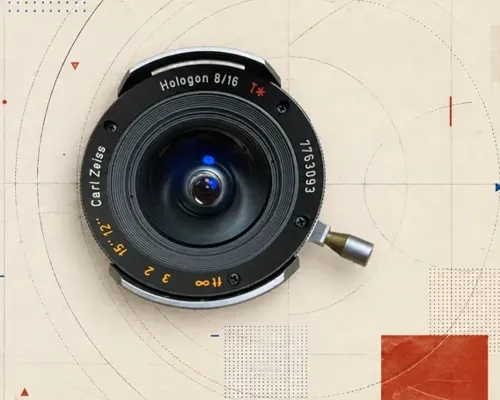
The Funky Lens List: 10 Weird and Wonderful Lenses You Can Put on a Leica
Discover 10 weird and wonderful Leica lenses, from body-cap oddities and organ transplants to Cold War glass and a 740g f/1 monster.
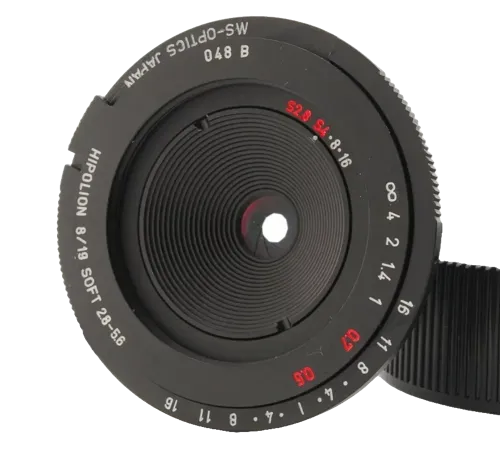
The MS-Optics Hipolion 19mm f/8 is a two-element Hypergon-formula ultra-wide Leica M-mount lens, prized by collectors as among the smallest M lenses made.
M mount
The MS-Optics Hipolion 19mm f/8 is a M-mount lens for Leica rangefinder cameras. As of October 2026, it sells from €374 used across 1 listing, with a 30-day median of €374. Leica price index →
The Hipolion is among the most unusual ultra-wide lenses ever made for the Leica M mount, built from just two elements arranged in two groups and resolving an extreme angle of view from a body little larger than a camera cap. It is the work of Sadayasu Miyazaki of MS-Optics, the one-man Japanese workshop he established in 2006, whose lenses are known for low element counts, the avoidance of aspherical glass, and extreme miniaturization [2]. The Hipolion revives the Hypergon, a symmetrical double-anastigbat design developed around 1900 by Emil von Höegh at the Berlin firm C. P. Goerz, which used two thin, near-hemispherical meniscus elements to cover very wide angles with essentially complete freedom from rectilinear distortion [1][3]. Miyazaki adapted that century-old concept to a modern rangefinder mount, producing what reviewers have described as one of the smallest M-mount lenses in existence.
The optical and mechanical design is defined by extreme economy. The lens uses two elements in two groups with a ten-blade aperture, and at a diameter of 50 mm and a weight of 27 g it is exceptionally compact and light. The barrel is anodised aluminium, and the seller's literature notes that all glass surfaces are multicoated. Minimum focusing distance is given as 0.3 m, though published figures vary with the camera and adapter used; the manufacturer's seller materials cite 0.8 m on a Leica M body and roughly 0.5 to 0.6 m on mirrorless cameras. The design is optimised for use stopped down, with the maker recommending working apertures around f/8 and f/16; the wider settings between f/2.8 and f/5.6 produce a deliberate soft-focus effect rather than conventional sharpness. Because of its symmetrical, distortion-free geometry, the Hipolion is presented primarily as a lens for architecture, interiors, landscapes and panoramas rather than general photography, echoing the original Goerz product description from around 1900.
Documented finish and configuration details vary between sources. Seller listings describe both black and silver anodised options and a 34 mm filter or hood thread, with an area provided for six-bit coding. The lens is sometimes catalogued under closely related designations referencing its soft-focus behaviour and nominal focal lengths near 18.5 to 19.5 mm, reflecting the imprecision common to MS-Optics naming.
Rendering The Hipolion's character is strongly aperture-dependent. Stopped down, it is praised for distortion-free rendering of straight lines, an inheritance of the symmetrical Hypergon geometry, which makes it well suited to architecture and interiors. Wide open and through the middle apertures it is intentionally soft, with one reviewer describing the f/2.8 to f/5.6 range as producing foggy, low-contrast images, while results sharpen markedly when closed to f/11 and especially f/16. The maker frames these wide settings as a soft-focus mode rather than a fault.
Distortion and vignetting Rectilinear distortion is reported to be effectively absent owing to the symmetrical design. As with the historical Hypergon, the lens shows noticeable light fall-off toward the edges, though at least one user found it not much stronger than other ultra-wides and readily corrected in post-processing.
Contrast and color Color rendering has been described as distinctive, tending toward pastel tones, an effect most pronounced wide open. One reviewer recommended the lens particularly for use on Leica Monochrom bodies, citing how much shadow detail those sensors recover from the corners.
Development and Launch MS-Optics is the trading name of the workshop founded by Sadayasu Miyazaki, born in 1940, who designs and hand-assembles every lens in Japan. The Hipolion was a deliberate attempt to render the Goerz Hypergon, long considered difficult or impossible to adapt for contemporary cameras, in a modern M-mount form, and it was first released in December 2020. It sits within a lineup of compact, low-element MS-Optics designs that includes the Perar wide-angles and the Historio Prot, several of which also draw on historical optical formulas.
Collector Notes Buyers should be aware that published specifications for the Hipolion vary between sources, including the nominal focal length, length, and minimum focusing distance, in part because MS-Optics lenses are produced in small hand-built batches. Seller materials reference a 34 mm filter or hood thread for which a glass element is sometimes salvaged from a standard filter, a practice common across the MS-Optics range, so any supplied hood and filter parts are worth verifying. Because the lens is sold in limited lots with serial numbers that cannot be reserved, originality and completeness of accessories are points to confirm before purchase.
About the usual price. The lowest listing is around the 30-day average.
Every shop grades differently. Leica Classic uses letters, Ffordes uses E++ and E+, German dealers write "Zustand B", Japanese dealers write A−. We map all of them onto the one ladder below. Where a shop states its own grade, we print it under ours.
As of October 2026, the MS-Optics Hipolion 19mm f/8 sells from €374 used, with a 30-day median of €374, across 1 active listing.
As of October 2026, the MS-Optics Hipolion 19mm f/8 is sold by 1 source (1 listing), from €374 used: all compared cheapest-first on this page.
Similar lenses you might be interested in
Comments