Best price New
MS Perar 4.5/17mm Ultra Thin Retrofocus
Sold by Japan Exposures
€431 ≈ $466
The MS Optics 17mm f/4.5 Perar is an ultra-wide angle pancake lens designed and hand-assembled by Sadayasu Miyazaki in Japan. Weighing only 47 grams and measuring just 10.2mm in length, it is one of the smallest wide-angle lenses ever produced for the Leica M mount. While its retrofocus design manages to keep the center sharp, the lens is defined by its significant optical compromises, including heavy vignetting, wavy distortion, and corner color shifts on digital sensors, making it a specialized tool for enthusiasts rather than a general-purpose architectural lens.
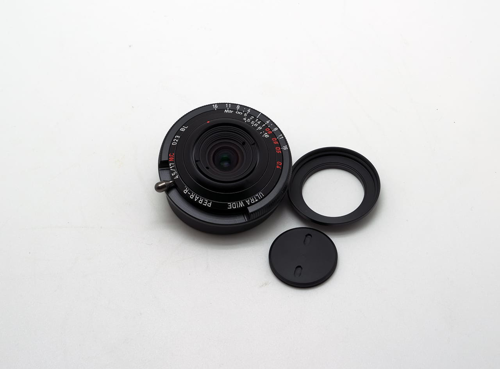
M mount
The MS-Optics Perar 17mm f/4.5 is a M-mount lens for Leica rangefinder cameras. As of October 2026, it sells from €431 used across 1 listing, with a 30-day median of €431. Leica price index →
The MS Optics 17mm f/4.5 Perar is a manual focus, ultra-wide angle prime lens for the Leica M mount, released by the boutique Japanese manufacturer MS Optics (Miyazaki Optical). Known for its extreme compactness, the lens is the creation of Sadayasu Miyazaki, who hand-assembles these optics in limited batches. The lens is characterized by its "pancake" profile, measuring roughly 10.2mm in length, effectively turning a full-frame rangefinder camera into a pocketable point-and-shoot system.
Unlike many previous "Perar" lenses which utilized triplet formulas, the 17mm f/4.5 employs a retrofocus design with four elements in four groups. This choice allows for a wider field of view (100 degrees diagonal) while attempting to mitigate some of the severe corner smearing often seen in symmetrical wide-angle lenses on digital sensors.
The build quality reflects the idiosyncratic nature of MS Optics. The barrel is machined from aluminum and weighs a mere 47 grams. The focusing mechanism is a rotating lever that moves the entire optical block.
The MS Optics 17mm occupies a niche for photographers prioritizing size above all else, standing in contrast to mainstream alternatives.
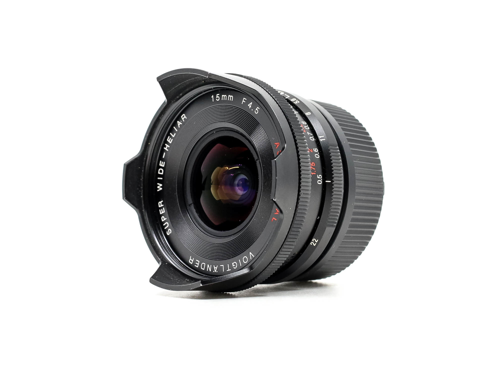
The Voigtländer 15mm Version III is the standard benchmark for modern ultra-wide rangefinder lenses.
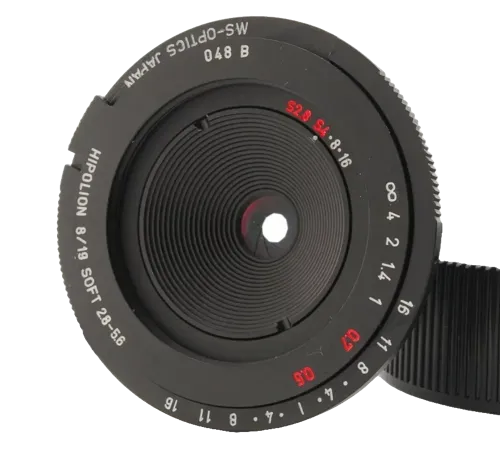
The Hipolion is an even simpler, more experimental lens from the same designer.
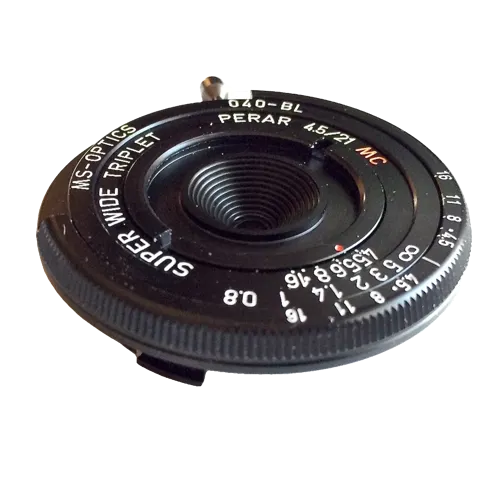
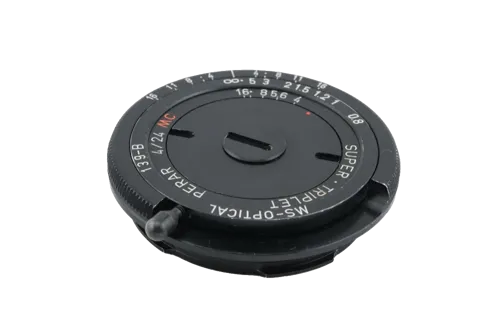
The 21mm and 24mm variants are the siblings in the "Perar" line, usually utilizing triplet designs.
Sources:
About the usual price. The lowest listing is around the 30-day average.
Every shop grades differently. Leica Classic uses letters, Ffordes uses E++ and E+, German dealers write "Zustand B", Japanese dealers write A−. We map all of them onto the one ladder below. Where a shop states its own grade, we print it under ours.
As of October 2026, the MS-Optics Perar 17mm f/4.5 sells from €431 used, with a 30-day median of €431, across 1 active listing.
As of October 2026, the MS-Optics Perar 17mm f/4.5 is sold by 1 source (1 listing), from €431 used: all compared cheapest-first on this page.
Similar lenses you might be interested in

Comments