Best price New
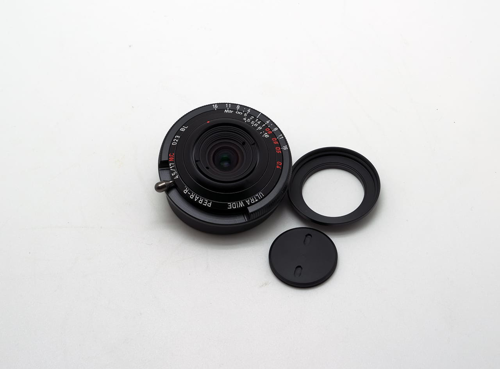
MS Super Triplet Perar 4/24
Sold by japanexposures.com
€397 ≈ $429
The MS Optics 24mm f/4 Perar is widely regarded as the "Goldilocks" lens of the Perar lineup, balancing the extreme pancake size of the 21mm with a slightly more manageable focal length and less aggressive color shifting on digital bodies. Hand-assembled by Sadayasu Miyazaki, this "Super Triplet" weighs 43 grams and measures just 5.2mm thick, effectively transforming a Leica M into a pocket camera. While it still demands patience due to its tiny, hood-controlled aperture and inevitable vignetting, it offers a distinct, high-contrast render that feels far more organic than clinical modern alternatives.
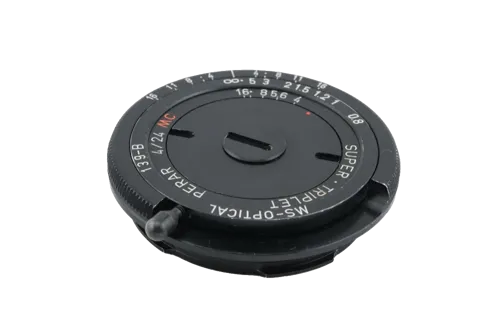
M mount
The MS-Optics Perar 24mm f/4 is a M-mount lens for Leica rangefinder cameras. As of October 2026, it sells from €397 used across 1 listing, with a 30-day median of €607. Leica price index →
Measured against the 6 other 24mm M-mount lenses in the catalogue.
The MS Optics 24mm f/4 Perar is a manual focus pancake lens produced by Miyazaki Optical (MS Optics) in Japan. Released around 2014, it sits in the middle of the famous "Perar" triplet trilogy (alongside the 21mm and 28mm). Many enthusiasts consider the 24mm iteration the "sweet spot" of the series: it retains the wafer-thin profile of the 21mm but offers a slightly more natural perspective and improved optical behavior on digital sensors.
The lens utilizes a triplet design (three elements in three groups), a formula famous for its simplicity and high contrast. Miyazaki-san calls this a "Super Triplet" because he utilizes premium Tantalum glass and advanced multi-coatings to push the performance beyond what historical triplets could achieve.
The lens is machined from aluminum and weighs approximately 43 grams. When mounted, it protrudes only 5.2mm from the camera body, making it one of the smallest interchangeable lenses in existence.
The 24mm focal length is somewhat rare in the M-mount system, positioning the Perar against very different competitors.
The practical, budget-friendly alternative.
The technical masterpiece.
The wider sibling.
Sources:
Good time to buy. The lowest listing is 35% below the 30-day average.
Over the last 5 weeks the median price for the MS-Optics Perar 24mm f/4 has fallen, ranging from €607 to €947 (now €607).
Weekly price (EUR). Median (Good or better) and lowest (Good or better) across 5 weeks. The full figures follow in the table below.
| Week | Median | Lowest |
|---|---|---|
| Jul 20, 2026 | €947 | €947 |
| Jul 27, 2026 | €672 | €397 |
| Aug 3, 2026 | €607 | €397 |
| Aug 10, 2026 | €680 | €397 |
| Aug 17, 2026 | €397 | €397 |
Every shop grades differently. Leica Classic uses letters, Ffordes uses E++ and E+, German dealers write "Zustand B", Japanese dealers write A−. We map all of them onto the one ladder below. Where a shop states its own grade, we print it under ours.
As of October 2026, the MS-Optics Perar 24mm f/4 sells from €397 used, with a 30-day median of €607, across 1 active listing.
As of October 2026, the MS-Optics Perar 24mm f/4 is sold by 1 source (1 listing), from €397 used: all compared cheapest-first on this page.
Similar lenses you might be interested in
Comments