Best price New
MS Optics Aporia 24mm f/2 M mount
Sold by Japan Exposures
€638 ≈ $689
The MS-Optics Aporia 24mm f/2 is a Leica M-mount pancake wide-angle, prized by collectors as one of the smallest, lightest fast full-frame lenses ever built.
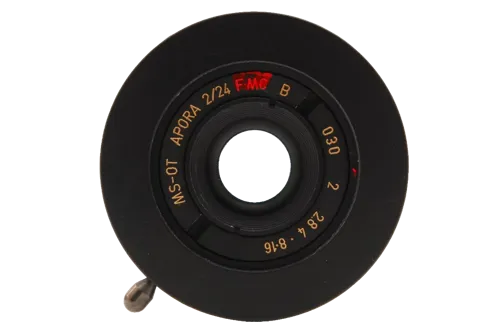
M mount
The MS-Optics Aporia 24mm f/2 is a M-mount lens for Leica rangefinder cameras. As of November 2026, it sells from €638 new across 1 listing, with a 30-day median of €638. Leica price index →
Measured against the 6 other 24mm M-mount lenses in the catalogue.
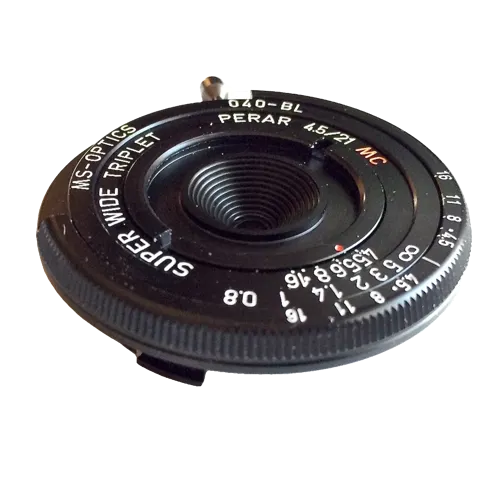
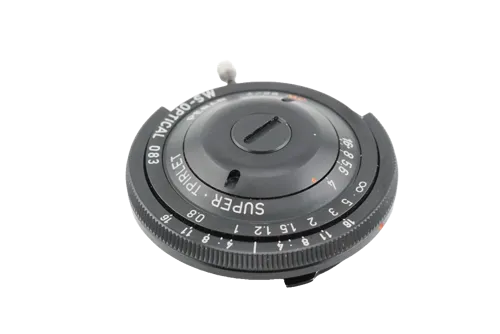
The Aporia 24mm f/2 is the kind of object that sounds implausible on paper: a fast 24mm wide-angle for the Leica M system that is barely thicker than a body cap, weighs only 45 grams, and still has a real diaphragm and a focusing helicoid [1][2]. It is the work of Sadayasu Miyazaki, the one-person Japanese workshop behind MS-Optics, who designs, machines, and hand-assembles each lens himself [3]. Miyazaki built it around a six-element, four-group Gauss arrangement and has described the central design problem as taming the coma flare from mid-frame to corner that such layouts tend to produce, an aberration he says he reduced to a usable level with low-dispersion glass.
Mechanically the lens is unusual to handle precisely because of its size. The whole barrel rotates on focus, helped by a small lever, and travels roughly 120 degrees from the close limit to infinity; the focusing range runs to a minimum of 0.5 m, which is most useful on mirrorless bodies where the lens can be focused at the sensor. The aperture is set by turning the inner ring carrying the markings, with no click stops, which several reviewers found fiddly, and the ten straight blades stop down to mark the chosen value against a small index dot. Filters are a special case: the lens carries a 34mm thread, but a normal filter will not mount, so the intended method is to salvage the glass from a filter and fit it into the supplied small hood. Because the barrel is so narrow in diameter, on a Leica M10 the camera's six-bit reader is not fully shielded, and bright light can make the body register a lens change; a small piece of tape over the area is a common user fix.
MS-Optics lenses are sold in very small batches and turn up mainly through specialist dealers such as Japan Camera Hunter, which makes finish and serial variation a real part of collecting them. The Aporia was offered in more than one finish, with anodised black and chrome and lacquer versions among those described at launch, though buyers were told serial numbers could not be reserved. Each lens ships with a hand-drawn MTF chart, a Miyazaki trademark that doubles as a provenance marker.
Rendering For a pancake this extreme the Aporia behaves better than its size suggests, but it is a lens of clear trade-offs. Documented testing shows good across-frame sharpness and contrast once stopped down, with a sharp focal plane already at f/2 thanks to low astigmatism, set against very high field curvature that complicates flat-field work. It is best understood as a lens whose character is shaped by deliberate compromise rather than brute correction.
Sharpness Reviewers report that the hand-drawn MTF data hints at well-controlled astigmatism but pronounced field curvature, with a noticeable dip in resolution across the mid-frame zone while the extreme corners can look slightly better; performance improves markedly on stopping down.
Distortion and vignetting Distortion is only minor, with a slightly wavy profile that a small negative correction largely removes toward the edges at the cost of the center. Vignetting is heavy, as the dimensions imply: corner falloff measured around 3.9 EV wide open, easing steadily on stopping down.
Aberrations The largely symmetrical design keeps lateral chromatic aberration low and easily corrected, and longitudinal CA is modest for the aperture, though the lens is not flawlessly apochromatic despite the family's "Apo" naming convention. Coma is visible at wider apertures and is one of the lens's weaker traits.
Flare resistance Flare control is a limitation. The multicoating keeps overall contrast reasonable, but with the sun in the frame, especially stopped down, frame-filling ghosts and internal reflections appear, partly from the diaphragm itself.
Bokeh and transitions Smooth background blur is not the point of a wide pancake, but the Aporia renders with an overcorrected-spherical-aberration signature, giving acceptable out-of-focus areas for its class wide open.
Development and Launch The Aporia 24mm f/2 was announced in 2020 as a return by MS-Optics to the compact wide-angle pancakes that are Miyazaki's specialty. It was positioned as a curiosity and a technical statement as much as a working tool, marketed as roughly the size of a body cap while retaining an f/2 aperture, a genuine iris, and a coupled focus mechanism, qualities that distinguish it from the fixed-focus novelty lenses that usually claim "smallest ever" status. Production has continued in limited runs since.
Special editions No formal military, export, or numbered special editions are widely documented; the meaningful variation is in finish rather than optical or mechanical specification.
Collector Notes Because output is small and hand-built, originality and finish matter when buying. Sources note the lens was offered in several finishes and that serial numbers were not reservable, so collectors should verify the finish and confirm the lens ships with its hand-drawn MTF sheet and the small hood that doubles as the filter-glass holder. The narrow barrel's interaction with the six-bit reader on digital M bodies is a known quirk to expect rather than a defect. One discrepancy worth flagging: some vendor listings cite a length near 5.8 mm and rangefinder coupling from about 0.8 m, whereas LeicaLensList records a 5 mm length and no rangefinder coupling, so verify the specific example against the dealer datasheet.
Over the last 17 weeks the weekly median asking price for the MS-Optics Aporia 24mm f/2 has risen, ranging from €625 to €638 (now €638).
Weekly price (EUR). Median (Good or better) and lowest (Good or better) across 17 weeks. The full figures follow in the table below.
| Week | Median | Lowest |
|---|---|---|
| Jul 27, 2026 | €625 | €625 |
| Aug 3, 2026 | €625 | €625 |
| Aug 10, 2026 | €625 | €625 |
| Aug 17, 2026 | €625 | €625 |
| Aug 24, 2026 | €625 | €625 |
| Aug 31, 2026 | €625 | €625 |
| Sep 7, 2026 | €625 | €625 |
| Sep 14, 2026 | €625 | €625 |
| Sep 21, 2026 | €625 | €625 |
| Sep 28, 2026 | €625 | €625 |
| Oct 5, 2026 | €625 | €625 |
| Oct 12, 2026 | €625 | €625 |
| Oct 19, 2026 | €625 | €625 |
| Oct 26, 2026 | €625 | €625 |
| Nov 2, 2026 | €625 | €625 |
| Nov 9, 2026 | €636 | €636 |
| Nov 16, 2026 | €638 | €638 |
Every shop grades differently. Leica Classic uses letters, Ffordes uses E++ and E+, German dealers write "Zustand B", Japanese dealers write A−. We map all of them onto the one ladder below. Where a shop states its own grade, we print it under ours.
As of November 2026, the MS-Optics Aporia 24mm f/2 sells from €638 new, with a 30-day median of €638, across 1 active listing.
As of November 2026, the MS-Optics Aporia 24mm f/2 is sold by 1 shop (1 listing), from €638 new: all compared cheapest-first on this page.
The MS-Optics Aporia 24mm f/2 takes 34 mm screw-in filters (E34).
The MS-Optics Aporia 24mm f/2 focuses down to 0.5 m. It is not rangefinder coupled, so focus by scale, live view or an EVF.
The MS-Optics Aporia 24mm f/2 weighs 45 g, lighter than 83% of the 6 other 24mm M-mount lenses in the catalogue.
The MS-Optics Aporia 24mm f/2 has a Leica M mount, so it fits every Leica M body natively and mirrorless cameras with an M adapter. It carries no 6-bit code, so select the lens profile by hand on a digital M.
The MS-Optics Aporia 24mm f/2 was produced from 2020.
No reviews yet. Own this lens? Be the first.
Write a review of the MS-Optics Aporia 24mm f/2Similar lenses you might be interested in
Comments