Best price New
MS Apoqualia-G 28/f2
Sold by japanexposures.com
€568 ≈ $613
The MS-Optics Apoqualia 28mm f/2 is a hand-built ultra-compact Leica M-mount wide-angle prized by collectors for its tiny size and unusual rendering.
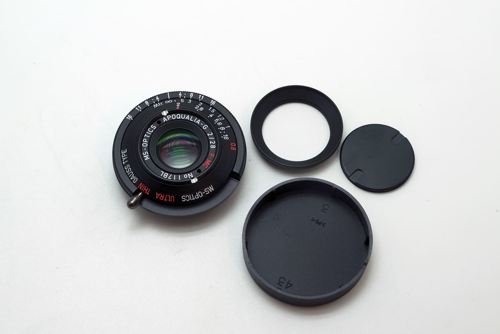
M mount
The MS-Optics Apoqualia 28mm f/2 is a M-mount lens for Leica rangefinder cameras. As of October 2026, it sells from €568 used across 3 listings, with a 30-day median of €844. Leica price index →
Measured against the 37 other 28mm M-mount lenses in the catalogue.
Among the smallest fast wide-angles ever made for the Leica M mount, the Apoqualia 28mm f/2 is the work of Sadayasu Miyazaki, the lone designer behind the MS-Optics (Miyazaki Sadayasu) workshop in Tokyo. The lens has become something of a cult object: a fast 28mm that is so shallow it sits barely taller than an M-mount rear cap, leading more than one reviewer to describe it as an "f/2 body cap" [2]. It packs six elements in four groups into a body roughly 50 mm across and only about 9 mm deep, weighing around 50 g, and the lens is designed, assembled and hand-finished by Miyazaki himself [1].
Handling reflects its handmade, minimalist nature. The whole lens rotates on focus, turning roughly 90 degrees between the 0.8 m close limit and infinity, and a small tab makes the shallow focus ring easier to grip on so slim a barrel. Aperture is set on a narrow inner ring with ten rounded blades; because the small metal hood threads onto that ring, one common technique is to grasp the hood itself to change the f-stop. The mount is Leica M. Reviewers note that on a Leica M10 the lens does not fully cover the six-bit code reader, which can cause the camera to misread it under bright light, an issue cured with a small piece of tape. As with most MS-Optics designs, all elements are multicoated.
The lens has been rereleased and mechanically revised several times, becoming the first MS-Optics lens to reach a third-generation casing, with the successive versions differing in barrel design and minimum focus distance while sharing the same optical formula. Later marketing uses the name Apoqualia-G, and the line has continued into newer iterations, including a 28mm f/1.7 MC introduced in 2023. Various limited finishes have appeared, among them an Apoqualia-II gold version with a traditional Urushi Wajima lacquer coating over anodized aluminum, offered alongside black, gold and red lacquer variants [3]. Because production is by hand and in small numbers, individual examples can vary, and buyers should confirm which generation and finish they are looking at.
Rendering The Apoqualia 28mm f/2 has a distinctive, polarizing signature rather than a clinically corrected one. Wide open it shows good central contrast that falls off toward the corners, and it is dominated by strong field curvature and focus shift; contrast and resolution do not peak in the same plane, and stopping down from f/2 produces noticeable backfocus. At close focus wide open the central subject separates strongly, with swirly, energetic backgrounds that one long-term user likened to an almost Petzval effect. Stopped down for "f/8 and be there" shooting it delivers clean, sharp results comparable to other compact wides of similar coverage.
Sharpness The center is contrasty from f/2, but the pronounced field curvature means the corners require focusing much closer than the center, and even across-frame sharpness is only reached when stopped well down, to around f/11 to f/16, with corners still modest.
Bokeh and transitions The same heavy field curvature shapes the out-of-focus rendering: background regions toward the edges can appear in focus even when the center is focused close, which some find characterful and others find distracting. Close-up, higher subject separation masks the effect and the swirl reads as a creative trait.
Flare resistance Despite multicoating, large ghosts and veiling flare can appear at maximum aperture; stopped down the larger artefacts mostly give way to a few smaller ghosts. Within the MS-Optics range it is considered one of the better performers for flare.
Distortion and vignetting Distortion is low but slightly wavy. Vignetting is heavy, with the deepest falloff wide open and a still-visible drop in the corners even stopped down.
Aberrations Lateral chromatic aberration is very well controlled, and purple fringing is minimal; some green outlining is visible in out-of-focus areas, and coma is strong at the widest apertures.
Digital use Reviewers recommend live view focusing on mirrorless and digital rangefinder bodies because the focus shift makes rangefinder focusing in the f/2.8 to f/4 range unreliable; using the lens on a film rangefinder without confirmation can be frustrating. Performance is somewhat better on bodies with a thin sensor filter stack such as the M10.
Development and Launch The Apoqualia 28mm f/2 comes from Sadayasu Miyazaki, who designs, manufactures and hand-assembles MS-Optics lenses in Tokyo, with the brand name following the Japanese convention of family name before given name. A writer who acquired an early example described receiving it directly from Japan and being struck by how the optic, even with its hood, was barely taller than an M rear cap. The lens established itself as one of Miyazaki's best-known designs and a frequent point of comparison within the MS-Optics catalogue.
Production Evolution There have been multiple versions sharing the same six-element optics but differing in casing and minimum focus distance, making this the first MS-Optics lens to reach a third-generation barrel; later examples carry the Apoqualia-G name, and the family has extended to a 28mm f/1.7 MC announced in 2023.
Special editions A gold Apoqualia-II finished in traditional Urushi Wajima lacquer over anodized aluminum has been offered, sitting alongside black, gold and red lacquer variants of the line.
Collector Notes Several traits warrant attention before buying. Because the helical is of a classically open design, the barrel breathes as it focuses and can draw dust into the camera in dirty environments. As with many Miyazaki lenses, parts can loosen over time; the bezel around the rear element is the usual culprit, and if it works fully loose the element can detach inside the body, so periodic careful tightening during cleaning is advised. There is no conventional filter thread, and the tiny focusing tab is prone to working loose unless secured. One discrepancy worth noting: at least one detailed review describes the lens as rangefinder coupled across its focus range, whereas LeicaLensList records it as not rangefinder coupled; given the strong focus shift, even where coupling exists reviewers caution against relying on the rangefinder at middle apertures.
Good time to buy. The lowest listing is 33% below the 30-day average.
Lowest price Click a mark to open that listing · arrow keys to step, Enter to open
Price against condition for 3 listings of MS-Optics Apoqualia 28mm f/2, €568 to €1,064, median €625. New: 2 at €568, €625. Excellent: 1 at €1,064. The full table follows.
| Condition | Lowest | Median |
|---|---|---|
| New | €568 | €596 |
| Excellent | €1,064 | €1,064 |
Over the last 16 weeks the median price for the MS-Optics Apoqualia 28mm f/2 has fallen, ranging from €596 to €1,026 (now €844).
Weekly price (EUR). Median (Good or better) and lowest (Good or better) across 16 weeks. The full figures follow in the table below.
| Week | Median | Lowest |
|---|---|---|
| Jun 15, 2026 | €941 | Unknown |
| Jun 22, 2026 | €941 | Unknown |
| Jun 29, 2026 | €941 | Unknown |
| Jul 6, 2026 | €941 | Unknown |
| Jul 13, 2026 | €941 | Unknown |
| Jul 20, 2026 | €1,110 | €1,110 |
| Jul 27, 2026 | €625 | €568 |
| Aug 3, 2026 | €625 | €568 |
| Aug 10, 2026 | €596 | €568 |
| Aug 17, 2026 | €625 | €568 |
| Aug 24, 2026 | €625 | €568 |
| Aug 31, 2026 | €596 | €568 |
| Sep 7, 2026 | €625 | €568 |
| Sep 14, 2026 | €625 | €568 |
| Sep 21, 2026 | €625 | €568 |
| Sep 28, 2026 | €625 | €568 |
Every shop grades differently. Leica Classic uses letters, Ffordes uses E++ and E+, German dealers write "Zustand B", Japanese dealers write A−. We map all of them onto the one ladder below. Where a shop states its own grade, we print it under ours.
As of October 2026, the MS-Optics Apoqualia 28mm f/2 sells from €568 used, with a 30-day median of €844, across 3 active listings.
As of October 2026, the MS-Optics Apoqualia 28mm f/2 is sold by 2 sources (3 listings), from €568 used: all compared cheapest-first on this page.
Similar lenses you might be interested in
Comments