Best price Fair
Voigtländer 28mm f2 Ultron
Sold by Kamerastore
€353 ≈ $382
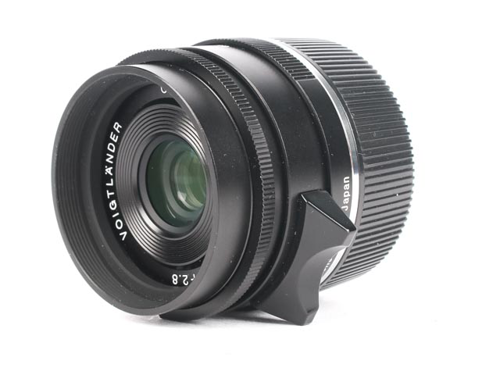
The Voigtländer Ultron 28mm f/2 is a compact, fast wide-angle for Leica M mount, prized by rangefinder users for sharp, low-distortion results in a small body.
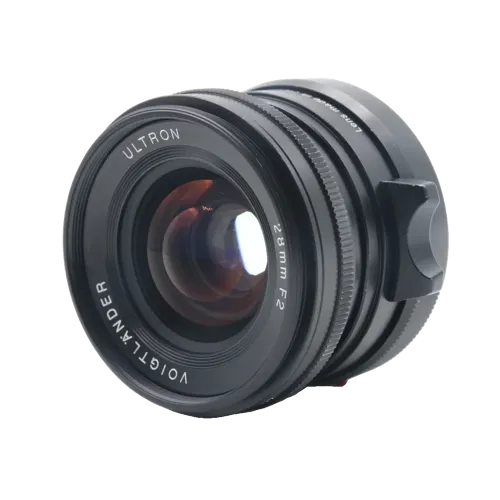
M mount
The Voigtländer Ultron 28mm f/2 is a M-mount lens for Leica rangefinder cameras. As of October 2026, it sells from €353 used across 3 listings, with a 30-day median of €553. Leica price index →
Measured against the 37 other 28mm M-mount lenses in the catalogue.
When Cosina introduced this Voigtländer Ultron in 2008, it offered Leica M users a genuinely fast 28mm in a body far smaller and cheaper than the comparable Leica options, slotting in below the 28mm f/2 Summicron-M and 28mm f/2.8 Elmarit-M on price while staying competitive on optical behaviour [1][2]. It was the M-bayonet successor to the earlier screw-mount Voigtländer 28mm f/1.9 Ultron, and it later became the first of several distinct 28mm f/2 generations from Cosina, predating the redesigned aspherical "Vintage Line" Type I and Type II lenses that followed with a 39 mm filter thread and a closer 0.5 m focus limit [3].
Optically the lens uses a ten-element, eight-group design that behaves much like a conventional, near-symmetrical wide-angle rather than a retrofocus SLR-style layout, which helps explain its very low distortion. It focuses down to 0.7 m, a typical figure for an M-mount wide-angle, and is rangefinder coupled for use on film and digital M bodies. The aperture runs on ten blades, and the barrel takes 46 mm filters. At roughly 244 g and only about 51 mm long it is light and pocketable, and reviewers have praised the mechanical quality of the focusing and diaphragm action. Because it is moderately fast rather than extreme, it tends to avoid the rangefinder calibration problems that can affect faster wide-angles.
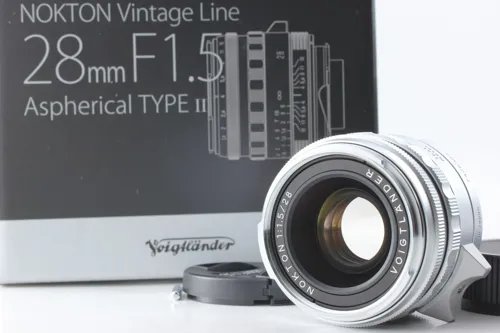
The main point of confusion for buyers is version identity. This entry covers the original black VM Ultron 28mm f/2 with the ten-element, eight-group formula, 46 mm filters and a 0.7 m minimum focus distance; the later aspherical Type I and Type II lenses share a different ten-element, seven-group optical formula, a 39 mm filter thread and a 0.5 m minimum focus distance, and they exist in different finishes and barrel styles. Lens correction profiles are not interchangeable across these generations, since profiles made for one version can degrade results on another.
Rendering Documented character points to a clean, modern rendering with strong sharpness and contrast and notably low distortion, traits that suit landscape, street and architectural work. On a native Leica M sensor the lens resolves well across the frame from wide open, with only a small mid-zone dip at f/2.
Sharpness On a 24 MP Leica M10 the lens performs strongly from f/2, close to a more complex Voigtländer 35mm despite its simpler construction; center resolution is high wide open and the frame tightens further on stopping down. It is generally regarded as not quite matching the very sharpest Leica 28mm ASPH lenses for pixel-level detail, while still being highly capable.
Distortion and vignetting Distortion is low and easily corrected, consistent with the near-symmetrical optical layout. As is normal for a compact, symmetrical fast wide-angle, corner light falloff is significant wide open and eases as the lens is stopped down.
Digital use On Leica M digital bodies with their thin sensor cover glass the lens shows its best corner and bokeh behaviour. On mirrorless cameras with a thicker filter stack, such as Sony A7-series bodies, the corners need more stopping down and a slight green corner colour cast can appear, a limitation shared by many rangefinder wide-angles rather than a fault of this lens specifically.
Development and Launch Cosina launched the M-mount Ultron 28mm f/2 under the Voigtländer name in 2008, giving rangefinder photographers a fast yet compact 28mm at a fraction of Leica prices. It replaced the older M39 screw-mount 28mm f/1.9 Ultron in Cosina's lineup and positioned itself as an affordable alternative to Leica's own 28mm wide-angles.
Production Evolution The 28mm f/2 designation was carried forward through several distinct lenses. After this original 10/8 version, Cosina released revised aspherical "Vintage Line" models, identified as Type I and Type II, which moved to a 10/7 formula, a 39 mm filter thread and a 0.5 m minimum focus distance. Type I and Type II are reported to share the same optics and differ mainly in barrel styling, with Type I using a small focus lever and Type II a more conventional focus tab.
Special editions No widely documented military, export or rare factory variants of the original Ultron 28mm f/2 are recorded; the meaningful variation in the 28mm f/2 family comes from the later aspherical Type I and Type II redesigns and their finish options rather than from special editions of this version.
Collector Notes The most important check is which generation a listing actually refers to, since the 28mm f/2 name has been reused across optically different lenses. The original here is the black 10/8 lens with 46 mm filters and a 0.7 m close-focus limit; confirm the filter thread and minimum focus distance to separate it from the later aspherical 39 mm-filter versions. Hoods are sold separately for the Cosina M-mount line, so verify whether a hood is included, and check the rangefinder coupling and focus and aperture action when buying used. Note that lens-correction profiles are version-specific and should not be carried over between generations.
Good time to buy. The lowest listing is 36% below the 30-day average.
Lowest price Click a mark to open that listing · arrow keys to step, Enter to open
Price against condition for 3 listings of Voigtländer Ultron 28mm f/2, €353 to €671, median €552. Good: 1 at €552. Fair: 1 at €353. Mint-: 1 at €671. The full table follows.
| Condition | Lowest | Median |
|---|---|---|
| Good | €552 | €552 |
| Fair | €353 | €353 |
| Other | €671 | €671 |
Over the last 13 weeks the median price for the Voigtländer Ultron 28mm f/2 has fallen, ranging from €454 to €850 (now €553).
Weekly price (EUR). Median (Good or better) and lowest (Good or better) across 13 weeks. The full figures follow in the table below.
| Week | Median | Lowest |
|---|---|---|
| Jun 1, 2026 | €850 | €850 |
| Jun 8, 2026 | €850 | €850 |
| Jun 15, 2026 | €525 | Unknown |
| Jun 22, 2026 | €525 | Unknown |
| Jun 29, 2026 | €525 | Unknown |
| Jul 6, 2026 | €459 | €459 |
| Jul 13, 2026 | €457 | €457 |
| Jul 20, 2026 | €455 | €455 |
| Jul 27, 2026 | €457 | €457 |
| Aug 17, 2026 | €455 | Unknown |
| Aug 24, 2026 | €454 | Unknown |
| Sep 21, 2026 | €554 | €554 |
| Sep 28, 2026 | €552 | €552 |
Every shop grades differently. Leica Classic uses letters, Ffordes uses E++ and E+, German dealers write "Zustand B", Japanese dealers write A−. We map all of them onto the one ladder below. Where a shop states its own grade, we print it under ours.
As of October 2026, the Voigtländer Ultron 28mm f/2 sells from €353 used, with a 30-day median of €553, across 3 active listings.
As of October 2026, the Voigtländer Ultron 28mm f/2 is sold by 2 sources (3 listings), from €353 used: all compared cheapest-first on this page.
Similar lenses you might be interested in
Comments