The Voigtländer Super Wide-Heliar 15mm f/4.5 II is a compact ultra-wide M-mount lens, the rangefinder-coupled successor to the original screw-mount 15mm.
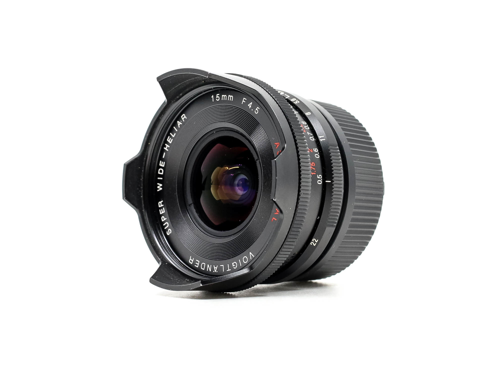
Voigtländer Super Wide-Heliar 15mm f/4.5 II
M mount
No listings tracked for this lens right now.
The Voigtländer Super Wide-Heliar 15mm f/4.5 II is a M-mount lens for Leica rangefinder cameras. Leica price index →
How it compares
Measured against the 5 other 15mm M-mount lenses in the catalogue.
Specification
About this lens
Voigtländer Super Wide-Heliar 15mm f/4.5 II
What sets this lens apart is how much ultra-wide coverage Cosina packed into so little space: at roughly 38 mm long, 59 mm in diameter, and about 156 g, the Super Wide-Heliar 15mm f/4.5 II remains one of the smallest 15 mm lenses ever made for full-frame use [1]. It was the version that finally brought a true Leica M bayonet and rangefinder coupling to a design that had previously existed only in screw mount, and that change, rather than any optical revision, is the headline of the second generation [2]. Sold under the full retail name Super Wide-Heliar 15mm f/4.5 Aspherical II (Cosina model code BA212M), it covers an extremely wide angle of view and uses a single aspherical element in its layout [3].
Optically the lens keeps the symmetrical, near-pancake formula of the original, an eight-element, six-group arrangement that is unchanged from the first M39 version. The barrel is all metal with engraved, paint-filled markings and even a red mounting index in the manner of Leica lenses; the focus ring carries a tab and rotates about 90 degrees from the 0.5 m minimum focus distance to infinity, while the aperture ring runs in half-stop clicks from f/4.5 to f/22 across roughly 80 degrees. A built-in, non-removable hood is part of the front of the lens, and unlike the screw-mount original this version adds a 52 mm filter thread and the rangefinder coupling, though a 15 mm field this wide still falls outside any built-in rangefinder finder and needs an external viewfinder for accurate framing. The minimum focusing distance was lengthened to 0.5 m, longer than the 0.3 m of the first version.
The second generation is easy to place within the family. The first lens was screw mount (M39 / LTM) with no rangefinder coupling, no filter thread, a tiny built-in hood, and a 0.3 m close-focus distance; the II reviewed here is the M-mount, rangefinder-coupled model with the 52 mm filter thread and larger built-in hood; and the later III moved to an 11-element, 9-group design with a 58 mm filter thread that was optimized for digital sensors and grew noticeably in size. Because the II is optically identical to the original and was discontinued when the III arrived, it is now found mainly on the used market. It was introduced in 2009, roughly a decade after the original screw-mount lens, which dates to the early years after Cosina licensed the Voigtländer name in 1999 [4].
Optical qualities
Rendering The II carries over the rendering of the symmetrical original, so its behavior is well documented through testing of this exact optical formula. It is praised for a strong balance of size, image quality, and price among ultra-wide rangefinder lenses [5].
Sharpness Center sharpness and contrast are high from f/4.5, while mid-frame and corners benefit from stopping down to about f/8 to f/11. Performance depends heavily on the camera: on a sensor with a thick filter stack the lens shows pronounced field curvature and weaker corners, whereas on the thinner-stack Leica M10 the mid-frame nearly matches the center and the corners are usable wide open, with peak across-frame results near f/8.
Distortion and vignetting Distortion is only minor, though slightly wavy, and a software profile corrects it reasonably well. Vignetting is heavy and changes little on stopping down, a known trait of compact symmetrical wide-angle designs; corner light falloff is roughly 3.8 EV wide open on one tested 42 MP sensor. The original screw-mount version was noted for low distortion and, in the M-mount era, relatively low color shift compared with earlier ultra-wides.
Flare resistance Flare control is reasonable for an ultra-wide; contrast holds up with the sun in or near the frame, but large, noticeable ghosts can appear, particularly in frames with dark areas.
Digital use On digital bodies the lens can show color cast from its near-symmetrical, short back-focus design, typically a green cast in the corners on some sensors and an asymmetric magenta cast on others, both correctable in post. The thinner filter stack of the Leica M10 suits it well, and some reviewers find it good enough there to question paying for the larger III. Coma is described as acceptable but better stopped down for night and cityscape work.
History
Development and Launch The Super Wide-Heliar lineage began in the screw-mount Cosina-Voigtländer era that followed Cosina's licensing of the Voigtländer brand in 1999, and the 15mm quickly became a favorite among Leica M shooters seeking an affordable, compact ultra-wide. The second version, launched in 2009, kept the optics intact but reworked the housing to add the native M bayonet, rangefinder coupling, a filter thread, and improved ergonomics, addressing the main limitations of the adapter-dependent screw-mount original [6].
Production Evolution Across its life the design changed mount and barrel rather than glass. The move from the first to the second version brought the M mount and rangefinder coupling, a larger built-in hood, the 52 mm filter thread, and a longer 0.5 m minimum focus distance, while the eight-element, six-group formula stayed the same. The optical recomputation came only with the III, which adopted an 11-element, 9-group layout tailored to digital sensors and a 58 mm filter thread.
Collector Notes Identification is straightforward from the barrel: the II carries M-mount bayonet, the 52 mm filter thread, and the larger built-in hood, distinguishing it from the screw-mount original and from the larger 58 mm-thread III. The built-in hood is not removable, which limits filter and square-filter use and has led some owners to have it professionally shaved down. Because a 15 mm angle of view is too wide for any rangefinder's built-in frame lines, a matching external optical finder is a key accessory to verify when buying, and on digital M bodies buyers should be prepared to manage color cast in post-processing.
Sources
- KJ Vogelius. Voigtländer 15/4.5 II Reviewgear.vogelius.se →
- BastianK / phillipreeve.net. Review: Voigtlander VM 15mm 4.5 II Super-Wide-Heliarphillipreeve.net →
- B&H Photo. Voigtlander Super Wide-Heliar 15mm f/4.5 Aspherical II Lens (BA212M)bhphotovideo.com →
- Photo Review. Voigtlander Super Wide-Heliar Aspherical II 15mm f/4.5 Lensphotoreview.com.au →
- Leica Rumors. My Muse: The 15mm f/4.5 Voigtlander Super Wide-Heliar III Lens Reviewleicarumors.com →
- Shoot It With Film. Voigtländer Super Wide 15mm Lens Reviewshootitwithfilm.com →
Where to buy
Related lenses
Similar lenses you might be interested in

Super Wide-Heliar 15mm f/4.5 III
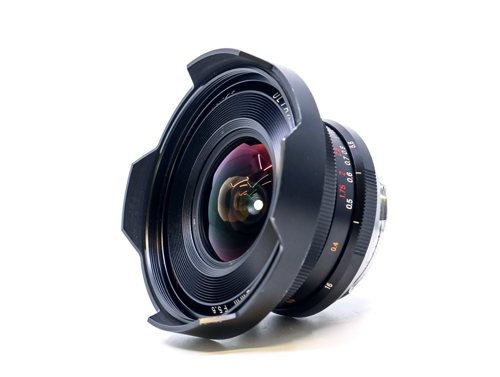
Ultra Wide-Heliar 12mm f/5.6 II
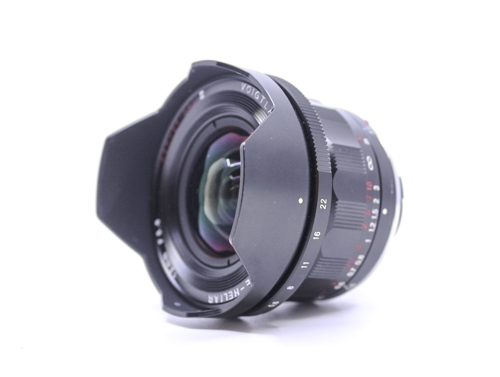
Ultra Wide-Heliar 12mm f/5.6 III
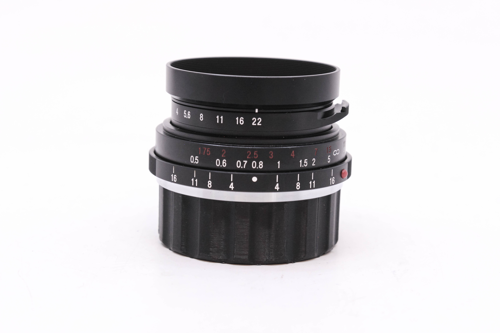
Color-Skopar 21mm f/4 P
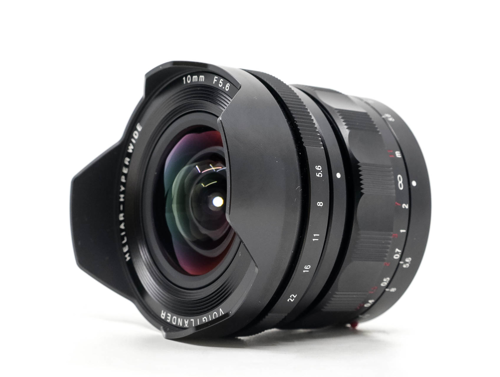
Hyper Wide-Heliar 10mm f/5.6
Comments