The Voigtländer Ultra Wide-Heliar 12mm f/5.6 II is a Cosina-made ultra-wide rectilinear prime in Leica M mount with rangefinder coupling, prized by M shooters.
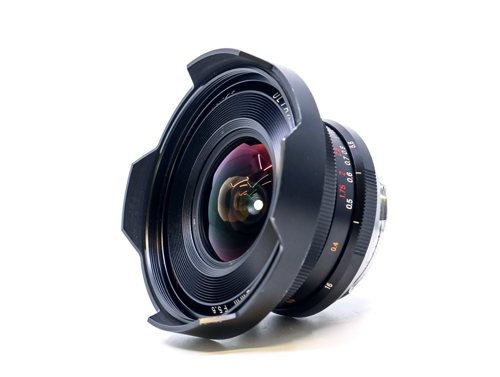
Voigtländer Ultra Wide-Heliar 12mm f/5.6 II
M mount
No listings tracked for this lens right now.
The Voigtländer Ultra Wide-Heliar 12mm f/5.6 II is a M-mount lens for Leica rangefinder cameras. Leica price index →
Specification
About this lens
Voigtländer Ultra Wide-Heliar 12mm f/5.6 II
When Cosina moved its 12mm Ultra Wide-Heliar from screw mount to a native bayonet, the resulting Version II became the first rangefinder-coupled iteration of one of the widest rectilinear lenses ever offered for a 35mm camera. Cosina produced the original 12mm in M39 screw mount without rangefinder coupling from 2000 to 2010, then the VM 12mm Version II in Leica M mount with rangefinder coupling from 2010 to 2016, before the Version III arrived for the 2016 to 2019 run. It sits between Cosina's later 10mm Hyper-Wide and the 15mm Super-Wide-Heliar in the brand's ultra-wide line, and is the version most associated with classic M handling because it added a coupled mount while keeping a conventional filter thread.
The optical layout carried over from the first model rather than being redesigned. The Version II retains the 10 element, 8 group formula unchanged from the Mark I, but switches to a non-removable hood, a 67mm filter thread, a minimum focus distance of 0.5 m, ten aperture blades, and a weight of 230 g. Build is the all-metal Cosina standard, with a broad, smoothly damped focus ring and a click-stopped aperture ring. Because the angle of view is so extreme, the lens intrudes heavily into the rangefinder window, so framing is normally done with an accessory optical finder or on the rear screen of a live-view body. The coupled mount allows the rangefinder mechanism to track focus, though at 12mm depth of field is so deep that zone focusing is usually sufficient. The M mount also adapts readily to mirrorless cameras.
Identification is straightforward against its siblings. The screw-mount original is lighter at 162 g with a 0.3 m minimum focus, nine blades and a removable hood, while the later Version III grew to 281 g, adopted a 12 element, 10 group design and dropped the filter thread entirely. The Version II is the only M-mount model that keeps a standard filter ring, which is a useful distinguishing feature when buying.
Optical qualities
Rendering The 12mm is a slow, very wide rectilinear lens whose character is defined more by perspective than by subject isolation. Detailed published testing of the optically identical later versions gives a reliable guide to behaviour: center and midframe perform well while the extreme corners benefit from stopping down but never become outstanding. Sharpness shows little change across the generations of this design.
Distortion and vignetting Distortion is low though slightly wavy. Heavy corner light falloff is typical of these compact M-mount ultra-wides, and stopping down does relatively little to reduce it.
Flare resistance Ghosting is largely a non-issue and only a specific sun position at the corner of the frame produces some veiling flare.
Digital use On modern Leica sensors the older M-mount ultra-wide-Heliars can show a magenta-to-cyan corner color cast. Cosina's stated reason for updating these Mark II ultra-wides was the "italian flag" color cast that appeared on Leica's sensors. For film M cameras or the BSI-sensor M11 the earlier versions are arguably the better choice given their similar optics, smaller size and filter threads, while on the M8, M9 and M10 the color cast must be managed in software.
History
Development and Launch The Leica M-mount Version II replaced the screw-mount original in 2010 and ran through 2016, adding rangefinder coupling while keeping the same optical formula. Phillip Reeve's review of the screw-mount lens notes that the newer Leica M version is optically the same, with differences beyond the mount itself.
Production Evolution Across the line the optics were carried unchanged from Mark I to Mark II, then revised for the Mark III with two additional elements; the Version II specifically introduced the M bayonet, the fixed hood, the 67mm filter thread, the 0.5 m minimum focus distance and a ten-blade diaphragm.
Special editions No widely documented factory special editions, military variants or unusual finishes of the Version II are recorded; it was produced in black.
Collector Notes The most common confusion is between the three 12mm generations. The Version II is distinguished from the screw-mount original by its M bayonet, coupled rangefinder, heavier weight and fixed hood, and from the Version III by its retained 67mm filter thread. The Mark III adds two more elements within the same group count for a cleaner Heliar design. Because all three share strong corner falloff and a green corner cast on some digital sensors, buyers pairing the lens with a Leica digital body should expect to correct color in post; the original and Version II remain comparatively affordable on the used market. As with any non-removable-hood ultra-wide, check the front element and coating for haze or cleaning marks before purchase.
Sources
- phillipreeve.net (Bastian Kratzke). Review: Voigtländer VM 12mm 5.6 Ultra-Wide-Heliar MK IIIphillipreeve.net →
- Casual Photophile. Voigtlander Ultra Wide-Heliar 12mm f/5.6 Aspherical III M Mount Lens Reviewcasualphotophile.com →
- phillipreeve.net. Review: Voigtländer 12mm 5.6 Ultra Wide Heliarphillipreeve.net →
Where to buy
Related lenses
Similar lenses you might be interested in

Comments