The Voigtländer Ultra Wide-Heliar 12mm f/5.6 III is a rangefinder-coupled M-mount ultra-wide lens, a short-lived 12-element redesign collectors now seek used.
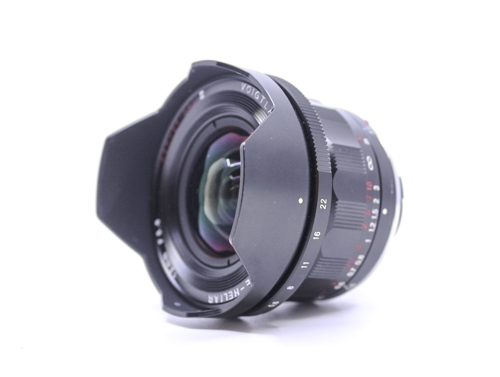
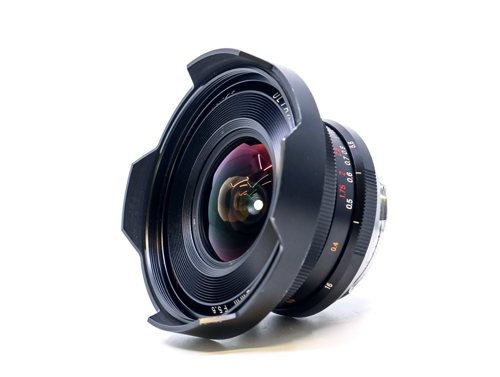
Voigtländer Ultra Wide-Heliar 12mm f/5.6 III
M mount
No listings tracked for this lens right now.
The Voigtländer Ultra Wide-Heliar 12mm f/5.6 III is a M-mount lens for Leica rangefinder cameras. Leica price index →
Specification
About this lens
Voigtländer Ultra Wide-Heliar 12mm f/5.6 III
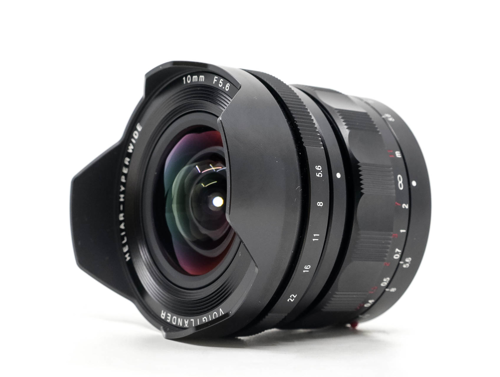
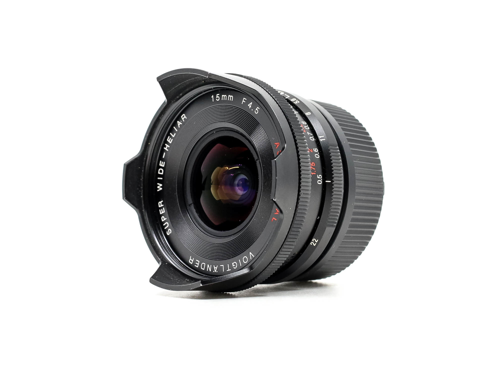
The Ultra Wide-Heliar 12mm f/5.6 III is the most thoroughly reworked member of Cosina's long-running 12mm Voigtländer line, and also the shortest-lived. It was one of three ultra-wide M-mount lenses Cosina released in the mid-2010s alongside the 10mm f/5.6 Hyper-Wide-Heliar and the 15mm f/4.5 Super-Wide-Heliar III, but unlike those two it was discontinued after only a few years on the market [1]. Its 121-degree rectilinear angle of view keeps straight lines straight rather than producing a fisheye effect, and the optical formula was revised to a twelve-element, ten-group design that incorporates an aspherical element to control spherical aberration and distortion, partly to better suit digital sensors[3].
The lens is rangefinder coupled and focuses to 0.5 m, with the focus ring moving roughly 90 degrees from the close limit to infinity and offering even resistance across its travel. The aperture ring uses half-stop clicks running from f/5.6 to f/22, and the barrel follows Cosina's usual anodized matte-black aluminium construction with engraved, paint-filled markings and a small red alignment dot. A petal-shaped lens hood is built into the front of the barrel, and as a result this version carries no filter thread. On a rangefinder body the lens produces noticeable rangefinder-window blockage, so framing in practice relies on an accessory viewfinder with 12mm lines or on live view, since the rangefinder patch cannot meaningfully aid focus at this focal length and aperture anyway[2]. Being an M-mount lens, it adapts readily to mirrorless bodies.
The "III" designation distinguishes this lens from earlier 12mm Heliars. The original 2000s lens used an LTM/M39 mount without rangefinder coupling, a 10-element design and a removable hood, while the second version moved to M-mount with rangefinder coupling, a 67mm filter thread and a fixed hood but retained the older optics. The Mark III broke from both by adopting the new twelve-element formula, dropping the filter thread, and growing noticeably larger and heavier than its predecessors. A Sony E-mount sibling sold concurrently appears to share the same optical block, differing mainly in mount, weight and a closer 0.3 m minimum focus distance. The M-mount III is engraved as an aspherical design, which is a useful identifier when separating it from the earlier versions.
Optical qualities
Rendering Reviewers describe a competent rather than spectacular ultra-wide. Center and mid-frame sharpness are good from wide open, while the extreme corners improve on stopping down but never become truly crisp.
Distortion and vignetting Distortion is low though slightly wavy, and software correction profiles exist for the E-mount version that can be applied to images from this lens. Vignetting is heavy and, as is typical of compact symmetric ultra-wides for M-mount, stopping down does little to reduce it; a slight green colour cast can appear in the corners on some sensors.
Flare resistance Flare control and coma correction are reported as strong points, and the lens renders defined sunstars when stopped down.
Aberrations Correction of lateral chromatic aberration is regarded as average for the type.
Digital use The lens performs similarly on a Leica M10 and on a higher-resolution Sony sensor with a thicker filter stack, aside from a more pronounced mid-zone dip, which supports the view that the M and E versions share the same optics.
History
Development and Launch Cosina introduced the Ultra Wide-Heliar 12mm f/5.6 III around 2016 as part of a cluster of ultra-wide M-mount Heliars, sitting between the record-setting 10mm f/5.6 and the more practical 15mm f/4.5. The redesign aimed at improved behaviour on digital bodies, hence the new aspherical formula optimised for sensor use.
Production Evolution Across its lineage the 12mm Heliar changed mount, coupling, optical formula and physical size. The III specifically introduced the twelve-element, ten-group aspherical design, removed the filter thread in favour of a built-in petal hood, and was the bulkiest of the family. It remained in production only briefly before being dropped, while the related 10mm and 15mm lenses continued for years afterward.
Special editions No widely documented factory special editions, finishes or commemorative variants of the 12mm f/5.6 III are recorded. The most relevant parallel variant is the Sony E-mount version sold at the same time, which is a different mount rather than a limited edition.
Collector Notes Because three generations of 12mm Heliar exist, buyers should confirm they are getting the M-mount III: it is rangefinder coupled, has no filter thread, carries a fixed petal hood and is engraved as an aspherical lens, which separates it from the screw-mount original and the filter-threaded II. The lack of filter thread means an accessory clamp or external finder is the usual companion, and a 12mm-line viewfinder is worth sourcing for rangefinder use. Its short production run has made the III comparatively scarce on the used market, where it typically appears alongside its more popular 10mm and 15mm siblings.
Sources
- Phillip Reeve (Bastian Kratzke). Review: Voigtländer VM 12mm 5.6 Ultra-Wide-Heliar MK IIIphillipreeve.net →
- Casual Photophile. Voigtlander Ultra Wide-Heliar 12mm f/5.6 Aspherical III M Mount Lens Reviewcasualphotophile.com →
- B&H Photo Video. Voigtlander Ultra Wide-Heliar 12mm f/5.6 Aspherical III (BA335A)bhphotovideo.com →
Where to buy
Related lenses
Similar lenses you might be interested in

Comments