A collapsible Japanese 50mm f/3.5 standard lens in coupled Leica M39 mount, offered with Reise-built Chiyoca IIF rangefinders from 1952.
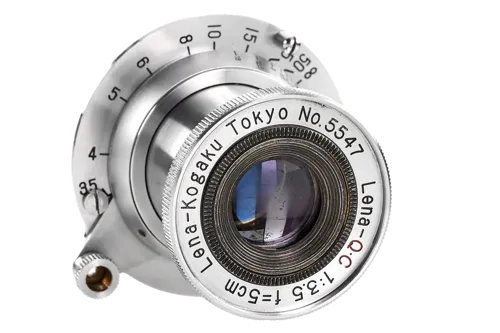
Lena Kogaku Lena-Q.C 50mm f/3.5 (Collapsible)
LTM mount
No listings tracked for this lens right now.
The Lena Kogaku Lena-Q.C 50mm f/3.5 (Collapsible) is a LTM-mount lens for Leica rangefinder cameras. Leica price index →
How it compares
Measured against the 108 other 50mm LTM-mount lenses in the catalogue.
Specification
About this lens
Lena-Q.C 50mm f/3.5 (Collapsible)
The Lena-Q.C 50mm f/3.5 is a Japanese collapsible standard lens made by Lena Kogaku for Leica-thread rangefinder cameras. It is documented as one of the 50mm f/3.5 lenses offered with the Chiyoca IIF, a coupled-rangefinder Leica copy introduced in 1952. The lens uses the Leica 39mm screw mount and has a mechanical rangefinder cam, allowing focusing to operate with a properly adjusted compatible body. Its retractable barrel reduces the depth of the camera-and-lens combination for storage.
Leitz Auction describes the Lena-Q.C as a Japanese copy of the Leitz Elmar 50mm f/3.5. That comparison establishes the intended market position and general collapsible format, but it does not by itself prove an identical optical formula. No accessible factory diagram or independent teardown has been found for this exact Lena-Q.C version. The element and group count therefore remain unconfirmed. The same caution applies to the diaphragm-blade count, closest-focus distance, filter fitting, coating specification, weight, and complete aperture range.
The 50mm focal length matches the normal view of early Leica-style finders, while f/3.5 kept the cell compact. The lens can be adapted to mirrorless cameras without electronic communication. Rangefinder accuracy, infinity calibration, and safe retraction depend on the individual lens and body.
Optical qualities
Rendering
There is no published manufacturer test or controlled modern comparison that supports a fixed rendering description for every Lena-Q.C. The lens belongs to the compact f/3.5 standard-lens class, but its exact formula has not been securely documented. It should not be assigned four elements in three groups merely because an auction catalogue calls it an Elmar copy. That language may refer to its role and constructional appearance as much as to the internal glass arrangement.
This 50mm f/3.5 class places compactness ahead of very shallow depth of field. Stopping down generally improves early standard lenses, but centre-to-corner behaviour requires testing. Decentring, incorrect tube extension, haze, and rangefinder error can all be mistaken for optical character.
Contrast and flare
The suffix “Q.C” is engraved on the lens, but the sources do not explain it or specify a coating. It should not be expanded into a technical claim. Old or uncoated surfaces may lose contrast in backlight, while haze, cleaning marks, and internal blackening can dominate present-day results. A small hood may help if it does not obstruct the finder.
Out-of-focus rendering
The modest aperture limits blur compared with faster 50mm lenses. No dependable blade count or controlled highlight study has been located, so terms such as smooth, busy, or swirled remain sample-specific. Close focus should be read from the actual scale.
History
Development and Launch
Pacific Rim Camera's Chiyoca history places the lens in a clear postwar sequence. Chiyoca Shoki, a Tokyo camera shop, contracted Reise Camera Company to manufacture Leica-style cameras carrying the Chiyoca name. The first Chiyoca 35 appeared in 1951, followed by the flash-synchronized 35 IF in 1952. Later that year the Chiyoca IIF added a coupled rangefinder, and the Lena-Q.C and Reise Q.C, both collapsible 50mm f/3.5 lenses, were offered for that model.
This chronology conflicts with Leitz Auction's estimate of circa 1935. The same auction entry also calls the Lena-Q.C a standard lens for early Chiyoca cameras, but the Chiyoca camera line described by the specialist reference did not begin until 1951. In the absence of period evidence for a 1930s Lena-Q.C, the 1952 Chiyoca IIF association is the more coherent date and is used here. The auction remains useful for confirming Lena Kogaku, the M39 fitting, and rangefinder coupling.
Production Evolution
The Lena-Q.C was one of two documented standard lenses at the IIF stage. Chiyoca Shoki marketed the camera, Reise built bodies, and specialist firms supplied optics. The record does not show how long Lena Kogaku produced this lens or whether its optical cell changed.
In 1954 Chiyoca changed to Chiyotax, reportedly to avoid confusion with Minolta's Chiyoko trademark, and the trade name ended in 1956. No source shows that every later package used the Lena-Q.C, so its firm association remains the Chiyoca IIF.
Special Editions/Variants
The Reise Q.C is a separate named lens, not a proven engraving variant. Both were collapsible 50mm f/3.5 options, but their maker names matter. No factory sequence turns observed Lena-Q.C engraving or finish differences into dated versions.
Collector Notes
Identification should preserve the full Lena-Q.C name, Lena Kogaku attribution, collapsible construction, and coupled M39 fitting. A damaged infinity lock on an auction lens is a condition issue, not a standard feature. Before use, check tube locking, cam movement, and infinity calibration. Photographs and measurements of unmodified examples are more useful than unverified Elmar specifications.
Sources
Where to buy
Related lenses
Similar lenses you might be interested in
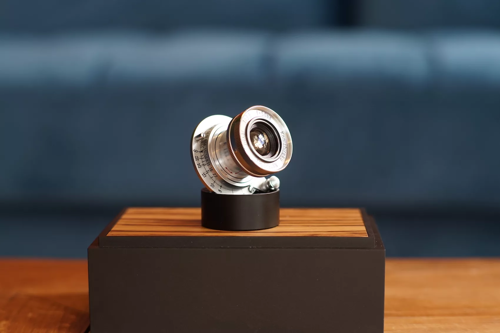
Hexar 50mm f/3.5
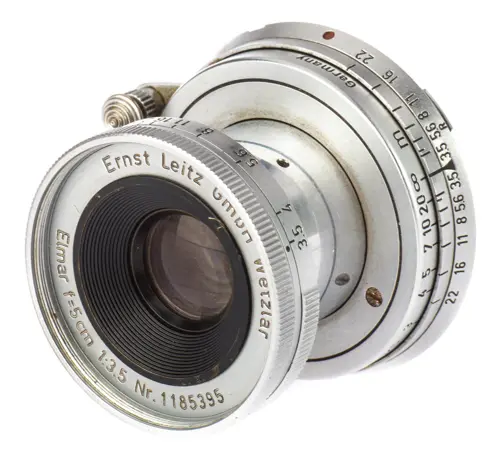
Elmar 50mm f/3.5 M (1954)
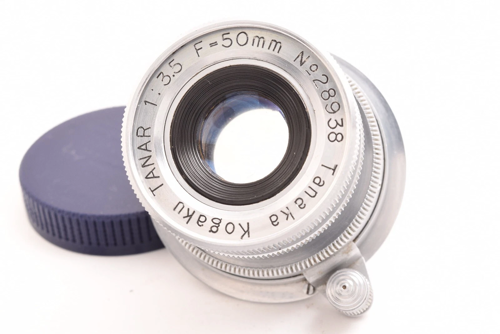
Tanar 50mm f/3.5
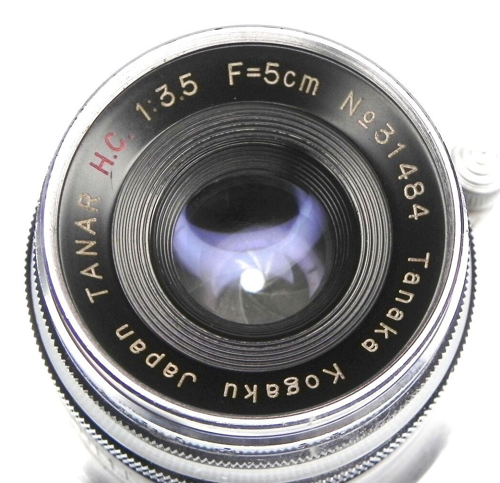
Tanar 50mm f/3.5 H.C. Close Focus
Comments