Best price Excellent
Leica Summicron-M 28mm/F2.0 ASPH Black 6 bit 11604 #23856
Sold by M&K Kamera
€2,218 ≈ $2,396
The Leica Summicron-M 28mm f/2 ASPH. I (11604) was the first f/2 wide-angle Summicron in M mount, a compact, fast 28mm prized by reportage shooters.
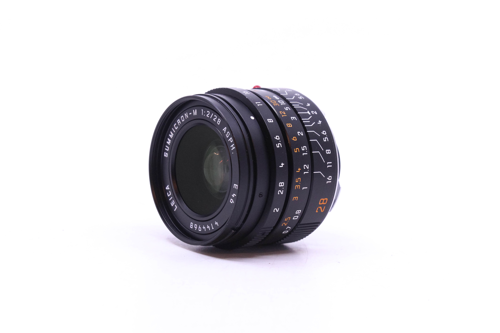
M mount
The Leica Summicron-M 28mm f/2 ASPH. I is a M-mount lens for Leica rangefinder cameras. As of October 2026, it sells from €2,218 used across 6 listings, with a 30-day median of €2,845. Leica price index →
Measured against the 37 other 28mm M-mount lenses in the catalogue.
When Leica brought the Summicron name to the 28mm focal length in 2000, it produced the first f/2 lens at that angle of view in the M system, giving reportage and street photographers a fast, compact wide-angle that sat between the slower 28mm Elmarit and the later 28mm Summilux [1][2]. This first version, model 11604, established the optical layout that Leica would carry forward through every subsequent 28mm Summicron: nine elements arranged in six groups, with one or more aspherical surfaces and a ten-blade diaphragm. It arrived before Leica's M cameras went digital, so the design priorities were film-era performance and a small barrel that suited the compact M bodies of the period.
The lens is built to the standard of its era: a short, all-metal barrel roughly 40 mm long and about 53 mm in diameter, weighing around 270 g, with engraved and paint-filled markings in Leica's typeface [3]. It focuses down to 0.7 m, couples to the rangefinder mechanically, and takes 46 mm screw-in filters, a thread it shares with several other Leica ASPH primes of the time. Aperture is set by a click-stopped ring driving the ten-blade diaphragm, and the M bayonet allows use across the full range of M cameras. This first version was supplied with a large plastic clip-on hood that reviewers have criticised as bulky and prone to intruding into the rangefinder/viewfinder frame.
The 11604 is the first of three generations of the 28mm Summicron. It was followed in 2016 by the second version, model 11672, which was launched alongside revised 28mm Elmarit and 35mm Summilux lenses; that update brought a much-improved metal screw-in hood and a reworked optical formula intended to flatten the field and lift edge and corner resolution, while keeping the same nine-element, six-group, ten-blade architecture. A third version, the close-focus 11618, continued the same basic optical scheme with further refinements. Within the first generation, LeicaLensList records the lens under model numbers 11604 and 11661; later Leica documentation also notes six-bit coding for in-body lens recognition, which owners of early uncoded examples sometimes had added during service.
Rendering Reviewers describe the first 28mm Summicron as a sharp, cleanly drawing wide-angle with a distinctive signature for its class. Detailed sourced commentary is limited to a handful of user reviews rather than published lab data, so the notes below reflect repeated observation rather than measured results.
Sharpness The lens is reported to be sharp even wide open at f/2, with good central resolution from maximum aperture.
Contrast and color Contrast is characterised as moderate rather than extreme for an aspherical design, holding detail in both highlights and shadows.
Bokeh and transitions For a wide-angle optic the out-of-focus rendering is regarded as smooth, giving usable subject separation with transitions between in- and out-of-focus planes that stay largely soft while retaining some structure.
Flare resistance The 11604 is noted for low flare and ghosting, though the later 11672 is said to handle stray light even better thanks to its refined formula.
Distortion and vignetting A slight darkening of the corners is visible at f/2 and clears as the lens is stopped down; geometric distortion is reported as well controlled.
Development and Launch The Summicron-M 28mm f/2 ASPH. arrived in 2000 as the first f/2 lens of its focal length in the M lineup, extending the high-speed Summicron family into the wide-angle range and answering demand for a fast 28mm suited to documentary work. The nine-element, six-group optical design with aspherical correction was set at this launch and proved durable enough to underpin later versions.
Production Evolution The 11604 was produced through the first half of the 2000s. Its successor, the 11672, appeared in 2016 with a redesigned metal screw-in hood replacing the original's large plastic one and a revised optical formula aimed at improving edge and corner performance, while keeping the nine-element, six-group layout and ten-blade diaphragm; a later close-focus version, the 11618, followed the same lineage.
Collector Notes The most reliable identifiers for the first version are its model number, 11604, and the original bulky plastic hood, which distinguishes it from the metal-hooded 2016 version. Buyers should check focus and aperture smoothness and the condition of the optics, since serviced examples often note refreshed mechanics, and confirm whether an individual lens received factory six-bit coding, as early units were not coded from the outset. As with most M lenses, originality of hood, caps and box affects collector value, and the 46 mm filter thread is worth verifying for interchangeability with other Leica ASPH primes.
Good time to buy. The lowest listing is 22% below the 30-day average.
Lowest price Click a mark to open that listing · arrow keys to step, Enter to open
Price against condition for 6 listings of Leica Summicron-M 28mm f/2 ASPH. I, €2,218 to €5,612, median €2,806. New: 1 at €5,612. Excellent: 5 at €2,218, €2,218, €2,806, €2,806, €4,460. The full table follows.
| Condition | Lowest | Median |
|---|---|---|
| New | €5,612 | €5,612 |
| Excellent | €2,218 | €2,806 |
Over the last 18 weeks the median price for the Leica Summicron-M 28mm f/2 ASPH. I has risen, ranging from €1,954 to €2,867 (now €2,845).
Weekly price (EUR). Median (Good or better) and lowest (Good or better) across 18 weeks. The full figures follow in the table below.
| Week | Median | Lowest |
|---|---|---|
| Jun 1, 2026 | €2,594 | €2,220 |
| Jun 8, 2026 | €2,988 | €2,220 |
| Jun 15, 2026 | €2,867 | €2,594 |
| Jun 22, 2026 | €2,594 | €2,325 |
| Jun 29, 2026 | €3,916 | €2,590 |
| Jul 6, 2026 | €2,221 | €1,853 |
| Jul 13, 2026 | €1,853 | €1,853 |
| Jul 20, 2026 | €1,853 | €1,853 |
| Jul 27, 2026 | €2,486 | Unknown |
| Aug 3, 2026 | €2,365 | €1,983 |
| Aug 10, 2026 | €2,365 | €1,983 |
| Aug 17, 2026 | €2,510 | €1,983 |
| Aug 24, 2026 | €2,510 | €1,983 |
| Aug 31, 2026 | €2,679 | €1,983 |
| Sep 7, 2026 | €2,773 | €1,983 |
| Sep 14, 2026 | €2,810 | €2,219 |
| Sep 21, 2026 | €2,773 | €2,219 |
| Sep 28, 2026 | €2,806 | €2,218 |
Every shop grades differently. Leica Classic uses letters, Ffordes uses E++ and E+, German dealers write "Zustand B", Japanese dealers write A−. We map all of them onto the one ladder below. Where a shop states its own grade, we print it under ours.
As of October 2026, the Leica Summicron-M 28mm f/2 ASPH. I sells from €2,218 used, with a 30-day median of €2,845, across 6 active listings.
As of October 2026, the Leica Summicron-M 28mm f/2 ASPH. I is sold by 3 sources (6 listings), from €2,218 used: all compared cheapest-first on this page.
Similar lenses you might be interested in
Comments