A circa-1951 Italian 50mm f/3.5 collapsible Tessar-type standard lens in coupled Leica M39 mount, made for AFIOM's Kristall rangefinders.
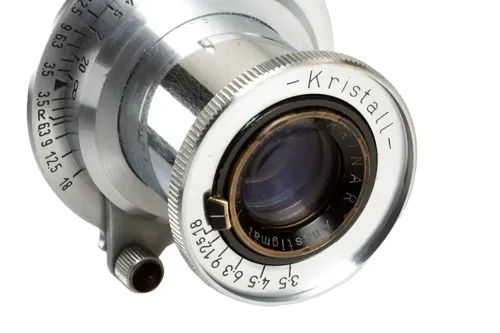
Kristall Krinar Anastigmat 50mm f/3.5 (Collapsible)
LTM mount
No listings tracked for this lens right now.
The Kristall Krinar Anastigmat 50mm f/3.5 (Collapsible) is a LTM-mount lens for Leica rangefinder cameras. Leica price index →
How it compares
Measured against the 108 other 50mm LTM-mount lenses in the catalogue.
Specification
About this lens
Krinar Anastigmat 50mm f/3.5 (Collapsible)
The Krinar Anastigmat 50mm f/3.5 is an Italian collapsible standard lens associated with the AFIOM Kristall family of Leica-style 35mm rangefinder cameras. Leitz Auction dates a documented rangefinder-coupled example to circa 1951 and identifies it as the standard lens for the Kristall. The later Kristall 53 of 1953 is also documented with a Krinar 50mm f/3.5, showing that the name remained in use across more than one Kristall model. The lens uses the Leica 39mm screw fitting and a retractable chromium-plated barrel.
Lens DB describes the Krinar fitted to the Kristall 53 as a Tessar construction and states that its surfaces were coated. In conventional terminology, a Tessar type uses four elements in three groups, with a cemented pair behind the diaphragm. That construction is consistent with Leitz Auction's independent description of the lens as “Elmar type,” since the Leitz Elmar belongs to the same broad four-element, three-group family. The maximum aperture is f/3.5. Accessible sources do not securely establish the blade count, full aperture scale, filter thread, weight, or close-focus limit for every Krinar version.
The lens focuses manually and couples to a correctly adjusted Leica-thread rangefinder. Its barrel must be fully extended and locked for use. L39 adapters permit mirrorless mounting without electronics, but retraction clearance and infinity calibration must be checked.
Optical qualities
Rendering
The four-element Tessar pattern combines a separated front pair with a cemented rear pair and was widely used for compact standard lenses. No Krinar resolution chart or controlled multi-sample test has been found, so a numerical performance level or guaranteed visual signature would be unsupported.
At f/3.5, residual aberrations may be more visible away from the centre than after stopping down. This is a design-level expectation, not proof of one sample's performance. Correct tube extension, cell spacing, and centring remain essential.
Contrast and colour
Lens DB states that the Kristall 53 Krinar was coated on all surfaces. This reduces reflection losses, but the source documents no separate coating generations or colour formulation. A hood remains useful, and low contrast should first prompt inspection for haze, cleaning damage, or internal reflections.
Out-of-focus rendering
The 50mm focal length allows some separation at short distances, although less than a fast normal lens. Diaphragm construction is not reliably documented, so bokeh claims should be tied to a known sample and aperture. Tessar construction alone does not determine defocus character.
Distortion and vignetting
No measured distortion or vignetting figures have been found. Some corner darkening may occur at full aperture and improve on stopping down, but the degree requires a test of the exact version.
History
Development and Launch
Domenico Chinaglia's Belluno operation entered the postwar Italian market for Leica-style cameras around 1949 or 1950. These cameras were sold under the Kristall name, and the Krinar provided a domestic 50mm standard-lens option. Leitz Auction's circa-1951 dating places the rangefinder-coupled lens near the beginning of that family. Christie's later catalogued a Kristall 53 with the same Krinar name, while an Italian camera reference dates the Kristall 53 and its 50mm f/3.5 Krinar to 1953.
AFIOM identifies the enterprise associated with the early Kristall system, while Domenico Chinaglia was the manufacturer behind the camera line. Krinar belongs to this Italian Leica-copy context and is not a generic name for every similar 50mm f/3.5 lens.
Production Evolution
The circa-1951 example and 1953 camera association indicate continuity without proving that every detail remained unchanged. Lens DB describes the Kristall 53 lens as coated, Tessar construction, and retractable; Leitz Auction confirms an Elmar-type coupled lens from circa 1951.
Steinar and Trixar standard lenses also appear in the Kristall and AFIOM record. Similar focal length and aperture do not make those names interchangeable, so specifications should not be transferred without period evidence.
Special Editions/Variants
The Krinar is documented on an early Kristall and the Kristall 53. Examples may differ in finish, scales, or small barrel details, but no factory chronology turns these observations into formal editions.
Collector Notes
Identification rests on the Krinar Anastigmat name, 50mm f/3.5 specification, retractable barrel, and coupled Leica screw fitting. M39 threading alone does not prove correct registration. Check tube locking, infinity calibration, the cemented group, and surface condition. Auction reports apply only to the object sold, while production quantity and formal rarity remain undocumented.
Sources
Where to buy
Related lenses
Similar lenses you might be interested in
Hexar 50mm f/3.5
Elmar 50mm f/3.5 M (1954)
Tanar 50mm f/3.5
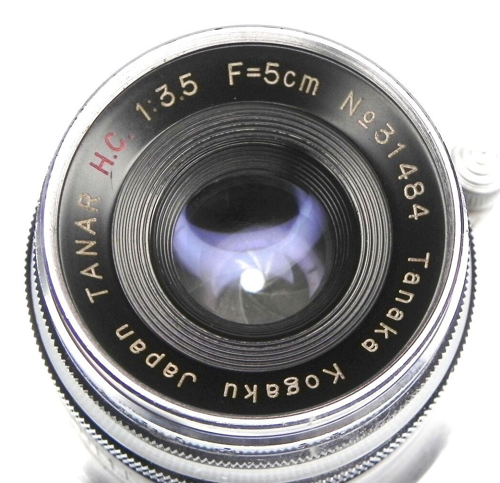
Tanar 50mm f/3.5 H.C. Close Focus
Comments