A 1957 Japanese Kowa 35mm f/2.8 wide-angle in coupled Leica M39 mount, with a six-element, four-group design, 3.5ft focus and E34 filters.
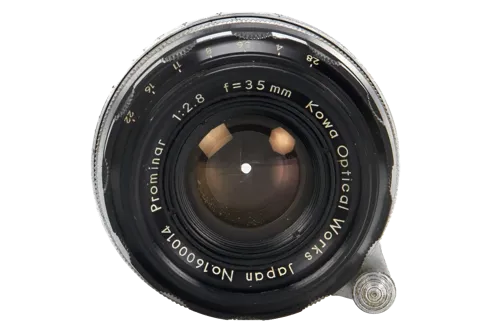
Kowa Prominar 35mm f/2.8
LTM mount
No listings tracked for this lens right now.
The Kowa Prominar 35mm f/2.8 is a LTM-mount lens for Leica rangefinder cameras. Leica price index →
How it compares
Measured against the 45 other 35mm LTM-mount lenses in the catalogue.
Specification
About this lens
Prominar 35mm f/2.8
The Kowa Optical Works Prominar 35mm f/2.8 is a Japanese wide-angle lens announced in 1957 for Leica-thread rangefinder cameras. Lens DB records a six-element, four-group optical construction, a closest focusing distance of 3.5 feet, and an E34 filter fitting. OstLicht documents the lens in Leica M39 mount with mechanical rangefinder coupling and dates a photographed example to 1959. Taken together, the sources place the model in the late 1950s, with 1957 as the launch year and surviving production represented around 1959.
The lens is a rigid, manually focused 35mm optic. Its rangefinder cam transfers focus movement to a compatible camera, while composition requires a 35mm finder or matching frame lines because many early screw-mount bodies have a built-in finder intended for 50mm. The maximum aperture is f/2.8. Lens DB's compact specification line is the stronger model-specific source for the optical formula and front fitting; a modern retail page that lists five elements in three groups and a 40.5mm filter appears inconsistent with the documented E34 lens and is not used here.
Compatibility depends on correct flange registration and cam adjustment. An L39 adapter permits mirrorless use, with focus checked from the sensor image and no electronics. A screw-to-bayonet adapter can mount it on Leica M cameras, but frame-line selection depends on the adapter and body.
Optical qualities
Rendering
The six-element, four-group construction differs materially from the five-element specification repeated by some seller pages. No factory performance chart or controlled multi-copy comparison has been found, so the formula does not support claims of superiority. It does show a purpose-built wide-angle design rather than a basic standard lens repackaged under another name.
At f/2.8, oblique rays make corner correction more difficult than central correction. Stopping down generally improves evenness and vignetting, but the optimum aperture is undocumented. Rangefinder calibration still matters at close distance and maximum aperture.
Contrast and flare
The sources give no formal coating name or transmission value. Surface reflections may suggest coating, but do not establish a uniform specification. Flare, lost internal blackening, and haze can reduce contrast. An E34 hood is useful when it does not intrude into the finder.
Distortion and vignetting
No measured distortion figure is available. Straight-line rendering, corner shading, and digital colour behaviour require testing on the exact camera because sensor-cover glass can interact with oblique rays differently from film.
Out-of-focus rendering
Near its 3.5-foot limit the lens offers moderate separation, but its role is wide-angle coverage rather than extreme blur. The blade count is not securely established, so highlight shape and transitions should be described only from images with known aperture and lens condition.
History
Development and Launch
Kowa's optical division emerged from the company's postwar diversification. The firm's official optical history records the Kalloflex I in 1954 as its first camera and the establishment of Kowa Optical Corporation in New York in 1955. Within that expansion, the Prominar name was used for photographic optics and later remained associated with Kowa's premium optical products. The 35mm f/2.8 LSM lens was announced in July 1957 according to Lens DB.
Leica M39 gave Kowa access to Leica bodies and compatible Japanese rangefinders, while the coupled cam integrated focusing with the camera. Its 35mm view complemented the 50mm lenses commonly supplied with these bodies.
Production Evolution
Lens DB gives a 1957 announcement, while OstLicht dates a documented example to 1959. These can represent introduction and later production. OstLicht also reported about one hundred made, but no factory register or independent table was found, so that figure is not treated as confirmed.
Prominar also appeared on fixed-lens Kowa cameras and later systems. Shared branding or focal length does not prove identical optics. Specifications from a Kallo or another Kowa 35mm lens cannot replace the six-element, four-group, E34 data for this Leica-thread model.
Special Editions/Variants
Leica-thread examples are seen in black-and-chrome finish. No authoritative source defines separate optical generations, editions, or coating changes. Finish and engraving differences alone do not demonstrate a revised formula.
Collector Notes
Identification should include the Prominar name, 35mm f/2.8 specification, Kowa attribution, coupled M39 mount, and E34 fitting. Seller pages sometimes combine data from other Kowa lenses, likely causing the conflicting five-element and 40.5mm specification. Check infinity, close focus, haze, separation, and aperture operation. Scarcity and production claims require factory evidence; auction condition describes only the example sold.
Sources
Where to buy
Related lenses
Similar lenses you might be interested in
Comments