A 1954 Japanese 35mm f/2 wide-angle with seven elements in five groups, coupled Leica M39 focusing, 1.07m close focus and E40.5 filters.
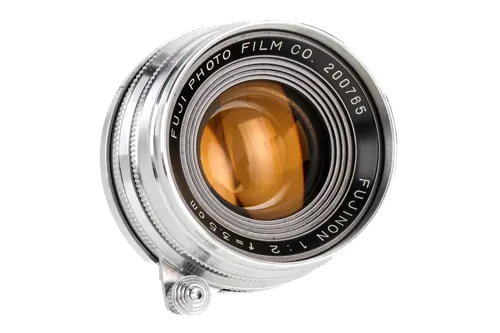
Fujifilm Fujinon 35mm f/2
LTM mount
No listings tracked for this lens right now.
The Fujifilm Fujinon 35mm f/2 is a LTM-mount lens for Leica rangefinder cameras. Leica price index →
How it compares
Measured against the 45 other 35mm LTM-mount lenses in the catalogue.
Specification
About this lens
Fujifilm Fujinon 35mm f/2
The Fujifilm Fujinon 35mm f/2 is a Japanese wide-angle lens made in an original Leica 39mm screw mount. Lens DB dates the model to 1954 and records seven elements in five groups, a 3.5-foot minimum focusing distance, and an E40.5 filter thread. A documented factory example confirms that the focusing mount operates the camera's rangefinder rather than functioning as a scale-focus or later adapted barrel.
The f/2 maximum aperture made this a comparatively fast 35mm option for screw-mount rangefinder photography. Its angle of view is substantially wider than a 50mm standard lens while remaining practical for general reportage, travel, and environmental portraiture. On a compatible Leica-thread camera, focusing runs from approximately 1.07 metres to infinity through a mechanical cam.
Fuji Photo Film supplied both the optical unit and the factory mount. This profile is limited to the original coupled LTM lens and does not cover the modern Fujinon XF 35mm f/2, fixed-camera Fujinon lenses, or optical cells installed in aftermarket mounts. Reliable sources used here do not establish the diaphragm-blade count, weight, barrel dimensions, or a complete production chronology.
Optical qualities
Rendering
The seven-element, five-group construction is a relatively complex formula for a compact 1950s rangefinder wide-angle. The cited sources do not provide an optical diagram or assign it to a named design family, so it should not be labelled a specific Gauss or retrofocus derivative without further documentation. No factory MTF chart or controlled comparison of multiple examples has been located.
At f/2, focus accuracy, element centring, and optical condition can have a pronounced effect on the result. Stopping down normally improves field evenness and reduces the visibility of residual aberrations, but the exact progression across the frame should be judged from a verified example. Statements about universal corner softness or exceptional sharpness are not supported by the model records alone.
Contrast and flare
Surviving lenses show period coatings, but the sources used here do not name a coating process or prove that every production year used an identical treatment. A 35mm lens includes a relatively broad field around the image area, making internal blackening and hood design relevant in oblique light. Haze, cleaning marks, coating damage, and reflective wear inside the barrel can lower contrast more than the original formula itself.
Out-of-focus rendering
The f/2 aperture permits visible subject separation at closer distances, although a 1.07-metre minimum limits the largest possible blur compared with a modern close-focusing 35mm lens. No dependable blade count or systematic highlight study has been found. Defocus shape and transition character should therefore be described from photographs made at a known aperture, not inferred from the Fujinon name.
Rangefinder and digital use
Accurate wide-open use depends on agreement between the lens cam, camera roller, and film plane. The native Leica screw mount can also be used on an M body with a suitable LTM-to-M adapter. An adapter changes the bayonet interface but does not correct a worn cam or incorrect infinity setting. Mirrorless live view can separate optical performance from rangefinder calibration, provided the adapter has accurate flange depth.
History
Development and Launch
Fujifilm's official history records the construction of an optical-glass factory at Odawara in 1940 for photographic glass and camera lenses. This established the industrial base from which Fuji Photo Film developed postwar Fujinon optics. The 35mm f/2 LSM appeared in 1954, placing it in the company's early period of interchangeable 35mm rangefinder-lens production.
The use of the Leica screw standard allowed Fuji to address an established international camera system without requiring a proprietary body. Its rangefinder cam and dedicated focusing mount distinguish it from a lens head or workshop conversion. The f/2 speed also placed it above slower compact wide-angles in low-light capability, although no original price list has been found for this audit.
Production Evolution
Leitz Auction documents an original coupled example dated 1961. That record demonstrates that a factory Fujinon 35mm f/2 in M39 existed at that date, but one auction example does not by itself prove uninterrupted production from 1954 to 1961. No authoritative serial table, annual output, or optical-revision schedule has been located.
Engraving and finish details may vary between surviving lenses. Such differences should not be promoted to separate generations unless period catalogues or multiple consistently dated examples support the distinction. The seven-element, five-group specification, E40.5 front thread, and 3.5-foot focusing limit are the better-supported model identifiers.
Special Editions/Variants
No formally named editions are established in the cited sources. Accessories such as a maker's hood, caps, box, or inspection tag can document an individual set, but they do not define a separate optical version. The later Fujinon L 50mm lenses and other Fuji screw-mount focal lengths belong to the same broad system history, not to this 35mm profile.
Collector Notes
Identification should combine the Fujinon 3.5cm or 35mm f/2 marking, Fuji attribution, coupled Leica M39 mount, 40.5mm front thread, and approximately 3.5-foot focusing limit. Confirm that the rangefinder cam moves smoothly and agrees with the camera at infinity and closer distances. A lens can mount correctly while remaining mechanically misregistered.
Inspect the optics for haze, separation, coating wear, cleaning damage, and decentring. Do not transfer specifications from the modern Fujinon XF 35mm f/2 or an unrelated fixed-lens Fuji camera.
Sources
Where to buy
Related lenses
Similar lenses you might be interested in
Comments