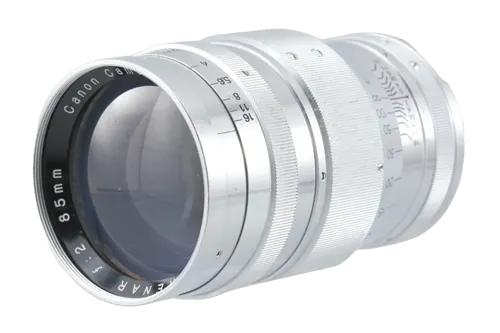
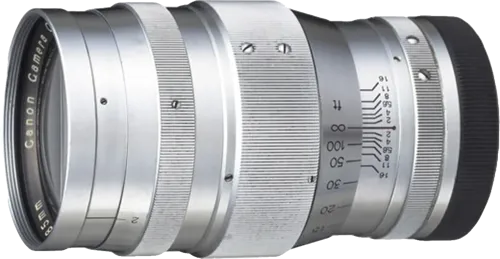
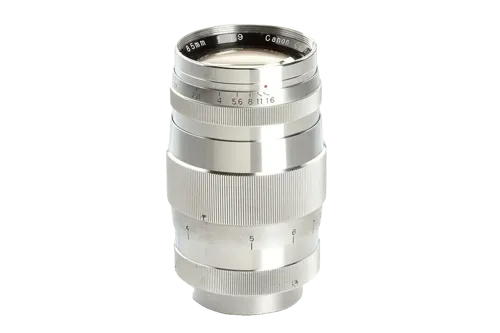
A late-1940s coupled 85mm f/2.8 LTM portrait lens for the Minolta-35, with five elements, ten blades and several documented chrome barrel revisions.
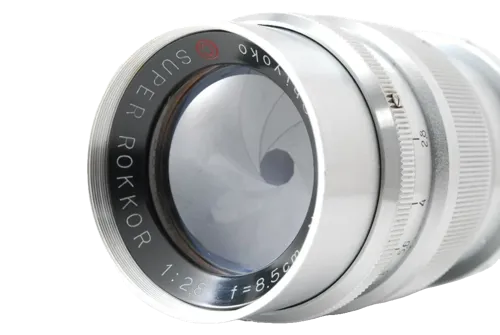
Chiyoda Kogaku Super Rokkor 85mm f/2.8
LTM mount
No listings tracked for this lens right now.
The Chiyoda Kogaku Super Rokkor 85mm f/2.8 is a LTM-mount lens for Leica rangefinder cameras. Leica price index →
How it compares
Measured against the 14 other 85mm LTM-mount lenses in the catalogue.
Specification
About this lens
Chiyoda Kogaku Super Rokkor 85mm f/2.8
The Chiyoda Kogaku Super Rokkor 85mm f/2.8 is an early short-telephoto lens for the Minolta-35 rangefinder system. Period lenses commonly carry the Chiyoko brand and express the focal length as 8.5cm. This profile covers the native Leica-standard screw-mount version with its own focusing helicoid and mechanical rangefinder coupling, not a later body-focused Minolta bayonet lens.
The optical system is documented as five elements in three groups and remains associated with the known chrome barrel revisions. The diaphragm uses ten blades and a 40mm filter thread is consistently reported. The minimum aperture is given as f/22 in brochure-derived research but as f/16 in an exact-lens test, while close focus is reported as 1.3 metres and 1.35 metres respectively. These differences may reflect production generations or measurement conventions, so they should not be collapsed into one universal specification. Published length and weight figures also vary and should be tied to a specific barrel generation.
The lens is fully manual. Focusing is performed on the lens, the rangefinder cam transfers distance to a compatible body and the aperture is set directly on the barrel. Its 85mm field of view normally requires a separate finder on classic LTM cameras. Leica M use requires an LTM-to-M adapter that selects an appropriate telephoto frame, although an 85mm field does not correspond exactly to every M body's available framelines.
The coupled screw-mount construction is collector-relevant. Similar Super Rokkor names appear on standard lenses and on lenses for other Minolta systems, but shared branding does not make their barrels, mounts or focus mechanisms interchangeable.
Optical qualities
Rendering
A modern full-frame test of an original LTM example found a usable central image with more visible residual aberrations away from the centre. The reviewer considered the lens suited to portrait and object work, while also noting that its behaviour differs substantially from a modern corrected 85mm. This is evidence from one tested lens and should not be treated as a factory rating for all copies.
Sharpness
The test shows stronger centre performance than corner performance, particularly at wider apertures. Stopping down improves practical definition, but the source does not support a universal numerical resolution claim. Rangefinder calibration, field curvature, optical centring and the condition of a lens made in the post-war period can all influence apparent sharpness.
Contrast and color
The tested lens showed reduced contrast in backlit conditions and sensitivity to stray light. A hood is therefore useful when an appropriate original or correctly sized substitute is available. Colour response on a modern sensor also depends on processing and coating condition, so no fixed colour signature is assigned.
Bokeh and transitions
The ten-blade diaphragm forms a rounded opening through much of the aperture range. Sample images show substantial blur at close focus and a visibly period transition toward the frame edges. Background structure varies with distance and aperture, and the surviving lens's optical condition can materially alter highlights and local contrast.
History
Development and Launch
Chiyoda Kogaku developed the Super Rokkor 8.5cm f/2.8 as part of the first accessory-lens group for the Minolta-35 system. Period-derived research places the earliest version around late 1948 or 1949. Contemporary brochure material shows the lens alongside the system's other early normal and telephoto choices, establishing it as a factory rangefinder accessory rather than a later conversion.
The five-element, three-group optical scheme, ten-blade aperture and coupled Leica thread mount provided Minolta-35 owners with a faster short telephoto than the longer Tele Rokkor models. The red C found on documented examples denotes coating.
Production Evolution
More than one chrome mechanical form is documented. Early lenses use a slimmer ring arrangement at the base, while later examples have a thicker, flatter mount-area band. Specialist research also describes additional production revisions while retaining the five-element, three-group optical scheme. Exact change dates are not settled consistently across accessible sources.
Period brochures give rounded dimensions and weight, while later measurements differ slightly. This does not necessarily indicate an optical redesign. Mechanical generation should be identified from the barrel before applying exact size or mass data. The lens remained part of the Minolta-35 accessory range into the mid-1950s, although published end dates vary.
Special Editions/Variants
The documented chrome barrel revisions belong to the same profile while the optical construction remains unchanged. A black-and-chrome form appears in period imagery, but specialist research has not confirmed that it entered regular production. It should therefore be described as unconfirmed rather than catalogued as an established special edition.
No commemorative or officially named special edition has been reliably documented. A red coating mark, base-ring change or minor engraving variation alone should not create a duplicate profile.
Collector Notes
The correct LTM version is identified by the Chiyoko Super Rokkor engraving, 8.5cm or 85mm focal-length identity, chrome focusing barrel and rear rangefinder cam. It must be separated from body-focused lenses for the Minolta Super A and from later Minolta SLR 85mm lenses. Those versions have different mounts and focusing arrangements even when the maker and focal length appear similar.
For use, inspect the heavy helicoid, ten-blade diaphragm and rangefinder cam, then verify focus at f/2.8. A separate 85mm finder may be needed. The red C records coating, but condition-specific claims about coating colour or performance should not define the complete profile.
Sources
Where to buy
Related lenses
Similar lenses you might be interested in
Comments