A compact 1956 Chiyoko 35mm f/3.5 wide-angle for Minolta-35 cameras in coupled M39, with a documented four-in-three design and Achromatic Coating.
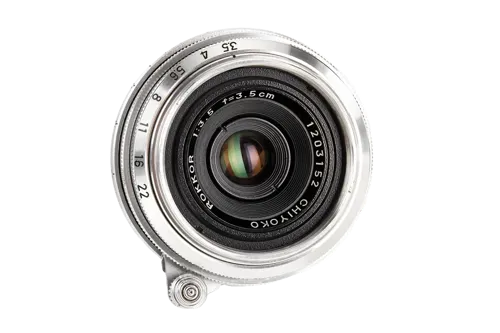
Chiyoda Kogaku Rokkor 35mm f/3.5
LTM mount
No listings tracked for this lens right now.
The Chiyoda Kogaku Rokkor 35mm f/3.5 is a LTM-mount lens for Leica rangefinder cameras. Leica price index →
How it compares
Measured against the 45 other 35mm LTM-mount lenses in the catalogue.
Specification
About this lens
Chiyoda Kogaku Rokkor 35mm f/3.5
The Chiyoko Rokkor 35mm f/3.5 is a compact wide-angle lens made by Chiyoda Kogaku Seiko for the Minolta-35 rangefinder system. Period camera documentation and specialist chronology place its introduction around 1956. Leitz Photographica Auction confirms a factory rangefinder-coupled M39 version rather than a later conversion.
Published specifications list four elements in three groups, an aperture range from f/3.5 to f/22, a six-blade diaphragm, approximately 63 degrees of view and a minimum focusing distance of 1 metre. The rigid metal lens uses manual focus and aperture control. Its 35mm field normally requires a suitable external finder on a screw-mount body without corresponding framing.
The lens is associated with Minolta’s period Achromatic Coating. Minolta technical literature describes a double-layer fluoride coating intended to improve correction across the visible spectrum. This is historically significant, but broad claims that it was unconditionally the first Japanese multi-coated photographic lens depend on how coating layers and commercial availability are defined.
Optical qualities
Rendering
Reliable controlled testing for the exact coupled M39 Rokkor 35mm f/3.5 is limited. Its four-element, three-group construction and f/3.5 maximum aperture do not by themselves establish a universal rendering style.
Sharpness and aberrations
No source cited here provides complete measured sharpness, distortion, vignetting or chromatic-aberration data for the rangefinder version. Results from a later Rokkor or a lens made for another Minolta mount should not be transferred without proof of shared optical construction.
Contrast and flare resistance
Achromatic Coating was intended to reduce reflections over a broader part of the visible spectrum than a simple single-layer treatment. The surviving condition of the coating remains important. Surface marks, haze and cleaning damage can reduce contrast regardless of the original process.
Digital use
The lens can be adapted to mirrorless cameras for direct sensor focusing. That use does not verify the rangefinder cam. Results should be attributed to the tested sample, particularly when coating condition and previous servicing are unknown.
History
Development and Launch
The 35mm f/3.5 Rokkor first appears in Minolta camera literature and the Minolta-35 Model II type b1 user documentation from around 1955 or 1956. Specialist chronology therefore treats a circa-1956 introduction as probable rather than deriving it from an auction date alone.
The Chiyoko engraving reflects Chiyoda Kogaku’s period branding. The lens broadened the Minolta-35 system beyond its standard focal lengths and was paired with a dedicated wide-angle finder.
Production Evolution
No authoritative source has established multiple optical generations of this exact coupled M39 lens. Cosmetic or engraving differences should not be treated as separate formulas without supporting factory material.
The lens must also be distinguished from later Minolta wide-angles and from similarly named Rokkors made for other mounts. Shared branding does not establish identical dimensions, focusing mechanisms or optical construction.
Special Editions/Variants
No factory special edition has been reliably documented. A finder, caps or leather case form part of the accessory set, not a separate lens edition.
Collector Notes
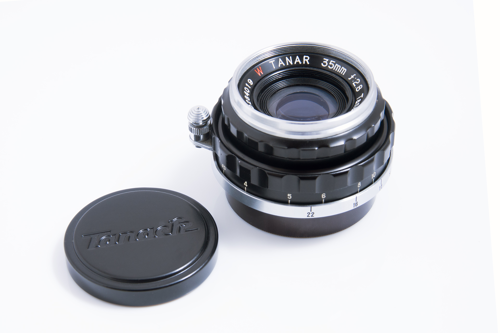
Useful identifiers are the Chiyoko and Rokkor engravings, 3.5cm or 35mm focal-length notation, metre focusing scale, rigid screw-mount barrel and visible rangefinder coupling mechanism. The complete rear construction should be checked because the label M39 alone does not guarantee Leica-rangefinder registration.
For use, inspect the six-blade diaphragm, helicoid, coupling cam and optical surfaces. A period finder is useful on bodies without 35mm framing. Achromatic Coating should be recorded as a documented historical treatment, while absolute priority claims should remain qualified.
Sources
Where to buy
Related lenses
Similar lenses you might be interested in
![Chiyoda Kogaku Super Rokkor 45mm f/2.8 [C]](https://assets.leicalenslist.com/images/2054_medium.webp)
Comments