Best price Fair
MINOLTA (ミノルタ) SUPER ROKKOR 45/2.8 (L39) 後期
Sold by Nisshin Camera
€186 ≈ $201
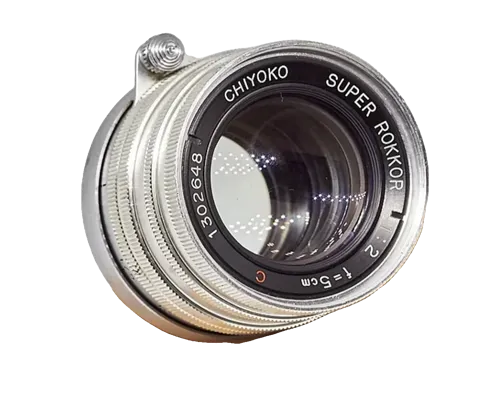
Chiyoda Kogaku Super Rokkor 45mm f/2.8 [C], the compact 5-element LTM standard lens of the Minolta 35 rangefinder, now a sought-after collector and adapter favorite.
![Chiyoda Kogaku Super Rokkor 45mm f/2.8 [C]](https://assets.leicalenslist.com/images/2054_medium.webp)
LTM mount
The Chiyoda Kogaku Super Rokkor 45mm f/2.8 [C] is a LTM-mount lens for Leica rangefinder cameras. As of October 2026, it sells from €186 used across 1 listing, with a 30-day median of €186. Leica price index →
Measured against the 4 other 40mm LTM-mount lenses in the catalogue.
The Super Rokkor 45mm f/2.8 is best known as the standard lens that shipped with Chiyoda Kogaku's Minolta 35, the Leica-inspired 35mm rangefinder the company began building in May 1947 after years of making medium-format folders and twin-lens reflexes [1][2]. Its unusual 45mm focal length suited the camera's 24x32mm and later 24x33mm frame format, which was a Japanese standard at the time and yielded extra exposures per roll. The lens earned a strong reputation early on, and period accounts held that it compared favorably with the Leitz Elmar fitted to many contemporary Leicas.
Optically the lens uses a coated five-element, three-group design, often described as a Heliar/Tessar hybrid, mounted in a fixed (non-collapsible) brass barrel[3]. It is small and light for a standard rangefinder lens, with a focus tab on a gear-like focusing ring and a front-mounted aperture ring; one common handling quirk is that turning the focus ring rotates the aperture ring as well. The barrel is screw mount (LTM / M39) and the lens is rangefinder coupled, so it can be focused through the coincident-image finder of a Minolta 35 or a screw-mount Leica body, with the 50mm finder frame serving adequately for the 45mm coverage. Minimum focus is one meter, and the glass is fully coated on its air-to-glass surfaces.
The lens appeared in more than one version. The earliest examples carry a small round window in the front bezel for reading the aperture, a feature dropped on later barrels; the lens is engraved Chiyoko (for Chiyoda Kogaku) rather than Minolta. It was sold alongside other coupled Minolta 35 optics, including an 8.5cm f/2.8 Super Rokkor portrait lens and Tele Rokkor telephotos in 11cm and 13.5cm. Many examples reached buyers outside Japan through Allied Occupation Forces stores, which is part of why the Minolta 35 became one of the first postwar Japanese cameras to find export success.
Rendering Documented impressions are consistent though limited in number. The lens is repeatedly described as very sharp with good contrast, and being fully coated it delivers clean results in both color and black and white. Collector commentary notes that Rokkor and Super Rokkor lenses are well regarded for sharpness on both their original rangefinders and on adapted digital cameras.
Digital use The screw mount makes the lens easy to adapt, and it is used on mirrorless and digital rangefinder bodies; its standing among adapted shooters contributes to current demand and pricing.
Development and Launch Chiyoda Kogaku Seiko entered the 35mm rangefinder field comparatively late, starting the Minolta 35 in May 1947 after specializing in rollfilm folders and Minoltaflex TLRs. The Super Rokkor 45mm f/2.8 was created as the camera's coupled standard lens, its focal length chosen to match the camera's reduced-width frame. The Minolta 35 line remained in production for about twelve years before being discontinued in 1959.
Production Evolution The first version of the lens has a small round aperture-reading window in the front bezel; this was omitted on later barrels. As the cameras evolved the body engraving changed (for example to 'C.K.S.' during Model B production), and the lens itself is found in several variants with minor exterior differences across its run.
Collector Notes The lens is commonly sold as a collector item and prices vary widely, from roughly the mid-hundreds upward depending on condition and version. Buyers should expect the early bezel-window variant to differ from later examples, verify the Chiyoko engraving, and check the coatings for haze given the lens's age. One reviewer cites a 34mm screw-in hood and 34mm cap as appropriate accessories, and notes that the lens uses 8 aperture blades; LeicaLensList records 9 blades, a discrepancy worth confirming on an individual example before purchase.
About the usual price. The lowest listing is around the 30-day average.
Over the last 4 weeks the median price for the Chiyoda Kogaku Super Rokkor 45mm f/2.8 [C] has fallen, ranging from €186 to €226 (now €186).
Weekly price (EUR). Median (Good or better) and lowest (Good or better) across 4 weeks. The full figures follow in the table below.
| Week | Median | Lowest |
|---|---|---|
| Jun 1, 2026 | €226 | Unknown |
| Jun 8, 2026 | €226 | Unknown |
| Sep 14, 2026 | €206 | €206 |
| Sep 28, 2026 | €186 | Unknown |
Every shop grades differently. Leica Classic uses letters, Ffordes uses E++ and E+, German dealers write "Zustand B", Japanese dealers write A−. We map all of them onto the one ladder below. Where a shop states its own grade, we print it under ours.
As of October 2026, the Chiyoda Kogaku Super Rokkor 45mm f/2.8 [C] sells from €186 used, with a 30-day median of €186, across 1 active listing.
As of October 2026, the Chiyoda Kogaku Super Rokkor 45mm f/2.8 [C] is sold by 1 source (1 listing), from €186 used: all compared cheapest-first on this page.
Similar lenses you might be interested in
![Chiyoda Kogaku Super Rokkor 50mm f/2.8 [C]](https://assets.leicalenslist.com/images/2065_medium.webp)
Comments