Best price Used
Carl Zeiss Jena Biotar 50mm f/1.4 – Full-Frame Leica M Conversion
Sold by Camera Obscura Elburg
€1,766 ≈ $1,907
A Carl Zeiss Jena 50mm f/1.4 Biotar cine lens rebuilt for Leica M, with conversion-specific focusing, coverage and rangefinder behaviour.
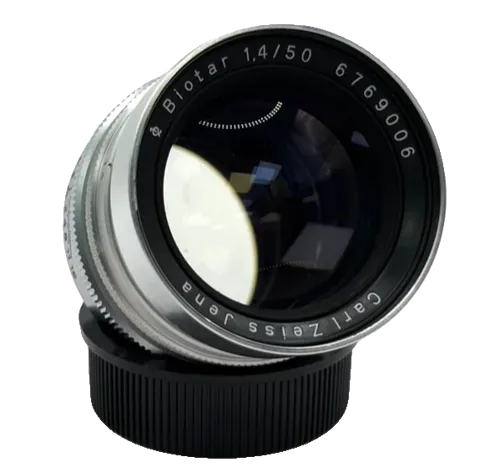
M (converted) mount
The Carl Zeiss Jena Biotar 50mm f/1.4 (Pentaflex 16, M-converted) is a M (converted)-mount lens for Leica rangefinder cameras. As of October 2026, it sells from €1,766 used across 1 listing, with a 30-day median of €1,776. Leica price index →
The Carl Zeiss Jena Biotar 50mm f/1.4 profiled here is a cine lens originally produced for the AK16 and Pentaflex 16 camera systems, subsequently rebuilt for use on Leica M cameras. It is not an original Leica-mount lens and should not be confused with the exceptionally rare pre-war Biotar 5cm f/1.4 lenses made in Leica screw mount.
Rendering
The Leica M conversion changes the mechanical interface but not the original optical design. The later Pentaflex 16 calculation was optimized for a much smaller image area than the 24×36mm Leica frame. On full frame, the central area can be detailed and contrasty, while the outer image may show softness, field curvature, vignetting and increasingly visible aberrations.
At wider apertures, the lens can produce lower contrast, luminous highlights and energetic out-of-focus rendering. Stopping down improves central definition and contrast, but the peripheral character remains part of the lens’s distinctive appearance.
At maximum aperture
Maximum-aperture performance requires accurate focusing. A coupled rangefinder measures distance rather than inspecting the image plane, so calibration errors, subject movement and field curvature can be mistaken for softness. The widest setting gives the most light and least depth of field, while residual aberrations and reflections may reduce contrast.
Stopped down
Closing the diaphragm increases depth of field and normally improves consistency across the frame. Middle apertures are often the practical choice for even detail. The smallest setting gives more depth but is not automatically the sharpest because diffraction gradually reduces fine contrast.
Handling and compatibility
Mount, registration and coupling must be verified before use. Similar-looking rangefinder fittings are not universally interchangeable. A suitable adapter must preserve the correct register and keep rear elements clear of internal camera parts.
Historical lenses should not be judged from one sample alone. Haze, separation, cleaning damage, displaced elements and dried lubricant can alter contrast and focus. Film choice, sensor cover glass and adapter tolerances also influence results.
Development and Launch
Carl Zeiss Jena developed the post-war 50mm f/1.4 Biotar as a fast telephoto lens for professional 16mm motion-picture photography. An initial optical calculation was completed in 1950, followed by a revised version in 1955. The later calculation was optimized more specifically for the smaller 16mm image area.
The lens uses six elements in four groups and belongs to the fast asymmetric double-Gauss family associated with the Biotar name. Its high speed made it suitable for available-light cinematography, while the 50mm focal length produced a distinctly telephoto field of view on 16mm film.
Production Evolution
Leica M versions are independent conversions rather than factory products. The original optical block is installed in a newly manufactured or extensively modified focusing barrel with a Leica M bayonet. Depending on the conversion, the lens may also receive a new aperture control, focusing helicoid and mechanical rangefinder coupling.
Because these conversions were made by different specialists, specifications such as minimum focusing distance, filter thread, external dimensions and rangefinder operation are not universal. Each converted lens should therefore be assessed individually.
Special Editions/Variants
Conversion barrels differ by specialist. Minimum focus, filter size, dimensions and coupling must remain conversion-specific.
Collector Notes
The appeal of this version lies in the combination of genuine Carl Zeiss Jena cine optics and a modern Leica M conversion. It offers a practical way to use the fast post-war Biotar on a rangefinder-style camera, but it remains fundamentally different from an original Leica screw-mount Biotar.
Condition and conversion quality are especially important. Accurate flange calibration, smooth focusing, correct aperture operation and properly adjusted rangefinder coupling cannot be assumed solely from the lens name.
Historical lenses should not be judged from one sample alone. Haze, fungus, separation, cleaning damage, displaced elements and dried lubricant can alter contrast and focus more than modest design differences. Film choice, processing, digital sensor cover glass and adapter tolerances also influence results. A hood may reduce oblique flare but cannot correct internal contamination.
Condition and calibration remain decisive. Mechanical rangefinder agreement, optical centering, diaphragm operation and close-focus accuracy should be checked separately. A single early sample cannot establish the performance of an entire production series.
About the usual price. The lowest listing is around the 30-day average.
Over the last 8 weeks the median price for the Carl Zeiss Jena Biotar 50mm f/1.4 (Pentaflex 16, M-converted) has fallen, ranging from €1,776 to €1,828 (now €1,776).
Weekly price (EUR). Median (Good or better) and lowest (Good or better) across 8 weeks. The full figures follow in the table below.
| Week | Median | Lowest |
|---|---|---|
| Jul 27, 2026 | €1,807 | €1,807 |
| Aug 3, 2026 | €1,815 | €1,815 |
| Aug 10, 2026 | €1,820 | €1,820 |
| Aug 17, 2026 | €1,840 | €1,840 |
| Aug 24, 2026 | €1,832 | €1,832 |
| Aug 31, 2026 | €1,828 | €1,828 |
| Sep 7, 2026 | €1,828 | €1,828 |
| Sep 28, 2026 | €1,776 | Unknown |
Every shop grades differently. Leica Classic uses letters, Ffordes uses E++ and E+, German dealers write "Zustand B", Japanese dealers write A−. We map all of them onto the one ladder below. Where a shop states its own grade, we print it under ours.
As of October 2026, the Carl Zeiss Jena Biotar 50mm f/1.4 (Pentaflex 16, M-converted) sells from €1,766 used, with a 30-day median of €1,776, across 1 active listing.
As of October 2026, the Carl Zeiss Jena Biotar 50mm f/1.4 (Pentaflex 16, M-converted) is sold by 1 source (1 listing), from €1,766 used: all compared cheapest-first on this page.
Similar lenses you might be interested in
Comments