Best price Fair
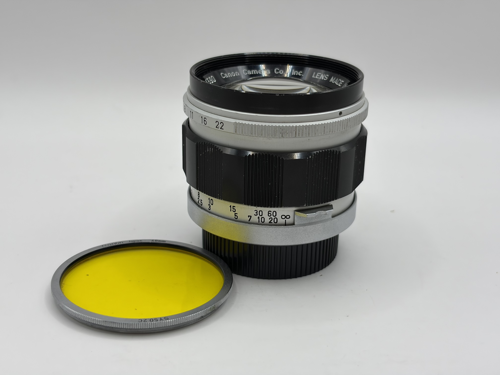
Canon 50mm f0.95
Sold by Kamerastore
€1,471 ≈ $1,589
The Canon 50mm f/0.95, the "Dream Lens" for the Canon 7 rangefinder, prized by collectors and used on Leica M after conversion from its native bayonet.
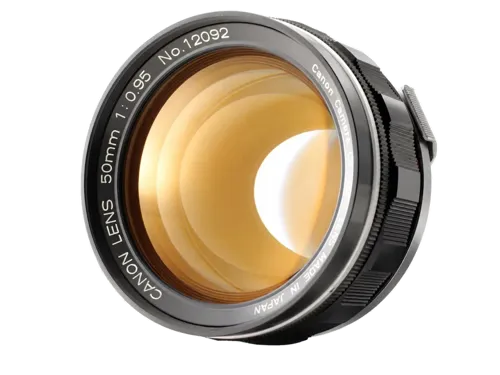
M (converted) mount
The Canon 50mm f/0.95 is a M (converted)-mount lens for Leica rangefinder cameras. As of October 2026, it sells from €1,471 used across 5 listings, with a 30-day median of €2,950. Leica price index →
When Canon launched this lens in 1961, it was the fastest lens then available for any camera, and the company promoted it as the "Dream Lens" [1][3]. It arrived as a standard optic for the Canon 7 rangefinder, decades before any comparable f/0.95 full-frame lens reached the market, and that head start is a large part of why collectors still seek it out [2]. Canon noted that its aperture gathered roughly four times more light than the human eye, a claim that fed the lens's reputation as much as its imaging character did.
Optically it is a Gauss-type design of seven elements in five groups, with a ten-blade diaphragm stopping down to f/16. The barrel is large for a 50mm rangefinder lens and substantial in the hand, and reviewers consistently describe the focus action as smooth and the aperture ring as well damped. The most important handling point is the mount: rather than the standard Leica screw thread used on other Canon rangefinder lenses, the 50mm f/0.95 employs a proprietary three-lug bayonet built into the Canon 7 body, and the rear element is cut away at its edge to clear the rangefinder coupling roller. The rangefinder-coupled version focuses to a minimum of about one metre. Because of the unusual mount, using this lens on a Leica M body requires a conversion; many surviving examples have been adapted by specialists to a standard M bayonet with working rangefinder coupling, sometimes with the rear element left intact and the close-focus distance shortened in the process.
Two basic forms exist, the rangefinder lens made for the Canon 7 and a "TV" or "Cine" variant; the rangefinder version carries the coupling and the rear-element cutout, while the TV type does not. Collector accounts based on Peter Kitchingman's reference work on Canon screw-mount lenses describe a total of five variants, counting a prototype, the main production "Type 1" rangefinder lens, and three lenses built for television use, with production of the Type 1 running to roughly 19,000 units across the 1960s. Published introduction dates vary slightly between sources, with Canon's own museum recording an August 1961 release.
Rendering The defining trait at maximum aperture is a soft, luminous glow produced by strong spherical aberration, which is widely held to be the source of the "Dream Lens" nickname. Stopping down to around f/1.4 clears most of that glow and brings the image toward conventional sharpness, so the lens behaves almost like two different optics depending on aperture.
Aberrations In addition to the wide-open glow, the lens shows pronounced focus shift as it is stopped down; one detailed test found the plane of best focus moving by roughly a centimetre per stop between f/0.95 and f/2.8, among the strongest the reviewer had measured. In practice this matters most for users who close the aperture down, since the main reason to own the lens is to shoot it wide open.
Digital use The lens is regularly used on mirrorless and Leica M digital bodies after mount conversion, where electronic focus aids help manage the focus shift; live view with the lens slightly stopped down is suggested when precise focus is needed.
Development and Launch Canon developed the 50mm f/0.95 as a flagship standard lens for the Canon 7 rangefinder, and at the time of its release it held the largest aperture of any photographic lens on the market. The "Dream Lens" name was attached early, reportedly by British photojournalists, and Canon's marketing adopted it. The lens predated Leica's first f/0.95 design by nearly half a century, which has reinforced its standing as a historically significant fast lens.
Special editions Beyond the standard rangefinder lens, Canon produced television and cine versions of the f/0.95, and collector references list a prototype alongside the production rangefinder lens and several TV variants. No widely documented commemorative or military factory editions are recorded.
Collector Notes The single most important point for buyers is that this is not a screw-mount lens; it uses a dedicated bayonet for the Canon 7 and cannot be mounted on a Leica M without conversion. Many examples on the market have already been adapted to M-mount, sometimes with the rear element recut or the close-focus distance altered, so it is worth confirming exactly what work has been done and whether rangefinder coupling functions. Because of the cut-down rear element on rangefinder lenses, condition of the rear group and the originality of any conversion are worth checking, as is the distinction between rangefinder and TV/Cine examples when assessing value. For a deeper documented history, collectors are pointed to Peter Kitchingman's book on Canon screw-mount rangefinder lenses, which devotes a chapter to this model.
Good time to buy. The lowest listing is 50% below the 30-day average.
Lowest price Click a mark to open that listing · arrow keys to step, Enter to open
Price against condition for 5 listings of Canon 50mm f/0.95, €1,471 to €3,391, median €2,974. Excellent: 2 at €2,974, €3,391. Good: 2 at €2,926, €3,129. Fair: 1 at €1,471. The full table follows.
| Condition | Lowest | Median |
|---|---|---|
| Excellent | €2,974 | €3,182 |
| Good | €2,926 | €3,028 |
| Fair | €1,471 | €1,471 |
Over the last 14 weeks the median price for the Canon 50mm f/0.95 has fallen, ranging from €2,950 to €3,332 (now €2,950).
Weekly price (EUR). Median (Good or better) and lowest (Good or better) across 14 weeks. The full figures follow in the table below.
| Week | Median | Lowest |
|---|---|---|
| Jun 1, 2026 | €3,332 | €3,332 |
| Jun 8, 2026 | €3,332 | €3,332 |
| Jul 20, 2026 | €3,332 | €3,332 |
| Jul 27, 2026 | €3,332 | €3,332 |
| Aug 3, 2026 | €3,268 | €3,203 |
| Aug 10, 2026 | €3,212 | €3,212 |
| Aug 17, 2026 | €3,168 | €2,929 |
| Aug 24, 2026 | €3,153 | €2,929 |
| Aug 31, 2026 | €3,147 | €2,929 |
| Sep 7, 2026 | €3,139 | €2,928 |
| Sep 14, 2026 | €3,182 | €2,927 |
| Sep 21, 2026 | €3,166 | €2,927 |
| Sep 28, 2026 | €3,117 | €2,926 |
| Oct 5, 2026 | €3,051 | €2,926 |
Every shop grades differently. Leica Classic uses letters, Ffordes uses E++ and E+, German dealers write "Zustand B", Japanese dealers write A−. We map all of them onto the one ladder below. Where a shop states its own grade, we print it under ours.
As of October 2026, the Canon 50mm f/0.95 sells from €1,471 used, with a 30-day median of €2,950, across 5 active listings.
As of October 2026, the Canon 50mm f/0.95 is sold by 2 sources (5 listings), from €1,471 used: all compared cheapest-first on this page.
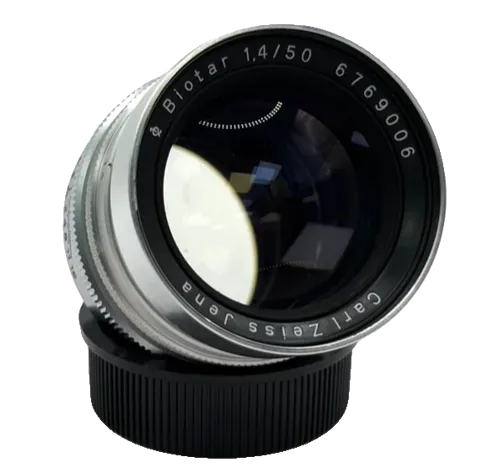
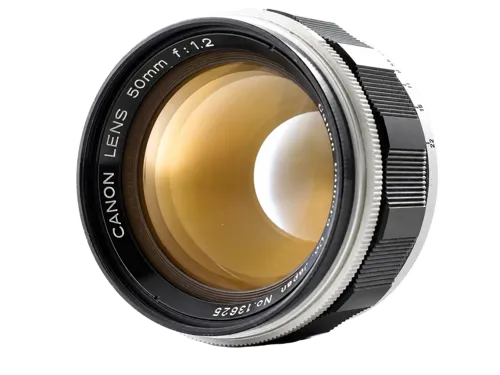
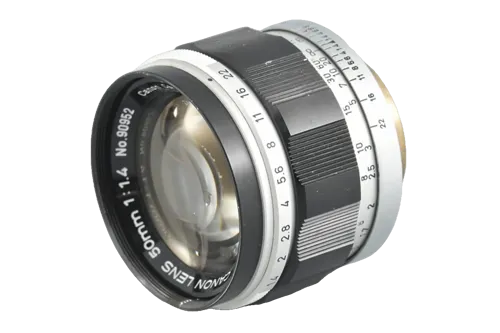
Similar lenses you might be interested in
Comments