Best price Excellent
Voigtländer 12mm f/5.6 Ultra Wide Heliar Aspherical
Sold by Fotohaus Wolf (Leica Boutique Basel)
€392 ≈ $423
Voigtländer's LTM Ultra Wide-Heliar 12mm f/5.6 I was the widest rectilinear 35mm lens at its 2000 launch, a tiny screw-mount wide prized by collectors.
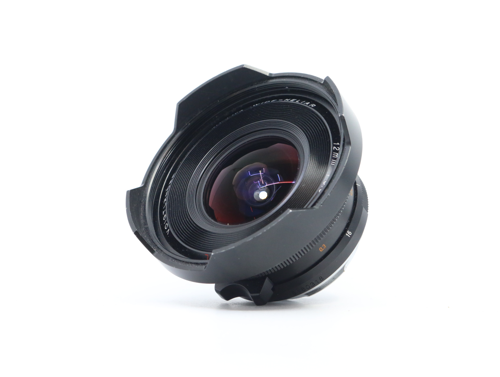
LTM mount
The Voigtländer Ultra Wide-Heliar 12mm f/5.6 I is a LTM-mount lens for Leica rangefinder cameras. As of October 2026, it sells from €392 used across 1 listing, with a 30-day median of €392. Leica price index →
When Cosina launched this lens under the Voigtländer name, it claimed a notable record: at its introduction it was the widest production rectilinear lens ever made for 35mm, a true wide angle rather than a fish-eye, covering a diagonal field of view of roughly 121 degrees [1]. The first version arrived in Leica screw mount (LTM / M39), and its combination of an extreme angle of view with a barrel that is only a few centimeters long made it a curiosity that quickly found a following among rangefinder users and, later, mirrorless adapters[2].
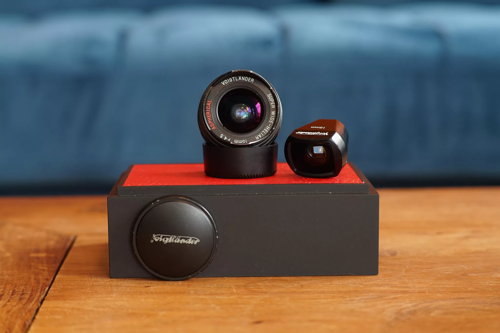
The optical formula uses ten elements in eight groups with an aspherical surface, and the design is broadly symmetrical, which helps keep rectilinear distortion low. The aperture runs from f/5.6 to f/22 with half-stop click positions, and the diaphragm uses nine straight blades. Because the lens is so wide, it is not rangefinder coupled; depth of field at these focal lengths is so deep that precise focusing is largely unnecessary, and the lens is operated with a small focusing lever down to a close distance of 0.3 m. Reviewers note the unusual touch of detented click stops on the focusing ring itself, at 0.3 m, 0.5 m, 1 m and infinity. The barrel carries a removable petal-shaped hood; with the hood off, the front element sits proud of the barrel, so most users leave it in place. Voigtländer supplied a matching all-metal 12mm bright-line viewfinder, since no rangefinder camera shows a frame this wide.
The screw-mount version reviewed here is the original of a family that later changed mount and form. Around 2009 it was effectively replaced by a Leica M bayonet version (Aspherical II) sharing the same optics but adding rangefinder coupling and a fixed hood that accepts 67mm filters directly, with the later Aspherical III being a redesigned optic. The first LTM version is distinguished by being lighter and roughly half the size of the M-mount version, and by being offered in both silver and black, where the M-mount lens was black only. A practical advantage collectors cite is that, because of its removable hood, the screw-mount lens accepts a dedicated filter adapter with a 77mm thread that allows large square filter holders, something the fixed-hood M version does not easily permit. The LTM lens also mounts on M bodies through a simple adapter, while M-mount lenses cannot be fitted to screw-mount cameras.
Rendering For an ultra-wide of this era the lens renders cleanly, with low rectilinear distortion that is a benefit of its near-symmetrical design and a built-in correction profile available in software. On film the symmetrical layout works without an issue, but on digital sensors the same design produces strong, fairly even vignetting and corner color casts that do not improve much on stopping down. Lateral chromatic aberration is well controlled for such a wide angle and easily corrected, and longitudinal CA is essentially a non-issue at this focal length and aperture.
Sharpness Center sharpness is strong, while corner performance is best described as adequate to good and is often hard to judge because of the extreme perspective stretching toward the edges of the frame; reviewers recommend stopping well down, around f/11, for the most even results, particularly on digital bodies where the thick sensor stack introduces field curvature.
Flare resistance and sunstars Flare resistance is considered good for a 12mm lens, holding up even with the sun in the frame. The nine straight blades yield distinct sunstars, though their points can be uneven depending on the light source.
Digital use On mirrorless cameras the lens is compact and convenient but shows its symmetrical-wide origins: pronounced vignetting and corner color shifts that require correction in post, and coma performance that limits its use for astrophotography despite the wide view.
Development and Launch Voigtländer announced the 12mm f/5.6 in Leica screw mount in March 2000, with sales beginning in Japan on 1 September 2000. At launch it was promoted as the widest production rectilinear lens available for the 35mm format, paired with a dedicated metal accessory finder whose own aspheric front element was described as difficult to manufacture. A Nikon F SL version for SLR use followed in September 2003.
Production Evolution The screw-mount original was succeeded by a Leica M bayonet version that retained the same optical formula but added rangefinder coupling and accepted 67mm filters via a fixed hood, after which a further redesigned Aspherical III generation appeared. The early screw-mount and M lenses share their optics, and contemporary commentary notes that the early LTM design shows stronger field curvature and color vignetting than later VM revisions, which were better matched to digital sensors.
Collector Notes Identification hinges on mount and form: the first version is the LTM screw-mount lens, lighter and about half the size of the later M-mount lens, and the only one offered in silver as well as black. Buyers should confirm whether a lens presented as "Leica M" is in fact the screw-mount lens fitted with a slim M adapter, a point of genuine confusion documented among owners since the early LTM barrel can carry such an adapter convincingly. The dedicated 77mm filter adapter is scarce and worth seeking separately if filter use is intended; note also that bright engraved markings on the barrel can reflect into the frame through some filters, which owners address by masking them. The matching 12mm viewfinder and the two-compartment lens case are accessories worth verifying for a complete example.
About the usual price. The lowest listing is around the 30-day average.
Over the last 18 weeks the median price for the Voigtländer Ultra Wide-Heliar 12mm f/5.6 I has risen, ranging from €328 to €447 (now €392).
Weekly price (EUR). Median (Good or better) and lowest (Good or better) across 18 weeks. The full figures follow in the table below.
| Week | Median | Lowest |
|---|---|---|
| Jun 1, 2026 | €328 | €328 |
| Jun 8, 2026 | €328 | €328 |
| Jun 15, 2026 | €328 | €328 |
| Jun 22, 2026 | €328 | €328 |
| Jun 29, 2026 | €328 | €328 |
| Jul 6, 2026 | €328 | €328 |
| Jul 13, 2026 | €328 | €328 |
| Jul 20, 2026 | €402 | Unknown |
| Jul 27, 2026 | €402 | Unknown |
| Aug 3, 2026 | €447 | Unknown |
| Aug 10, 2026 | €399 | Unknown |
| Aug 17, 2026 | €405 | €405 |
| Aug 24, 2026 | €403 | €403 |
| Aug 31, 2026 | €400 | €400 |
| Sep 7, 2026 | €397 | €397 |
| Sep 14, 2026 | €393 | €393 |
| Sep 21, 2026 | €391 | €391 |
| Sep 28, 2026 | €392 | €392 |
Every shop grades differently. Leica Classic uses letters, Ffordes uses E++ and E+, German dealers write "Zustand B", Japanese dealers write A−. We map all of them onto the one ladder below. Where a shop states its own grade, we print it under ours.
As of October 2026, the Voigtländer Ultra Wide-Heliar 12mm f/5.6 I sells from €392 used, with a 30-day median of €392, across 1 active listing.
As of October 2026, the Voigtländer Ultra Wide-Heliar 12mm f/5.6 I is sold by 1 source (1 listing), from €392 used: all compared cheapest-first on this page.
Similar lenses you might be interested in
Comments