Best price Mint
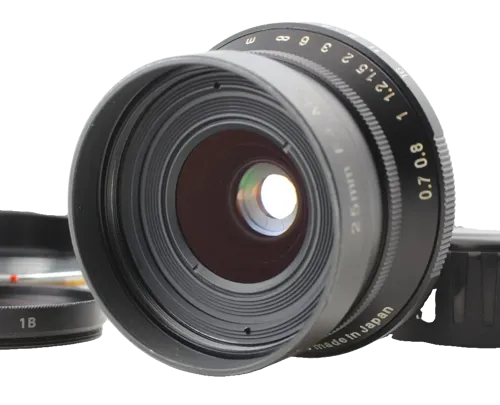
VOIGTLANDER 15MM F4.5,Super Wide-Heliar Black Aspherical lens with caps and SM to M adapt & 15mm finder Mint-
Sold by Classic Connection
€416 ≈ $449
The Voigtländer Super Wide-Heliar 15mm f/4.5 is an LTM screw-mount ultra-wide that revived the Voigtländer name and remains a collector favorite.
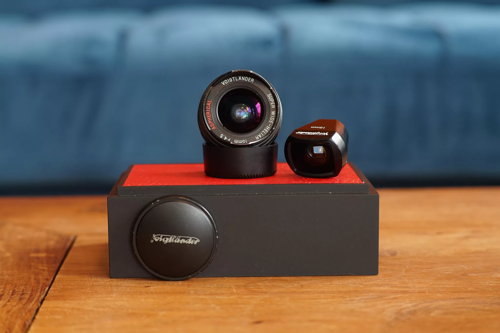
LTM mount
The Voigtländer Super Wide-Heliar 15mm f/4.5 is a LTM-mount lens for Leica rangefinder cameras. As of October 2026, it sells from €416 used across 2 listings, with a 30-day median of €477. Leica price index →
When Cosina relaunched the Voigtländer brand in 1999 alongside the screw-mount Bessa L body, the Super Wide-Heliar 15mm f/4.5 was one of the lenses that made the rangefinder world take notice. At its release it was promoted as the widest rectilinear lens of its kind for the screw-mount system, and it paired a very wide angle of view with a body far smaller and far cheaper than any comparable SLR ultra-wide of the day [1][3]. This first version uses the M39 Leica Thread Mount and is not coupled to the camera rangefinder, so it is focused by scale or by zone, a practice that is straightforward at this focal length because of the enormous depth of field [2].
Optically the lens uses an aspherical element to keep the design compact while controlling distortion across the frame, and it carries an integrated petal-style hood and a screw-on front cap as standard. The barrel is short and light, with a smooth focus action and firm, well-defined aperture detents on the ten-blade diaphragm. Because it is uncoupled, the lens relies on an external optical viewfinder for composition; the original kit finder is a plastic-bodied unit without frame lines, and many users later substituted a metal accessory finder for durability and easier framing. The minimum focus distance is 0.3 m. On a screw-mount Barnack Leica it can be used directly, and on an M body it works through a thread-to-bayonet adapter.
The 15mm Super Wide-Heliar went through several generations that are easy to confuse. The original is the uncoupled LTM lens described here. It was followed roughly a decade later, around 2009, by a Version II in Leica M bayonet mount that retained the same basic optical formula but added ergonomic refinements and rangefinder coupling, and later by a substantially larger Version III aspherical design reworked for full-frame digital sensors, with a redesigned rear group that sits further from the sensor. A native Sony E-mount aspherical version was also produced later in the line [4]. Buyers should note that the LTM original and the M-mount Version II share the same optical layout, so the screw-mount lens delivers comparable image quality at a lower price and with more mounting flexibility.
Rendering For an ultra-wide of its size and price the lens is well regarded, with high contrast and surprisingly restrained geometric distortion in real-world architectural use. Reviewers report performance that is sharp enough across the frame, with corner detail improving on stopping down.
Distortion and vignetting Distortion is low for the focal length, with only slight pincushion noted in practical shooting. Like most lenses this wide it vignettes noticeably wide open, and stopping down toward f/8 reduces the falloff and improves the corners.
Flare resistance Because of its more complex optical design the lens can show flare, which tends to take on a structured, multi-element form rather than a simple veil; some users treat the stopped-down sunstars as a creative feature.
Digital use On full-frame mirrorless bodies the short back focus of this symmetrical-style wide can cause color shifts toward the edges, and at least one user reports a purple cast on a Sony A7; performance is better on sensors more tolerant of steep ray angles. This limitation was a key reason Cosina later developed the larger retrofocus Version III for digital cameras.
Development and Launch The lens appeared in 1999 as part of the new Cosina-built Voigtländer system introduced with the Bessa L. The screw-mount 15mm and a 25mm were the first lenses offered, and the 15mm was singled out as both far more compact than equivalent SLR optics and far less expensive than other ultra-wide rangefinder alternatives.
Production Evolution The original uncoupled LTM lens was succeeded by a rangefinder-coupled Version II in M mount about ten years later, then by a redesigned, larger aspherical Version III aimed at full-frame digital cameras, and the family was later extended with a native E-mount version. The screw-mount original and the M-mount Version II are reported to use the same optical formula.
Collector Notes The defining identifier of this entry is the M39 screw mount with no rangefinder coupling, which separates it from the later M-bayonet versions. Originals were supplied with an integrated hood and a basic plastic 15mm viewfinder without frame lines; that finder is fragile, so buyers should check it or budget for a metal replacement. When comparing listings, confirm which generation is being sold, since the visually larger Version III and the coupled Version II command different prices and are not interchangeable in handling or size.
Good time to buy. The lowest listing is 13% below the 30-day average.
Lowest price Click a mark to open that listing · arrow keys to step, Enter to open
Price against condition for 2 listings of Voigtländer Super Wide-Heliar 15mm f/4.5, €416 to €477, median €446. Mint: 1 at €416. Excellent: 1 at €477. The full table follows.
| Condition | Lowest | Median |
|---|---|---|
| Mint | €416 | €416 |
| Excellent | €477 | €477 |
Over the last 17 weeks the median price for the Voigtländer Super Wide-Heliar 15mm f/4.5 has risen, ranging from €299 to €495 (now €477).
Weekly price (EUR). Median (Good or better) and lowest (Good or better) across 17 weeks. The full figures follow in the table below.
| Week | Median | Lowest |
|---|---|---|
| Jun 1, 2026 | €299 | €299 |
| Jun 8, 2026 | €299 | €299 |
| Jun 15, 2026 | €299 | €299 |
| Jun 22, 2026 | €299 | €299 |
| Jul 6, 2026 | €456 | €416 |
| Jul 13, 2026 | €456 | €416 |
| Jul 20, 2026 | €456 | €416 |
| Jul 27, 2026 | €456 | €416 |
| Aug 3, 2026 | €456 | €416 |
| Aug 10, 2026 | €456 | €416 |
| Aug 17, 2026 | €456 | €416 |
| Aug 24, 2026 | €456 | €416 |
| Aug 31, 2026 | €456 | €416 |
| Sep 7, 2026 | €456 | €416 |
| Sep 14, 2026 | €495 | €495 |
| Sep 21, 2026 | €477 | €477 |
| Sep 28, 2026 | €446 | €416 |
Every shop grades differently. Leica Classic uses letters, Ffordes uses E++ and E+, German dealers write "Zustand B", Japanese dealers write A−. We map all of them onto the one ladder below. Where a shop states its own grade, we print it under ours.
As of October 2026, the Voigtländer Super Wide-Heliar 15mm f/4.5 sells from €416 used, with a 30-day median of €477, across 2 active listings.
As of October 2026, the Voigtländer Super Wide-Heliar 15mm f/4.5 is sold by 2 sources (2 listings), from €416 used: all compared cheapest-first on this page.
Similar lenses you might be interested in

Comments