A circa-1960 Sankyo Kohki 35mm f/3.5 wide-angle in coupled Leica thread mount, documented in black and black-chrome finishes with a matching finder.
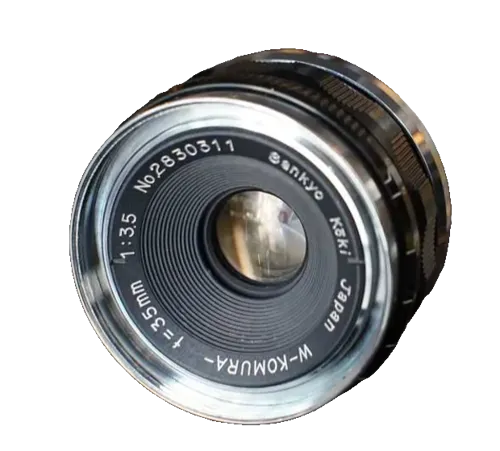
Sankyo-Kohki W-Komura 35mm f/3.5
LTM mount
No listings tracked for this lens right now.
The Sankyo-Kohki W-Komura 35mm f/3.5 is a LTM-mount lens for Leica rangefinder cameras. Leica price index →
How it compares
Measured against the 45 other 35mm LTM-mount lenses in the catalogue.
Specification
About this lens
Sankyo-Kohki W-Komura 35mm f/3.5
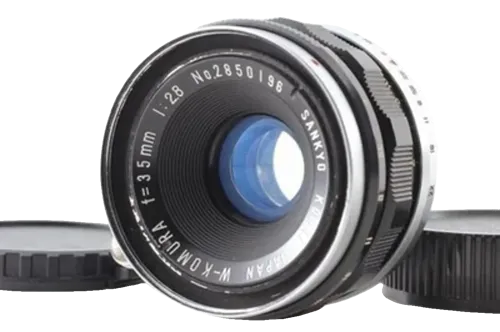
The W-Komura 35mm f/3.5 is a compact wide-angle rangefinder lens made by Sankyo Kohki, also rendered Sankyo Koki in English-language records. It uses a native, rangefinder-coupled Leica thread mount. Auction documentation confirms both black and black-and-chrome examples, while a documented circa-1960 set includes a matching external finder and original accessories.
The available model-specific sources do not establish a dependable element-and-group count, diaphragm-blade number, minimum focusing distance or filter fitting. Those values should remain unknown. Specifications from W.Acall, Honor or another visually similar Japanese 35mm f/3.5 lens must not be transferred without proof of an identical optical and mechanical construction.
The lens has a rigid manual-focus barrel and mechanical rangefinder coupling. A separate 35mm finder is normally needed on screw-mount cameras without suitable framing. On Leica M bodies, use a 35mm LTM-to-M adapter and verify both frame selection and focus calibration.
Optical qualities
Rendering
No controlled optical test for the exact W-Komura 35mm f/3.5 is cited here. The confirmed focal length and maximum aperture establish its intended wide-angle role, but do not support a universal description of sharpness, contrast, colour or bokeh.
Sharpness and aberrations
Results from a W.Acall or another Komura-branded 35mm lens should not be assigned solely because the barrels appear related. Without a verified optical diagram, claims about distortion, field curvature, vignetting or aberration correction would create false precision.
Contrast and flare resistance
The available auction records document physical examples but do not provide measured coating or flare performance. Present-day contrast can be affected by haze, surface cleaning marks, coating wear and earlier servicing.
Digital use
The lens can be adapted to a mirrorless camera for direct sensor focusing. That provides a practical way to evaluate one sample but does not test the rangefinder cam or prove the specifications of other similarly branded lenses.
History
Development and Launch
Sankyo Kohki used the Komura brand across lenses for several camera systems. FilmPhotograph records the W-Komura 3.5/35mm under 1960, and Leitz Photographica Auction independently dates a boxed M39 set to approximately the same period.
The circa-1960 evidence provides a useful chronological reference point, but does not establish the exact first and final production years. An unrestricted 1950 start date should not be inferred from the company’s broader rangefinder-lens activity.
Production Evolution
Auction records show black and black-and-chrome finishes. No authoritative evidence currently ties those exterior differences to separate optical formulas or mechanical generations, so they remain production-finish variations within one profile.
The Komura name was used on multiple focal lengths and mounts. The maker identity alone does not permit specifications to be transferred from another Komura lens.
Special Editions/Variants
No factory special edition has been reliably documented. A matching finder, box, caps or case represents original sales context and does not create a separate edition of the optical model.
Collector Notes
The full W-Komura 1:3.5 f=35mm engraving, Sankyo Koki or Sankyo Kohki maker marking, rear rangefinder cam and Leica-thread mount are the most useful identifiers. The same M39 thread diameter can occur on incompatible systems, so the rear construction must be inspected.
Check the focusing movement, aperture action, coupling travel and glass condition. Original finders and accessories add context, but unknown formula, filter and focusing specifications should remain unfilled until period documentation or reliable measurements become available.
Sources
- Leitz Photographica Auction, Sankyo Koki W-Komura 35mm f/3.5 in black and chromeleitz-auction.com →
- Leitz Photographica Auction, Sankyo Koki W-Komura 35mm f/3.5 boxed setleitz-auction.com →
- Flints Auctions, Sankyo Koki W-Komura 35mm f/3.5flintsauctions.com →
- FilmPhotograph, Komura maker and lens chronologyfilmphotograph.com →
Where to buy
Related lenses
Similar lenses you might be interested in
Comments