Best price Mint
Carl Zeiss Jena Biotar 50mm f1.4 for Leica M
Sold by Camera Obscura Elburg
€1,821 ≈ $1,967
The Carl Zeiss Jena Biotar 50mm f/1.4 (Pentaflex 16, M-converted) is a postwar cine optic rebuilt in a new Leica M barrel with mechanical rangefinder coupling.
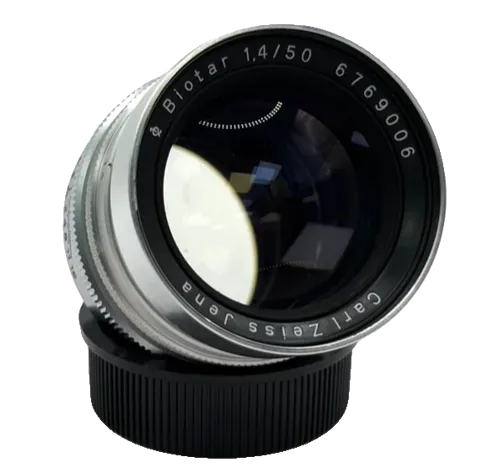
M (converted) mount
The Carl Zeiss Jena Biotar 50mm f/1.4 (Pentaflex 16, M-converted) is a M (converted)-mount lens for Leica rangefinder cameras. As of August 2026, it sells from €1,821 used across 1 listing, with a 30-day median of €1,807. Leica price index →
The lens profiled here is a modern Leica M conversion built around a postwar Carl Zeiss Jena Biotar 1.4/50 optical unit originally made for the AK16 and Pentaflex 16 cine-camera system. It is not an original factory Leica lens and must not be confused with the exceptionally rare prewar Biotar 5cm f/1.4 lenses made in original coupled or uncoupled Leica screw fittings.
The documented example carries serial number 6616335. Its original Pentaflex focusing assembly was replaced by a newly manufactured Leica M focusing barrel with mechanical rangefinder coupling. The conversion also received a machined aperture-control ring with newly engraved aperture markings. According to the seller, the rear barrel was opened to reduce mechanical obstruction and vignetting on full-frame cameras.
The converted barrel has a metric focusing scale extending to approximately 1 metre and accepts 49mm filters. These mechanical specifications belong to this particular conversion and should not automatically be applied to other Biotar 50mm f/1.4 rehousings.
The lens uses the characteristic Biotar asymmetrical double-Gauss arrangement of six elements in four groups. Native Pentaflex 16 examples are documented with an eight-blade diaphragm and an aperture range from f/1.4 to f/16.
Carl Zeiss Jena used two postwar calculations for the Biotar 1.4/50. Approximately 1,900 lenses were produced from the calculation completed on 2 May 1950. A revised calculation followed on 10 September 1955 and was used for approximately 6,500 later lenses.
The transition reportedly occurred above serial number 4,500,000. Serial number 6616335 therefore belongs to the later 1955 optical version. This calculation increased the diaphragm spacing and changed the effective focal length from approximately 50.6mm to 51.5mm, optimizing the lens for the smaller 16mm cine frame.
Independent testing of a Pentaflex Biotar 50mm f/1.4 found very high central resolution even at full aperture, with low central chromatic aberration and very little distortion. The lens can illuminate most or all of a 24×36mm sensor, but its outer image area extends far beyond the field for which the later optical calculation was optimized.
On full frame, photographers should therefore expect a strong difference between the centre and outer image area. Edge softness, field curvature, corner darkening and visibly stretched or swirling background blur can become part of the rendering. Results may vary with focusing distance, aperture and the exact optical version.
Opening the rear of the conversion can reduce mechanical vignetting, but it does not change the underlying optical correction or intended cine image field.
The coating status and exact optical condition can differ between surviving examples. Strong light sources may cause reduced contrast, veiling flare or internal reflections. A suitable lens hood is recommended, particularly when the lens is used near its maximum aperture.
The documented conversion was described as rangefinder-coupled and calibrated for both film and digital Leica cameras. Because depth of field is extremely shallow at f/1.4, coupling accuracy should still be checked on the individual camera body.
The lens has no factory Leica pedigree, six-bit coding or standardized conversion specification. Other Leica M conversions may use different helicoids, filter threads, focusing distances and coupling mechanisms.
The original AK16 was introduced as a production camera at the Leipzig Autumn Fair in September 1952. Its standard lens set included the Biotar 25mm f/1.4 and the longer Biotar 50mm f/1.4.
The camera was renamed Pentaflex 16 around the Leipzig Spring Fair of 1960. Although the camera was externally modernized, its underlying lens system remained substantially unchanged.
Historical production research estimates that approximately 8,500 Biotar 50mm f/1.4 lenses were manufactured for the AK16 and Pentaflex 16 systems. Lens production appears to have ended in 1965.
Modern conversions adapt the original cine optical unit for still photography by installing it in a newly manufactured focusing mount. The documented conversion uses a Leica M bayonet and includes mechanical rangefinder coupling.
The new focusing barrel, aperture-control ring and modified rear opening are conversion components rather than original Carl Zeiss Jena parts. Consequently, the dimensions, weight, filter fitting and minimum focusing distance may differ between converted examples.
These conversions are aftermarket creations rather than official Carl Zeiss Jena Leica variants. Their prices and production histories should remain separate from those of the original prewar Leica-mounted Biotar 5cm f/1.4.
Collectors should verify the front engraving and serial number to distinguish the postwar Biotar 1,4/50 cine optic from the prewar Biotar 1,4/5cm. The complete focusing barrel, Leica M bayonet and rangefinder mechanism should be treated as later conversion components.
Serial number 6616335 places the documented optical unit after the reported transition to the revised 1955 calculation. The condition and calibration of the conversion are at least as important as the condition of the original optical unit.
Rangefinder accuracy should be tested at close distance, medium distance and infinity. Even a small calibration error becomes visible at f/1.4. Buyers should also inspect the lens for haze, cleaning marks, internal reflections, diaphragm contamination and mechanical obstruction around the enlarged rear opening.
For price tracking, this entry should accept only postwar Biotar 50mm f/1.4 optics converted to a functional Leica M mount. Original LTM examples, uncoupled Non-Standard lenses, Biotar 58mm f/2 lenses and unconverted Pentaflex 16 lenses should not be linked here.
About the usual price. The lowest listing is around the 30-day average.
Over the last 4 weeks the median price for the Carl Zeiss Jena Biotar 50mm f/1.4 (Pentaflex 16, M-converted) has risen, ranging from €1,807 to €1,807 (now €1,807).
Weekly price (EUR). Median (Good or better) and lowest (Good or better) across 4 weeks. The full figures follow in the table below.
| Week | Median | Lowest |
|---|---|---|
| Jul 27, 2026 | €1,807 | €1,807 |
| Aug 3, 2026 | €1,815 | €1,815 |
| Aug 10, 2026 | €1,820 | €1,820 |
| Aug 17, 2026 | €1,821 | €1,821 |
Every shop grades differently. Leica Classic uses letters, Ffordes uses E++ and E+, German dealers write "Zustand B", Japanese dealers write A−. We map all of them onto the one ladder below. Where a shop states its own grade, we print it under ours.
As of August 2026, the Carl Zeiss Jena Biotar 50mm f/1.4 (Pentaflex 16, M-converted) sells from €1,821 used, with a 30-day median of €1,807, across 1 active listing.
As of August 2026, the Carl Zeiss Jena Biotar 50mm f/1.4 (Pentaflex 16, M-converted) is sold by 1 source (1 listing), from €1,821 used: all compared cheapest-first on this page.
Similar lenses you might be interested in
Comments