Best price Official store New
ARTRALAB 28mm f/2.8 Φ28 (Full Frame) M mount (Glossy Black Paint)
Sold by Artra Lab
€581 ≈ $627
Coupon code LeicaLensList: 5% off at Artra Lab for the Artralab 28mm f/2.8.
Copied!
The ArtraLab 28mm f/2.8 Φ28 is an ultra-thin brass Leica M lens with nine elements, 0.3m close focus, ten blades and a 28mm filter thread.
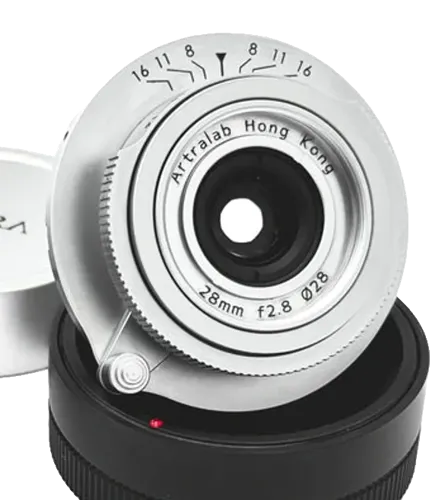
M mount
The Artralab 28mm f/2.8 is a M-mount lens for Leica rangefinder cameras. As of September 2026, it sells from €581 used across 3 listings, with a 30-day median of €581. Leica price index →
Measured against the 37 other 28mm M-mount lenses in the catalogue.
The ArtraLab 28mm f/2.8 Φ28 is a compact full-frame wide-angle lens made for the Leica M mount. Its name combines the 28mm focal length with the unusually small 28mm front filter thread. The lens is built around a nine-element, three-group optical formula in a brass barrel that measures approximately 13mm from mount to front, giving it a pancake-like profile on an M camera.
ArtraLab specifies an aperture range of f/2.8 to f/16, ten diaphragm blades, a 75-degree angle of view and a minimum focusing distance of 0.3m. The barrel is approximately 55mm in diameter and the official listed weight is 200g. A focusing lever provides purchase on the shallow barrel, while the front thread accepts the supplied screw-in hood and compatible 28mm filters.
The lens is rangefinder coupled through the conventional Leica M focusing range. Focusing closer than the mechanical coupling limit of most M cameras requires Live View, an electronic viewfinder or careful distance estimation. This extended close-focus travel is useful for details and environmental photographs, but it does not change the limitations of the camera's optical rangefinder.
This profile covers the native Leica M production lens. Finish variations share the same published optics and mechanics and should remain grouped as variants unless a later version introduces a documented optical or mechanical revision.
Rendering
The 28mm focal length provides a broad documentary field of view without the exaggerated perspective associated with more extreme wide-angle lenses. At f/2.8 the lens can isolate nearby details when used close to its 0.3m limit, although depth of field increases quickly at normal street-photography distances.
ArtraLab publishes a nine-element, three-group construction with low-reflective multilayer coating. The manufacturer does not identify aspherical, extra-low-dispersion or special high-refractive-index elements in the current specification. Descriptions should therefore avoid assigning special glass types that have not been documented.
Sharpness
Independent field reports describe useful central and mid-frame detail at full aperture, with the outer field improving as the aperture is closed. Some samples may show field curvature, so a flat subject focused in the centre can appear less even at the edges than a three-dimensional scene. Stopping down is the most reliable approach when consistent definition across the frame is required.
Because the rear optical group sits close to the image plane, digital performance can vary with sensor cover-glass thickness and microlens design. Results from one camera body should not automatically be treated as universal for every digital M or adapted mirrorless camera.
Contrast and color
The low-reflective multilayer coating is intended to support contrast and color transmission while keeping internal reflections under control. Practical contrast still depends on the angle of incident light, the cleanliness of the optical surfaces and whether the compact hood is fitted. Strong oblique light can reveal localized reflections or reduced contrast in some situations.
Distortion and vignetting
A lens this small necessarily balances optical correction against barrel depth. Moderate corner darkening at wider apertures is plausible for the format and becomes less prominent when stopped down. Distortion should be judged from architectural subjects rather than casual scenes, and software correction should not be assumed to represent the native optical image.
Close-focus use
At short distances the rangefinder no longer provides direct confirmation on most Leica M bodies. Live View or an electronic viewfinder is the preferred method below the coupled range. The ten-blade diaphragm helps maintain a comparatively rounded opening as the lens is stopped down, although background rendering also depends on subject distance and the shape of highlights.
Handling
The shallow 13mm barrel keeps the camera compact and limits viewfinder obstruction. The focusing lever gives the user a tactile distance reference, but the small controls require more deliberate handling than those of a conventional full-depth lens. Brass construction provides a dense feel despite the limited dimensions.
Development and Launch
ArtraLab developed the Φ28 as an unusually thin modern wide-angle lens for the Leica M system. The design was promoted around the engineering challenge of fitting nine glass elements and three optical groups into a body only about 1.3cm thick. The native M mount and rangefinder coupling position it as a practical camera lens rather than a fixed-focus body cap.
The official product specification identifies a full-frame image circle, 28mm focal length, f/2.8 maximum aperture, 0.3m minimum focus and brass construction. These specifications are more useful for cataloguing than temporary launch prices or sales language, which can change and should not form part of a permanent database description.
Production Evolution
The lens has been offered in silver chrome, glossy black paint and exposed-brass finishes. The published optical formula, focusing range and basic dimensions are shared across these finishes. Finish should therefore be stored as variant metadata, not treated as proof of a separate optical generation.
Published weight figures have not always been consistent across retailer and field reports. LeicaLensList follows the manufacturer's 200g specification unless a revised official figure or clearly differentiated production version is documented. Individual measurements should be recorded as sample observations rather than substituted for the model specification.
Special Editions/Variants
No commemorative or numbered special edition is confirmed. Standard silver, black and exposed-brass finishes are regular cosmetic variants. A finish alone does not justify a separate lens profile or Special Edition tag.
Accessories can differ by package or market. The presence of a hood, caps, pouch or presentation box should be recorded with the individual listing rather than used to define a new lens model.
Collector Notes
Collectors and users should inspect rangefinder calibration, focusing resistance, aperture action and the condition of the compact front thread. The shallow barrel leaves limited space around the controls, so damage to the focusing lever or filter thread can affect usability more than minor cosmetic wear.
Optical inspection should cover haze, coating marks, decentring and internal reflections. A sample that is sharp on one side but visibly weak on the other may require alignment assessment. Close-focus accuracy should be checked through Live View, while conventional rangefinder calibration should be tested at normal coupled distances.
The lens should be identified by the ArtraLab branding, 28mm f/2.8 specification, Leica M bayonet, 28mm filter thread and approximately 13mm barrel depth. Its native M mount should not be confused with adapted or converted versions of unrelated compact wide-angle lenses.
About the usual price. The lowest listing is around the 30-day average.
Lowest price Official store Click a mark to open that listing · arrow keys to step, Enter to open
Price against condition for 3 listings of Artralab 28mm f/2.8, €581 to €581, median €581. New: 3 at €581, €581, €581. The full table follows.
Official-store listings are affiliate links: buying through them supports Leica Lens List at no extra cost to you.
Over the last 7 weeks the median price for the Artralab 28mm f/2.8 has held steady, ranging from €581 to €581 (now €581).
Weekly price (EUR). Median (Good or better) and lowest (Good or better) across 7 weeks. The full figures follow in the table below.
| Week | Median | Lowest |
|---|---|---|
| Aug 3, 2026 | €581 | €581 |
| Aug 10, 2026 | €581 | €581 |
| Aug 17, 2026 | €581 | €581 |
| Aug 24, 2026 | €581 | €581 |
| Aug 31, 2026 | €581 | €581 |
| Sep 7, 2026 | €581 | €581 |
| Sep 14, 2026 | €581 | €581 |
Official store Official-store listings are affiliate links. Buying through one supports Leica Lens List at no extra cost to you, and never changes where a listing sits in this table.
Every shop grades differently. Leica Classic uses letters, Ffordes uses E++ and E+, German dealers write "Zustand B", Japanese dealers write A−. We map all of them onto the one ladder below. Where a shop states its own grade, we print it under ours.
As of September 2026, the Artralab 28mm f/2.8 sells from €581 used, with a 30-day median of €581, across 3 active listings.
As of September 2026, the Artralab 28mm f/2.8 is sold by 1 source (3 listings), from €581 used: all compared cheapest-first on this page.
Similar lenses you might be interested in
Comments