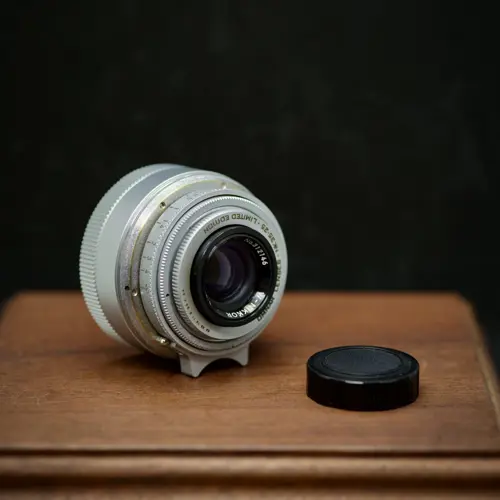
The Omnar CG28-28 rehouses the Zeiss 28mm f/2.8 Biogon from the Contax G into a brass, rangefinder-coupled Leica M-mount conversion prized by collectors.
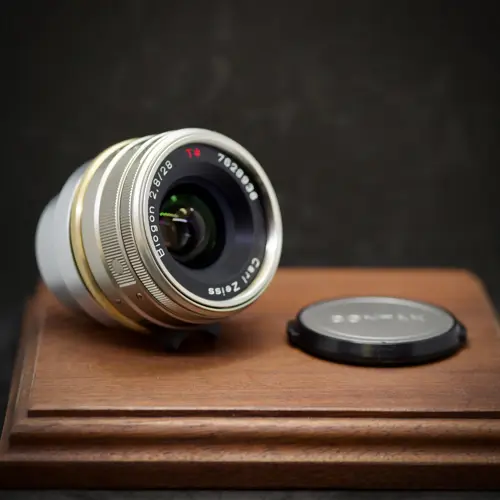
Omnar CG28-28 (Contax G 28mm conversion)
M mount
No listings tracked for this lens right now.
The Omnar CG28-28 (Contax G 28mm conversion) is a M-mount lens for Leica rangefinder cameras. Leica price index →
How it compares
Measured against the 37 other 28mm M-mount lenses in the catalogue.
Specification
About this lens
Omnar CG28-28 (Contax G 28mm conversion)
The CG28-28 is not a newly computed optic but a rehousing: Omnar Lenses takes the Carl Zeiss 28mm f/2.8 Biogon built for the Contax G autofocus system and rebuilds it for the Leica M mount. The conversion reuses the original lens glass and its metal exterior frame, combining them with machined brass components made in the United Kingdom [1]. The result places a respected 1990s Zeiss wide-angle design onto the manual focus rangefinder body for which it was never originally intended, which is the main reason it draws interest from M-mount users and collectors.
A custom all-brass helicoid replaces the Contax G's focus-by-wire actuation and gives the lens true mechanical focusing. It is rangefinder coupled from 0.65 m to infinity, and the barrel also allows an uncoupled minimum focus distance of 0.2 m, so the 28mm Biogon can be used at near-macro distances with Live View or an electronic viewfinder when the rangefinder is no longer accurate. The optical core remains the seven-element Biogon, and the conversion keeps a compact, lightweight form consistent with the small original lens. Omnar is a collaboration between the publication 35mmc and the repair and conversion workshop Skyllaney Opto-Mechanics, and the firm describes this generation of Zeiss glass as among the finest lenses ever produced. Skyllaney's own listing for the equivalent conversion notes that the donor lenses are extremely sharp and highly compact, with conversions tested on the Leica M9 and M11 digital bodies [2].
Because the CG28-28 is a hand-built conversion produced in small numbers between 2024 and 2025 rather than a mass-manufactured lens, documented variants are limited. The official listing shows the lens offered in a silver finish. Buyers should understand that each example is built from a salvaged Contax G Biogon, so the condition and coating state of the donor optic, and the calibration of the brass helicoid to a given camera, matter as much as cosmetic finish.
Optical qualities
Rendering The rendering is essentially that of the original Zeiss 28mm f/2.8 Biogon for the Contax G, since the conversion retains that lens's glass. That optic was released in 1994 alongside the Contax G1 and was praised for high resolving power, excellent build quality and low distortion, remaining unchanged until the G series was discontinued in 2005 [3]. In use it has been described as impeccably sharp with punchy, colorful output; wide open it shows mild vignetting and slight corner softness, and these largely disappear by f/5.6. Sellers of the converted version likewise report sharpness, compactness, pleasant bokeh and vibrant color. Note that some users have observed field curvature when adapting these G-system lenses to digital sensors rather than film [4].
History
Development and Launch The donor optic is the Carl Zeiss Biogon T* 28mm f/2.8, introduced in 1994 with the Contax G1 and later carried over to the Contax G2. It served as the system's standard wide-angle lens and stayed in production unchanged until the G line ended in 2005. Omnar's conversion programme, run jointly with Skyllaney, was publicly launched in 2022 with the aim of turning non-rangefinder lenses into rangefinder-coupled M-mount optics. The CG28-28 applies that approach to the 28mm Biogon, with the M-mount version produced between 2024 and 2025.
Special editions No major factory special variants of the CG28-28 are widely documented; it is a small-batch conversion offered through Omnar's own channel, with a silver finish shown on the product listing.
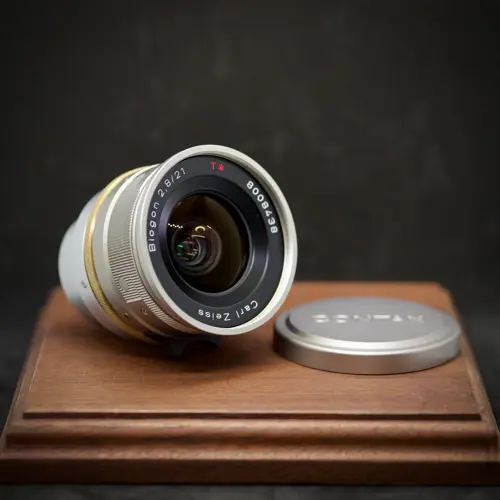
Collector Notes The CG28-28 should not be confused with Omnar's other Contax-derived conversions, such as the CG21-28 from the 21mm Biogon or the CX38-28 based on the Contax T/T2 Sonnar. Prospective buyers are essentially buying a converted vintage Zeiss lens, so it is worth verifying the donor optic for haze or coating wear, confirming that the rangefinder coupling has been correctly calibrated, and checking that the uncoupled close-focus range performs as intended with Live View or an EVF. Field curvature reported on digital bodies is a characteristic of the original optical design rather than a fault of the conversion.
Sources
- Omnar Lenses. Omnar CG28-28omnarlenses.com →
- Skyllaney Opto-Mechanics. Carl Zeiss 28mm f/2.8 Biogon Contax G – Leica M Conversionskyllaney.com →
- Casual Photophile. Carl Zeiss G Mount 28mm F/2.8 Biogon Lens Reviewcasualphotophile.com →
- PetaPixel. Omnar Can Convert Any Lens to M-Mount for Rangefinderspetapixel.com →
Where to buy
Related lenses
Similar lenses you might be interested in
Comments