A rare 50mm f/1.8 standard lens made specifically for the Kiev-5, with a six-element design, its own helicoid and a modified external bayonet.
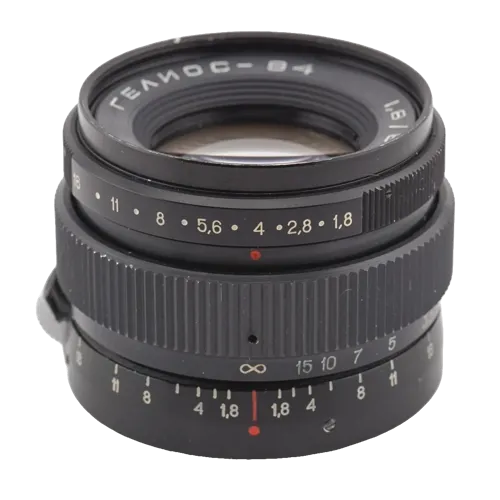
Arsenal Helios-94 50mm f/1.8
Contax RF mount
No listings tracked for this lens right now.
The Arsenal Helios-94 50mm f/1.8 is a Contax RF-mount lens for Leica rangefinder cameras. Leica price index →
How it compares
Measured against the 15 other 50mm Contax RF-mount lenses in the catalogue.
Specification
About this lens
Arsenal Helios-94 50mm f/1.8
The Arsenal Helios-94 50mm f/1.8 is a rare Soviet standard lens built specifically for the Kiev-5 rangefinder. Production is generally placed between 1969 and 1971. It combines a six-element, four-group optical construction with nine diaphragm blades and a dedicated focusing barrel, unlike the internal-bayonet normal lenses used on earlier Kiev bodies.
The database records a 0.9m minimum focusing distance, 49mm filter thread, 52mm barrel diameter, 45mm length and approximately 230g weight. Although the mount derives from the Contax/Kiev external bayonet concept, specialist accounts warn that the Kiev-5 interface is modified. The Helios-94 should therefore not be represented as a universally interchangeable Contax RF lens.
Optical qualities
Rendering
As a 50mm f/1.8 lens, the Helios-94 provides a natural standard field and useful available-light speed. The six-element, four-group formula belongs to the broad double-Gauss family. Open-aperture images may combine central detail with gentler contrast and less uniform outer-field definition. The nine-bladed iris helps keep the opening relatively rounded through part of its range.
A historical lens should not be judged from one sample alone. Haze, separation, cleaning damage, displaced elements and inaccurate rangefinder adjustment can alter contrast and focus. This profile therefore addresses the design rather than promising identical results from every surviving copy.
Film choice, processing, digital sensor cover glass and adapter accuracy also affect the final image. A hood can reduce oblique flare, but cannot correct internal contamination or damaged coatings.
At maximum aperture
At f/1.8 the lens permits selective focus and faster shutter speeds than the slower standard lenses commonly supplied with rangefinder cameras. Accurate body coupling and helicoid adjustment are essential. Flare or glow around bright details can be intensified by haze, coating wear or oil inside the lens, so a single sample should not define the whole model.
Maximum-aperture use demands accurate focusing. A coupled rangefinder measures distance rather than inspecting the image plane, so calibration errors and subject movement can be mistaken for softness.
Stopped down
Closing the diaphragm increases depth of field and generally improves consistency across the frame. Middle apertures suit documentary work and landscapes where the unusual Kiev-5 system is used as intended. The 0.9m near limit is useful for a coupled rangefinder standard lens, though exact framing at close distance remains subject to parallax.
The smallest aperture is not automatically the sharpest. Extra depth of field can help, while diffraction gradually reduces fine contrast. Mid apertures are usually the practical choice for even detail.
Handling and compatibility
Unlike the Helios-103 optical unit, the Helios-94 contains its own focusing helicoid. It attaches through the Kiev-5's modified external bayonet and couples to that camera's rangefinder. Similarity to the ordinary Contax/Kiev external mount is insufficient proof of compatibility, and the lens should never be forced onto another body.
Similar-looking rangefinder mounts are not universally interchangeable. A suitable adapter must preserve the correct register and keep the rear assembly clear of internal parts.
History
Development and Launch
The Kiev-5 represented Arsenal's substantial redesign of the Contax-derived Kiev rangefinder. Its changed body construction eliminated the familiar internal standard-lens socket and required dedicated external-bayonet normal lenses. The Helios-94 was the faster 50mm option created for that system.
Production Evolution
Its short production life followed that of the Kiev-5 itself. The specialised mount limited interchangeability and later demand, helping explain why surviving Helios-94 lenses are much less common than Jupiter-8 or Helios-103 units. The model should be catalogued by its Kiev-5 identity rather than folded into a generic Contax RF category without qualification.
Special Editions/Variants
Engraving and finish may differ among surviving lenses, but no separate optical generation is established here. Kiev-5 Jupiter standard lenses share the camera system without sharing the Helios-94 formula. Modern conversions or custom adapters are secondary modifications and should be described explicitly.
Collector Notes
Collectors should verify the engraving, native mount, rangefinder cam and mechanical construction instead of relying on a seller's title. A later conversion is not evidence of a factory variant, and an isolated serial number does not establish a production year.
Check the aperture, focusing travel, haze, fungus, separation and signs of incorrect reassembly. Test rangefinder agreement at several distances. Accessories add context but do not change the lens's identity.
A Helios-94 should be evaluated together with its dedicated mount geometry. Confirm that the helicoid moves evenly, the rangefinder cam engages correctly and infinity is reached on a Kiev-5. Damage can result from attempts to fit it to an ordinary Contax/Kiev external bayonet, so mount provenance is more important than a loose claim of Contax compatibility.
Sources
Where to buy
Related lenses
Similar lenses you might be interested in
Comments