A Soviet 53mm f/1.8 six-element standard lens for the Contax/Kiev internal bayonet, focused by the camera body and rangefinder coupled.
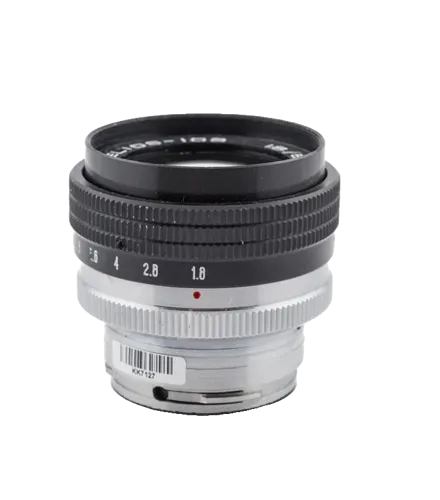
Arsenal Helios-103 53mm f/1.8
Contax RF mount
No listings tracked for this lens right now.
The Arsenal Helios-103 53mm f/1.8 is a Contax RF-mount lens for Leica rangefinder cameras. Leica price index →
Specification
About this lens
Arsenal Helios-103 53mm f/1.8
The Arsenal Helios-103 53mm f/1.8 is a Soviet standard lens made in Kyiv for Kiev rangefinder cameras. Production references place it from 1978 to 1985. Its six elements in four groups, 53mm focal length and f/1.8 aperture provided a faster successor-era standard lens for bodies using the Contax-derived internal bayonet.
The lens is mechanically distinct from ordinary helical-focus lenses. Its optical unit locks into the camera's internal bayonet and is moved for focus by the body's focusing mechanism. The database records a 40.5mm filter thread, nine diaphragm blades, approximately 150g weight and dimensions of 47.8mm diameter by 45.8mm overall length.
Optical qualities
Rendering
The Helios-103 combines a conventional standard-lens angle with useful f/1.8 speed. Its double-Gauss-derived six-element, four-group layout is different from the Sonnar-type Jupiter-8 family that preceded it on many Kiev cameras. Images can show strong central definition and a smoother outer field at large apertures, but coating condition, internal haze and focus accuracy substantially influence results.
A historical lens should not be judged from one sample alone. Haze, separation, cleaning damage, displaced elements and inaccurate rangefinder adjustment can alter contrast and focus. This profile therefore addresses the design rather than promising identical results from every surviving copy.
Film choice, processing, digital sensor cover glass and adapter accuracy also affect the final image. A hood can reduce oblique flare, but cannot correct internal contamination or damaged coatings.
At maximum aperture
At f/1.8 the lens supports low-light photography and subject separation. Focus accuracy is critical because the camera body, not an independent lens helicoid, controls extension. A worn body mechanism or mismatched calibration can make an optically sound lens appear soft. Bright light near the frame may reveal flare, especially in contaminated examples.
Maximum-aperture use demands accurate focusing. A coupled rangefinder measures distance rather than inspecting the image plane, so calibration errors and subject movement can be mistaken for softness.
Stopped down
At middle apertures depth of field increases and performance normally becomes more even across the 35mm frame. The nine-bladed diaphragm influences out-of-focus highlight geometry as the lens is stopped down. For distant scenes, careful infinity calibration remains important because the body's focusing system determines the final optical position.
The smallest aperture is not automatically the sharpest. Extra depth of field can help, while diffraction gradually reduces fine contrast. Mid apertures are usually the practical choice for even detail.
Handling and compatibility
The internal Contax/Kiev bayonet fits the standard-lens socket of compatible bodies. The camera's focusing wheel moves the lens, and the rangefinder remains coupled through the body mechanism. It must not be confused with the larger external bayonet or with Nikon S, whose dimensional similarity does not guarantee correct focus.
Similar-looking rangefinder mounts are not universally interchangeable. A suitable adapter must preserve the correct register and keep the rear assembly clear of internal parts.
History
Development and Launch
Arsenal introduced the Helios-103 late in the long Kiev rangefinder production history. It supplied a modernised f/1.8 normal-lens option while preserving the established internal bayonet interface. JAPB lists production from 1978 through 1985 and identifies Arsenal as manufacturer.
Production Evolution
Surviving examples show normal production differences in engraving and finish. These do not necessarily indicate an optical redesign. The Helios-103 remained a 53mm f/1.8 internal-bayonet lens, while other Helios models for SLRs or the Kiev-5 use different mounts and should not be merged with it.
Special Editions/Variants
The profile covers Arsenal-made Helios-103 lenses for the Contax/Kiev internal bayonet. Later modifications for mirrorless cameras are adaptations, not factory mount variants. Finish and lettering may vary by year, and some examples are marketed loosely as Contax or Nikon compatible. Mechanical fit and infinity focus must be verified independently.
Collector Notes
Collectors should verify the engraving, native mount, rangefinder cam and mechanical construction instead of relying on a seller's title. A later conversion is not evidence of a factory variant, and an isolated serial number does not establish a production year.
Check the aperture, focusing travel, haze, fungus, separation and signs of incorrect reassembly. Test rangefinder agreement at several distances. Accessories add context but do not change the lens's identity.
The optical unit should seat securely and move smoothly when controlled by the camera. Check the aperture ring and blades for oil, then confirm focus on an accurately calibrated Kiev or Contax-compatible body. A loose body focusing mount can affect every internal-bayonet lens and should not be attributed to this lens alone.
Sources
Where to buy
Related lenses
Similar lenses you might be interested in
Comments