A 1950s French 55mm f/1.5 standard lens in a bright-chrome brass, rangefinder-coupled Leica M39 barrel made by A. Garneau in Paris.
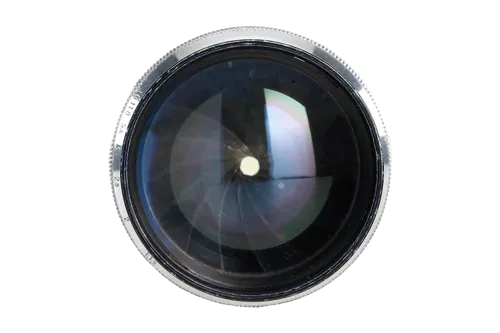
SOM Berthiot Flor 55mm f/1.5
LTM mount
No listings tracked for this lens right now.
The SOM Berthiot Flor 55mm f/1.5 is a LTM-mount lens for Leica rangefinder cameras. Leica price index →
Specification
About this lens
SOM Berthiot Flor 55mm f/1.5
The SOM Berthiot Flor 55mm f/1.5 is a French high-speed standard lens documented in an original rangefinder-coupled Leica M39 mount. Leitz Auction dates the known form to the 1950s and records a brass barrel with a bright-chrome finish. Its coupling assembly was made for SOM Berthiot by A. Garneau in Paris and is engraved accordingly.
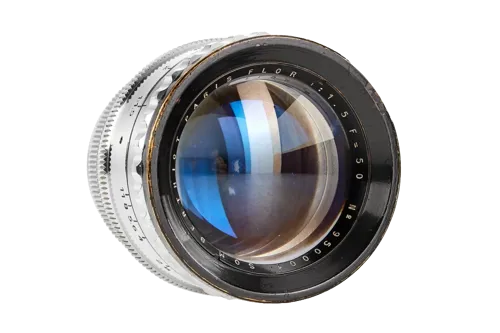
This profile covers the 55mm f/1.5 Flor with that documented factory-associated rangefinder mount. It is separate from the 50mm f/1.5 Flor, slower Flor lenses and Berthiot cine optics. The optical formula, diaphragm blade count, filter fitting and minimum focusing distance remain unknown because no reliable exact-version specification has been located.
Optical qualities
Rendering
No verified factory diagram or controlled period evaluation has been found for this precise 55mm coupled version. The Flor name alone does not identify one optical formula across every focal length and application. An element count or design label from the 50mm lens, a cine Flor or another Berthiot product must not be transferred to it.
On 35mm film, 55mm gives a field slightly narrower than a conventional 50mm standard lens. The f/1.5 aperture permits selective focus and shorter exposures in limited light. That combination describes its photographic role without claiming a universal rendering signature. Background appearance and apparent contrast vary with distance, aperture, scene structure and optical condition.
At f/1.5
Maximum aperture provides the least depth of field and places a high demand on the accuracy of both camera and coupling cam. Testing should include infinity and several measured near and intermediate distances. A lens that agrees at only one point may need mechanical calibration.
The consulted sources do not support numerical claims for resolution, distortion, vignetting, chromatic correction or flare. Nor do they confirm whether every surviving example has the same coating. Haze, fungus, separation, cleaning wear and coating damage can alter results greatly and should be treated as condition issues.
Stopped down
Closing the aperture increases depth of field and usually improves consistency across more of the frame. The actual diaphragm should be inspected to determine blade count, smallest marked aperture and opening shape. Those values cannot be inferred safely from another Flor lens.
Handling and compatibility
The bright-chrome brass mount is an important part of this version's identity. Its Leica-standard M39 thread and coupled mechanism are intended for a rangefinder camera, but surviving lenses should be tested for correct infinity register and cam travel. A generic 39mm screw description is not enough to confirm compatibility.
A suitable LTM-to-M adapter provides mechanical mounting on Leica M bodies but does not correct a worn or misadjusted cam. Mirrorless adaptation allows direct sensor focusing and can help evaluate the optics independently. A 50mm finder may provide approximate framing, but a 55mm field is slightly narrower and should be allowed for when precise composition matters.
History
Development and Launch
SOM Berthiot grew from the French optical business founded by Claude Berthiot in 1857. Through later Lacour-Berthiot and SOM identities, the company became a substantial producer of photographic, cinema and instrument lenses. By the 1950s it operated within a mature French precision-optics industry.
Leitz Auction dates the documented Flor 1.5/55mm to the 1950s. The auction record identifies the original rangefinder-coupled Leica mount and specifically attributes the coupling assembly to A. Garneau of Paris. This is direct evidence for a commercial SOM Berthiot configuration, not merely a modern adapter experiment.
Production Evolution
The known form uses a brass barrel in bright chrome with the A. Garneau attribution on the coupling. No factory chronology has been found for alternative finishes, optical revisions or distance scales. Observed differences should therefore be recorded per lens until independent documentation shows a production sequence.
The 50mm f/1.5 Flor is not merged into this entry. Apart from the nominal focal length, its documented barrel description lacks the A. Garneau attribution central to the 55mm profile. Specifications from either lens should remain separate unless a factory source explicitly connects them.
Special Editions/Variants
No commemorative edition or separately catalogued special series of the 55mm f/1.5 has been confirmed. The Garneau-made coupling is part of the documented product identity rather than evidence of a one-off conversion. Claims about the number of surviving examples are omitted because no complete production record has been verified.
Collector Notes
Identification should combine the SOM Berthiot Flor engraving, 1:1.5 55mm specification, bright-chrome brass barrel, Leica-standard M39 thread, coupled cam and A. Garneau Paris marking. The rear construction is particularly important when distinguishing an original associated mount from a later conversion.
Test infinity position, focusing smoothness, aperture operation and rangefinder agreement at several distances. Inspect the large optical surfaces for haze, fungus, separation, coating damage and cleaning wear. Individual serial numbers, auction condition, included accessories, provenance and prices are not generic model data.
Sources
- Leitz Auction, SOM Berthiot Flor 1.5/55mm with A. Garneau couplingleitz-auction.com →
- University of Strasbourg Museum of Seismology, SOM and SLOM company historymusee-sismologie.unistra.fr →
- Apenas Imagens, Berthiot company and lens historyapenasimagens.com →
- Old Photographic Lenses, Claude Berthiot historical overviewoldphotographiclenses.com →
Where to buy
Related lenses
Similar lenses you might be interested in
Comments