A rare French 28mm f/3.3 coupled rangefinder wide-angle documented in native Leica M39 and Contax RF forms, with its optical grouping unresolved.
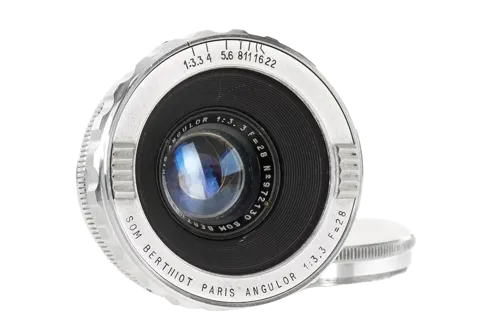
SOM Berthiot Angulor 28mm f/3.3
LTM / Contax RF mount
No listings tracked for this lens right now.
The SOM Berthiot Angulor 28mm f/3.3 is a LTM / Contax RF-mount lens for Leica rangefinder cameras. Leica price index →
How it compares
Measured against the 16 other 28mm lenses in the catalogue.
Specification
About this lens
SOM Berthiot Angulor 28mm f/3.3
The SOM Berthiot Angulor 28mm f/3.3 is a compact French wide-angle lens produced for coupled 35mm rangefinder cameras around 1950. Surviving examples and auction records establish original Leica M39 and Contax RF versions. The lens provides a substantially wider view than a 50mm standard lens while retaining a moderate f/3.3 maximum aperture.
Published descriptions conflict over whether the six elements are arranged in four groups or six groups. No sufficiently authoritative factory diagram has been located to resolve that disagreement, so LeicaLensList leaves the elements-and-groups field unconfirmed rather than selecting the most repeated secondary claim. The profile likewise avoids importing dimensions, blade counts or weights from a single auction specimen.
Optical qualities
Rendering
The Angulor's 28mm focal length is suited to architecture, travel, streets and interiors. Period symmetrical wide-angle designs can provide low geometric distortion, but that general design tendency is not a measured result for this exact lens. Edge illumination, corner definition and flare depend on aperture, coatings and sample condition. On thick-cover-glass digital sensors, oblique rays may also produce behaviour different from film.
A historical lens should not be judged from one sample alone. Haze, separation, cleaning damage, displaced elements and inaccurate rangefinder adjustment can alter contrast and focus. This profile therefore addresses the design rather than promising identical results from every surviving copy.
Film choice, processing, digital sensor cover glass and adapter accuracy also affect the final image. A hood can reduce oblique flare, but cannot correct internal contamination or damaged coatings.
At maximum aperture
At f/3.3 the lens offers a practical compromise between size and speed. Central detail may appear more decisive than the outer field, particularly at close or middle distance, while strong light near the frame can lower contrast. These are evaluation points rather than guaranteed flaws. A clean, correctly assembled sample should be assessed separately from a hazy or misaligned example.
Maximum-aperture use demands accurate focusing. A coupled rangefinder measures distance rather than inspecting the image plane, so calibration errors and subject movement can be mistaken for softness.
Stopped down
Closing the aperture expands depth of field, useful with a 28mm lens for layered street scenes and near-to-far compositions. It may also improve field consistency and reduce vignetting, although no factory curves are available here to quantify the change. The distance scale can support zone focusing after the lens and camera have been checked for correct calibration.
The smallest aperture is not automatically the sharpest. Extra depth of field can help, while diffraction gradually reduces fine contrast. Mid apertures are usually the practical choice for even detail.
Handling and compatibility
Original M39 examples are rangefinder coupled, as confirmed by Leitz Auction. Contax RF examples use a different native bayonet. Many period cameras lack a built-in 28mm frame, so an accessory finder is usually required. Users should confirm that the rear assembly clears the chosen body or adapter before mounting.
Similar-looking rangefinder mounts are not universally interchangeable. A suitable adapter must preserve the correct register and keep the rear assembly clear of internal parts.
History
Development and Launch
SOM Berthiot was an established French optical manufacturer with experience in photographic and cine lenses. The Angulor name was used for wide-angle optics, and the 28mm f/3.3 reached rangefinder users when compact wide lenses were specialist accessories rather than standard kit. Its appearance around 1950 places it within the postwar expansion of independent Leica-thread and Contax-compatible lenses.
Production Evolution
Auction evidence confirms more than one factory rangefinder mount, but it does not support treating each mount as a separate optical model. The M39 and Contax RF forms remain together in this profile unless future primary documentation establishes a material optical or mechanical revision beyond the mount interface.
Special Editions/Variants
Known native forms include coupled Leica M39 and Contax RF barrels. Scale units and engraving can vary. Adapted cine or other Angulor lenses should not be merged solely because they share the name and focal length. The unresolved 6/4 versus 6/6 descriptions are recorded as a research limitation, not presented as two confirmed variants.
Collector Notes
Collectors should verify the engraving, native mount, rangefinder cam and mechanical construction instead of relying on a seller's title. A later conversion is not evidence of a factory variant, and an isolated serial number does not establish a production year.
Check the aperture, focusing travel, haze, fungus, separation and signs of incorrect reassembly. Test rangefinder agreement at several distances. Accessories add context but do not change the lens's identity.
A prospective example should be checked for an original coupled mount and correct 28mm identity. Because published specifications disagree, opening a lens merely to count cemented groups is not recommended. Future catalogues, patents or factory literature may resolve the formula without risking the object.
Sources
Where to buy
Related lenses
Similar lenses you might be interested in
Comments