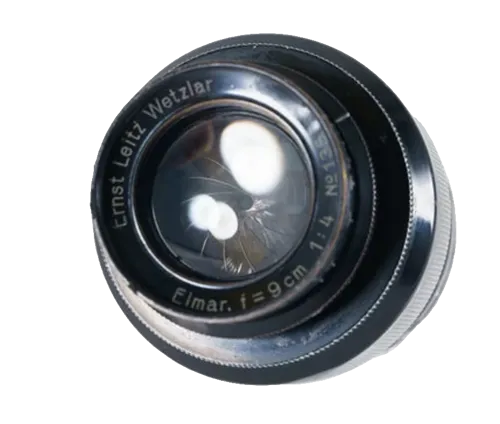
A 1949 Dutch 90mm f/4.5 short telephoto in an original chrome, rangefinder-coupled Leica M39 mount; its optical formula remains undocumented.

Old Delft Delfar 90mm f/4.5
LTM mount
No listings tracked for this lens right now.
The Old Delft Delfar 90mm f/4.5 is a LTM-mount lens for Leica rangefinder cameras. Leica price index →
How it compares
Measured against the 14 other 90mm LTM-mount lenses in the catalogue.
Specification
About this lens
Old Delft Delfar 90mm f/4.5
The Old Delft Delfar 90mm f/4.5 is a Dutch short telephoto made in 1949 for Leica screw-mount rangefinder cameras. Surviving auction records document a chrome lens in an original, rangefinder-coupled M39 mount. Its moderate f/4.5 maximum aperture and compact 9cm specification place it among the slower short telephotos intended for portraits, landscape details and general distant subjects.
Optical qualities
Rendering
At 90mm on 35mm film, the lens gives a narrower angle of view than a 50mm standard lens and a comfortable perspective for head-and-shoulders portraits when the photographer steps back. It can also isolate architectural details and compress the apparent spacing of distant landscape layers, although that visual compression results primarily from shooting position rather than focal length by itself.
At wider apertures
Full aperture is f/4.5, a setting that still allows subject separation at portrait distance because of the 90mm focal length. Exact sharpness, contrast and background transition must be evaluated from a known example. Coating condition, internal haze, spacing and focus calibration can alter the result substantially. Auction descriptions that call the optics good refer to the inspected lot, not to a guaranteed performance level for the design.
Stopped down
Stopping down increases depth of field and can improve evenness if residual aberrations remain at f/4.5. With a lens that already starts at a moderate aperture, the practical gain must be balanced against slower shutter speeds and eventual diffraction. A tripod or faster film may be more useful than choosing the smallest aperture in low light.
Handling and compatibility
The original coupled M39 mount lets a compatible Leica-thread camera transfer focusing movement to its rangefinder. The coupling cam and correct register are essential; the thread alone does not guarantee accurate focusing. Because the documented minimum distance is unknown, it should be read from the actual scale and verified at the image plane instead of inferred from another 90mm lens.
History
Development and Launch
Old Delft, also known as De Oude Delft and later Oldelft, was a Dutch optical and imaging manufacturer based in Delft. The Science Museum Group records that it was founded in 1939 as Van Leer's optical industry and was renamed during the German occupation of the Netherlands. The Delfar's 1949 date therefore places it in the company's first post-war decade.
Leitz Auction identifies a 1949 9cm f/4.5 Delfar in coupled Leica M39 mount. That configuration connected a Dutch optical maker with the international ecosystem of Leica-thread cameras and third-party lenses. The consulted material does not supply a catalogue introduction, original price, design patent or named optical designer, so those details remain open research questions.
Production Evolution
Two separate Leitz Auction records document 1949 coupled M39 examples, supporting the date and basic configuration. They do not establish how long production continued or how many lenses were made. Market descriptions such as uncommon are useful indicators of present-day availability but cannot replace factory totals.
No chronological sequence of formula changes has been found. Without verified element counts or factory sections, external differences should not be used to infer new optical generations. Scale engravings, finish details and internal fittings may still be valuable catalogue observations when multiple examples can be compared directly.
Special Editions/Variants
Delfar 9cm f/4.5 lenses are also documented for Exakta cameras. That version demonstrates that Old Delft offered the name and specification beyond Leica thread, but it is a separate mount variant with different mechanical requirements. Data from it should only be transferred when a common factory document confirms the relationship.
Collector Notes
The strongest identification points are the Old Delft or De Oude Delft maker marking, Delfar name, 9cm f/4.5 specification, chrome barrel and functional coupled Leica-thread mount. Inspect the cam as well as the thread, since an uncoupled lens or later conversion may otherwise appear similar. Engraving typography and scale layout are more useful when compared with documented examples than when judged in isolation.
Optical inspection should record haze, fungus, coating condition, scratches, separation and any evidence of disassembly. Mechanical checks should cover aperture movement, focusing travel, mount threads and rangefinder agreement. Because basic specifications remain undocumented, measurements from an individual lens should be labelled as sample data until corroborated. Auction prices and condition grades belong to particular sales and should not be folded into the model description.
The gaps in the record are themselves important. Leaving element count, groups, close focus, blade count and filter size blank prevents later researchers from mistaking an attractive guess for a factory fact. A period Old Delft catalogue, instruction sheet or patent that names the M39 Delfar would be the most valuable evidence for expanding this entry.
Sources
- Leitz Auction: Old Delft Delfar 4.5/9cm in coupled Leica M39leitz-auction.com →
- Leitz Auction: earlier Old Delft Delfar 4.5/9cm recordleitz-auction.com →
- Flints Auctions: Old Delft Delfar 90mm f/4.5 in Leica L39flintsauctions.com →
- Science Museum Group: Oldelft company historycollection.sciencemuseumgroup.org.uk →
Where to buy
Related lenses
Similar lenses you might be interested in

Comments