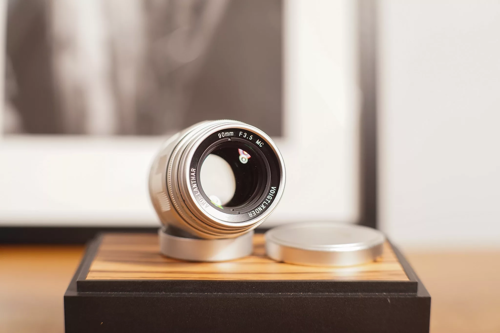
The Tokyo Kogaku Topcor 90mm f/3.5 is a scarce LTM triplet telephoto sold with Leotax rangefinders, valued by collectors of Japanese screw-mount glass.
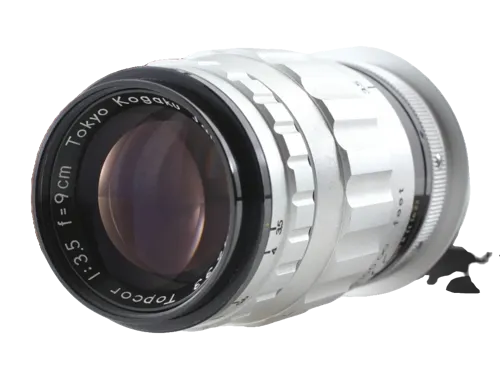
Tokyo Kogaku Topcor 90mm f/3.5
LTM mount
No listings tracked for this lens right now.
The Tokyo Kogaku Topcor 90mm f/3.5 is a LTM-mount lens for Leica rangefinder cameras. Leica price index →
How it compares
Measured against the 14 other 90mm LTM-mount lenses in the catalogue.
Specification
About this lens
Tokyo Kogaku Topcor 90mm f/3.5
This is one of the lesser known short telephotos that Tokyo Kogaku built in Leica thread mount, made not as a standalone catalogue item but as an accessory for the Leotax rangefinder cameras, the Japanese Leica copies that the company supplied with lenses. Surviving documentation is thin, and most of what is known comes from collector research and period Leotax brochures rather than from a manufacturer datasheet. The wide angle and telephoto accessory lens range was limited to a few lenses that rarely turn up these days, indicating that not many were made, and there appear to be no separate advertisements for them apart from their appearance alongside Leotax cameras. That low production is the main reason the lens is uncommon today.
Optically the design is a simple three-element triplet, an arrangement that was modest even for its era but well understood and capable of clean results in a slow telephoto. Collector research compares it to the three-element Leitz Elmar f/4 9cm, noting that the modest three-element layout sounds unambitious but that both lenses have good reputations. The barrel is aluminium, with a preset-style diaphragm running on a ten-blade iris, and focusing is by hand down to a little over a metre. As an LTM lens it threads onto Leica screw bodies, but it is not rangefinder coupled in the usual sense for accurate focus at this focal length; it was supplied with its own auxiliary optical viewfinder for framing. Period images show a 9cm lens with chunky aperture and focusing rings, distinct from the finer ribbed 13.5cm Topcor telephoto.
There is evidence of more than one version. The 9cm is thought to have been released in 1956 though it could be earlier, and the commonly found later version bears a strong design resemblance to the rigid f/3.5 Leotax K lens released in 1955. According to the Topcon Club, two noticeably different coatings were used on the lens, and a Showa Optical Works brochure that pictured an early silver-nosed 9cm with finer ribbing seems to imply the 9cm was the newer of the two telephotos, with the two different 9cm types possibly connected to that coating difference. On the question of finish and markings, the two telephotos and the wide angle retained their Topcor names on their lens caps rather than carrying the Leotax brand used on the standard 5cm lenses.
Optical qualities
Rendering Detailed, repeatable rendering reports for this specific lens are scarce, so any characterisation should be treated as tentative. What can be said is grounded in the design: a coated three-element telephoto of the mid 1950s, comparable in formula to the three-element Leitz Elmar 9cm. That class of lens has a good reputation despite the simple element count, which points to clean, contained output at moderate apertures rather than the higher-order correction of more complex telephotos. Beyond that, published rendering evidence is limited and stronger claims are not supported.
History
Development and Launch The lens comes out of a company with a long optical pedigree. Tokyo Kogaku Kikai K.K. was formed in 1932 from the merger of two Japanese companies, with a name translating to Tokyo Optical Company, and was later known as Topcon. Its first lens was a triplet made in 1933 called the Slate, after which it produced many lenses, often for other camera brands. The firm began making LTM lenses around the mid 1940s, best known for the Leotax, a Japanese Leica clone. The 90mm f/3.5 belongs to this Leica thread mount accessory line built for Leotax users.
Production Evolution Both the 9cm and the longer 13.5cm Topcor were aluminium bodied telephotos, and the 9cm appears to have evolved through at least an early silver-nosed, finely ribbed form into the more commonly seen later barrel. A brochure suggests the 9cm was the newer of the two telephotos and links the existence of two 9cm types to a reported difference in coatings.
Special editions No distinct factory special editions, military or export variants of the LTM 90mm f/3.5 Topcor are widely documented; the recorded differences are the version and coating variations described above rather than named special models.
Collector Notes The most common point of confusion is mount. Tokyo Kogaku used the Topcor name across both this rare Leica screw-mount telephoto and its later, far more numerous Topcon SLR lenses, including a 9cm and a 90mm in the reflex bayonet mounts, so listings should be checked for the LTM thread rather than an SLR fitting. Because the lens was sold with Leotax cameras and shipped with a dedicated finder, completeness matters: the obligatory metal caps carried the Topcor name on the two telephotos and the wide angle, and accessory viewfinders for the wide and telephoto lenses are documented within the Topcor range. The early single-frame 9cm finder was eventually supplanted by the multi-frame 50/90/135mm finder that came with the 13.5cm lens, which is more convenient and appears to have replaced the 9cm version completely, so a matched original finder is worth verifying before purchase. As with any 1950s Japanese coated optic, inspect for coating wear and haze, since this affects both value and the lens's already modest contrast.
Sources
Where to buy
Related lenses
Similar lenses you might be interested in

Comments