Best price Excellent
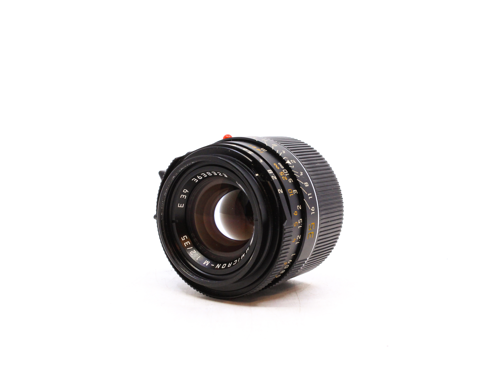
Minolta Rokkor M 40/2 Type 1
Sold by Shop (Asia)
€440 ≈ $475
The Minolta M-Rokkor 40mm f/2 is a compact M-mount normal lens built for the Minolta CLE, sharing the Leica Summicron-C 40mm optical design and prized by collectors.
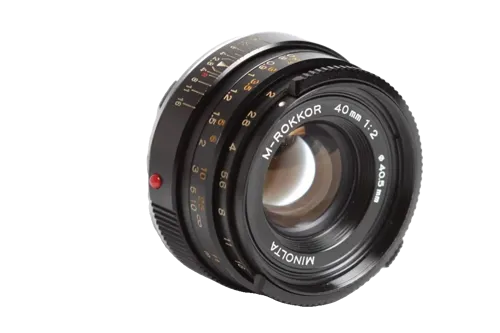
M mount
The Minolta M-Rokkor 40mm f/2 is a M-mount lens for Leica rangefinder cameras. As of October 2026, it sells from €440 used across 2 listings, with a 30-day median of €440. Leica price index →
Measured against the 9 other 40mm M-mount lenses in the catalogue.
Few rangefinder normals are as small as the Minolta M-Rokkor 40mm f/2, a six-element design that traces directly back to the Leica Summicron-C 40mm f/2. The optical layout originated with the lens shipped on the Leitz Minolta CL, and Minolta carried it forward, reportedly with revised coatings, as one of the three M-Rokkor lenses made to accompany the Minolta CLE [1][2]. Its unusual 40mm focal length and tiny footprint have made it a long-standing favorite among photographers who want a Leica-mount everyday lens without the cost of a Summicron[3].
The lens uses six elements in four groups and focuses to 0.8 m, with a ten-bladed aperture that stops down in half-stop clicks between f/2 and f/16. The barrel is almost entirely metal with engraved, paint-filled markings, and the aperture ring sits at the front of the barrel while the focus ring carries a small tab. It is rangefinder-coupled and mounts on Leica M cameras as well as the Minolta CL and CLE; on some bodies it raises the 50mm frame lines rather than dedicated 40mm lines, which photographers learn to work around. Reviewers describe a focus throw of roughly 110 degrees and note that the focus helicoids on surviving examples can feel slightly slack after decades of use, though handling overall remains pleasant for so small a lens. Published weights vary; figures around 104 to 125 g are commonly cited for this lens.
The 40mm M-Rokkor was made in at least two main variations. Early examples built for the Leitz Minolta CL are single coated, carry their serial number on the front bezel, and sometimes bear a "QF" marking on the nameplate; the code denotes the optical formula, with "Q" indicating four groups and "F" indicating six elements, and it is unrelated to coating or quality grading. Later CL-era lenses dropped the "QF" mark while keeping the serial number on the bezel. With the arrival of the Minolta CLE, a new generation of M-Rokkors moved the serial number onto the lens barrel and adopted multicoating, while keeping the same optical formula. The claim that late CL-era lenses gained multicoating is not supported by Minolta literature and should be treated with caution.
Rendering The M-Rokkor 40mm f/2 has a reputation as a compact lens that performs well above its size, with a look reviewers often call surprisingly modern while retaining a degree of vintage warmth. Centre sharpness is good even wide open, and the lens is regarded as a capable everyday optic on both film and digital bodies.
Sharpness On high-resolution digital sensors the lens shows clear focus shift, most noticeably between f/2.8 and f/4, where the plane of focus moves rearward; this is far less obvious on lower-resolution cameras but can affect rangefinder focusing at middle apertures. Centre resolution improves steadily on stopping down.
Bokeh and transitions Background blur is smooth near the centre at f/2 but grows busier toward the edges and corners, a behaviour typical of a small, fast lens of this era.
Flare resistance At f/2 a strong light source in or near the frame can produce a large ring flare; stopping down to about f/2.8 is enough to suppress it. The later multicoated M-Rokkor is generally said to handle flare and contrast better than the earlier single-coated Summicron-C, though direct comparisons are scarce.
Distortion and vignetting Distortion is negligible in practice. Vignetting is heavy wide open, on the order of around 3.5 EV at f/2 and easing as the lens is stopped down, which is common among compact fast rangefinder lenses.
Aberrations Coma is visible at f/2 and f/2.8 and largely clears by f/4 to f/5.6. Lateral chromatic aberration is low to moderate and easily corrected, and longitudinal colour fringing is modest for such a simple design.
Development and Launch The optical design began life as the Leica Summicron-C 40mm f/2 supplied with the compact Leica CL, a camera developed jointly by Leitz and Minolta and built in Japan, sold domestically as the Leitz Minolta CL. Minolta continued the design as the M-Rokkor 40mm f/2, and when it introduced the Minolta CLE in 1981 the lens became the standard normal in a small family of three M-Rokkor lenses for that camera.
Production Evolution Across its life the lens kept the same six-element, four-group formula while its identification and coatings changed. CL-era lenses carry the serial number on the front bezel, with early ones marked "QF," and CLE-era lenses moved the serial number to the barrel and adopted multicoating for improved contrast and flare control.
Collector Notes The most useful identification cues are the position of the serial number, on the front bezel for CL-era lenses and on the barrel for CLE-era multicoated lenses, and the presence or absence of the "QF" marking on the earliest examples. Buyers should be aware that the "QF" code refers to the optical formula rather than coating type or quality grading, contrary to some online claims. As with many lenses of this era, used examples can show slack in the focus helicoid from age and use, so checking focus feel and rangefinder coupling before purchase is sensible. The original system uses 40.5 mm filters and a dedicated clip-on hood worth verifying as present and correct.
About the usual price. The lowest listing is around the 30-day average.
Lowest price Click a mark to open that listing · arrow keys to step, Enter to open
Price against condition for 2 listings of Minolta M-Rokkor 40mm f/2, €440 to €578, median €509. Excellent: 1 at €440. Used: 1 at €578. The full table follows.
| Condition | Lowest | Median |
|---|---|---|
| Excellent | €440 | €440 |
| Other | €578 | €578 |
Over the last 19 weeks the median price for the Minolta M-Rokkor 40mm f/2 has fallen, ranging from €431 to €736 (now €440).
Weekly price (EUR). Median (Good or better) and lowest (Good or better) across 19 weeks. The full figures follow in the table below.
| Week | Median | Lowest |
|---|---|---|
| Jun 1, 2026 | €599 | €549 |
| Jun 8, 2026 | €549 | €500 |
| Jun 15, 2026 | €549 | €500 |
| Jun 22, 2026 | €500 | €500 |
| Jun 29, 2026 | €500 | €500 |
| Jul 6, 2026 | €529 | €529 |
| Jul 13, 2026 | €528 | €528 |
| Jul 20, 2026 | €495 | €463 |
| Jul 27, 2026 | €497 | €463 |
| Aug 3, 2026 | €463 | €463 |
| Aug 10, 2026 | €463 | €463 |
| Aug 17, 2026 | €463 | €431 |
| Aug 24, 2026 | €463 | €431 |
| Aug 31, 2026 | €492 | €463 |
| Sep 7, 2026 | €472 | €416 |
| Sep 14, 2026 | €431 | Unknown |
| Sep 21, 2026 | €431 | €431 |
| Sep 28, 2026 | €417 | €394 |
| Oct 5, 2026 | €440 | €440 |
Every shop grades differently. Leica Classic uses letters, Ffordes uses E++ and E+, German dealers write "Zustand B", Japanese dealers write A−. We map all of them onto the one ladder below. Where a shop states its own grade, we print it under ours.
As of October 2026, the Minolta M-Rokkor 40mm f/2 sells from €440 used, with a 30-day median of €440, across 2 active listings.
As of October 2026, the Minolta M-Rokkor 40mm f/2 is sold by 2 sources (2 listings), from €440 used: all compared cheapest-first on this page.
Similar lenses you might be interested in
Comments