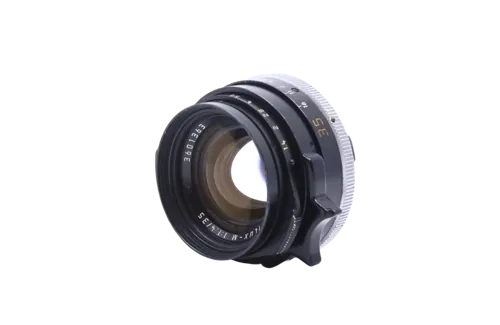
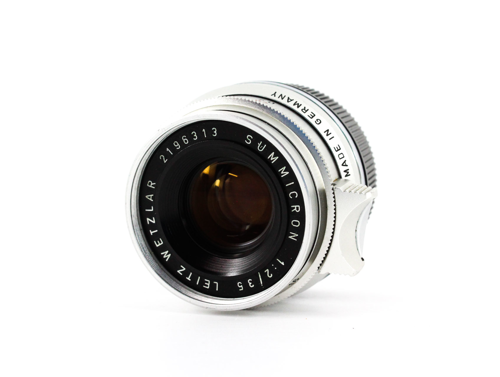
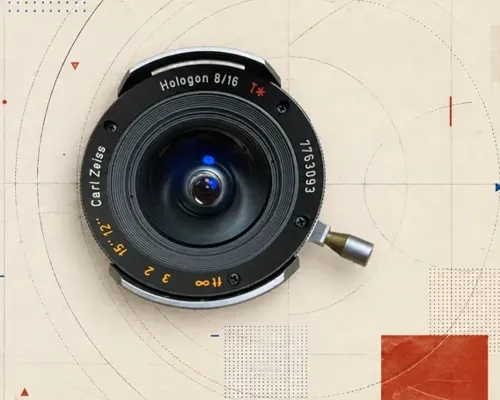
The Funky Lens List: 10 Weird and Wonderful Lenses You Can Put on a Leica
Discover 10 weird and wonderful Leica lenses, from body-cap oddities and organ transplants to Cold War glass and a 740g f/1 monster.
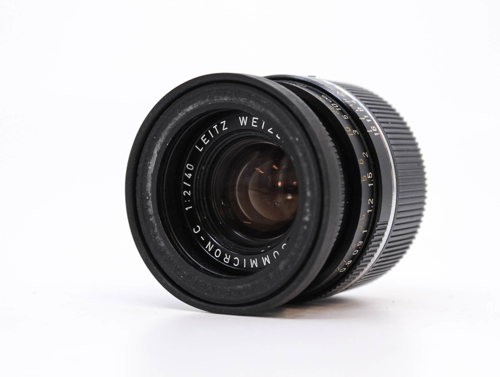
The Leica Summicron-C 40mm f/2 is a compact M-mount rangefinder lens built for the Leica CL, prized by collectors as an affordable Summicron sleeper.
M mount
The Leica Summicron-C 40mm f/2 is a M-mount lens for Leica rangefinder cameras. As of October 2026, it sells from €644 used across 7 listings, with a 30-day median of €952. Leica price index →
Measured against the 9 other 40mm M-mount lenses in the catalogue.
Designed as the standard lens for the compact Leica CL, the Summicron-C 40mm f/2 occupies an unusual position in the Leica M family. It is one of the smallest M-mount lenses Leica has made, and its 40mm focal length sits between the more common 35mm and 50mm options, which is part of why it long carried a reputation as an inexpensive "sleeper" with Summicron rendering at a fraction of the cost of its better-known siblings [2]. The lens was introduced in 1973 alongside the CL, a small and more economical 35mm rangefinder that Leica developed in cooperation with Minolta, sold under the model number 11542 [1].
Optically the lens uses a compact six-element design in four groups, with a ten-blade aperture and a minimum focusing distance of 0.8 m. It is a very short and light lens, around 22 mm long and roughly 125 g, with a 40 mm filter thread that matches its small front. The lens is rangefinder coupled, but its coupling differs from a conventional Leica lens: it engages the rangefinder arm through a pitched cam rather than the parallel cam used by most M and screw-mount lenses, and at launch Leica suggested it might not focus perfectly on every other M body. In practice most users report accurate focus on standard M cameras, with any error usually traceable to a rangefinder that has drifted from factory adjustment. A further quirk is framing: no standard Leica M camera has 40mm frame lines, and the lens natively raises the 50mm lines on the body. Users who prefer to frame with the 35mm lines on later bodies commonly hold or jam the frame-line preview lever, or in more drastic cases file down the bayonet lug that selects the lines. The CL, the Leitz Minolta CL and the Minolta CLE, as well as the Voigtlander R-series, do provide native 40mm frame lines.
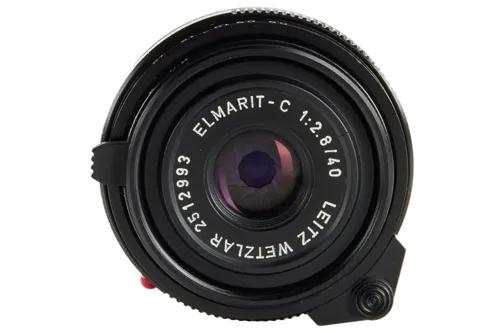
The lens also exists as the Minolta 40mm M-Rokkor f/2, made in Japan with Minolta glass. The early M-Rokkor shipped with the Leitz Minolta CL and shares the same optical design, while the later version supplied with the Minolta CLE was multicoated and used a parallel rangefinder cam. Alongside the 40mm, the CL system included a 90mm lens, and a rare Elmarit-C 40mm f/2.8 was reportedly produced in very small numbers.
Rendering Reviewers describe a clearly 1970s Summicron character: strong contrast, high perceived sharpness, and a slightly gentler tonal rendering than modern lenses, often summarized as a "film look". The lens is regarded as sharp across the frame and resistant to obvious distortion, and its overall signature is frequently compared favorably to the contemporaneous 35mm and 50mm Summicrons.
Flare resistance As a single-coated lens from the early 1970s, it is prone to flare and ghosting when shooting toward a light source, producing veiling and occasional colored artifacts. A hood helps, and reviewers note it avoids the large red ghosting blob associated with the 35mm Summicron of the same era.
Bokeh and transitions Out-of-focus rendering is the most commonly criticized aspect of the lens, but several users find it acceptable in practice and broadly in line with other Summicrons rather than notably harsh.
Distortion and vignetting Distortion is reported as negligible. Vignetting is visible wide open at f/2 and largely clears when the lens is stopped down.
Digital use The lens has seen continued use on digital M bodies, where its moderate contrast and film-like tonality remain part of its appeal.
Development and Launch The Summicron-C 40mm f/2 was introduced in 1973 as the standard lens for the Leica CL, a compact rangefinder Leica developed jointly with Minolta as a smaller, more affordable companion to the Leica M line. The collaboration involved Minolta staff working at Leica in Wetzlar, and the CL system launched with a small set of dedicated CL lenses, of which the 40mm was the normal lens. The project came during a difficult commercial period for Leica, and while the CL family sold well it did not ultimately reverse the company's troubles.
Production Evolution The lens was sold as the Summicron-C, with the closely related Minolta M-Rokkor 40mm f/2 produced in Japan. The early M-Rokkor matched the Summicron-C optical formula, while the later CLE-era M-Rokkor was multicoated and changed to a parallel rangefinder cam, the main practical difference between the variants.
Special editions No major factory special editions of the Summicron-C 40mm are widely documented. The most notable related variants are the Minolta-branded M-Rokkor versions and the rare Elmarit-C 40mm f/2.8, reportedly made in very limited numbers.
Collector Notes The lens trades well below the price of other M-mount Summicrons, which is much of its collector appeal, with typical secondhand prices reported in the few-hundred-dollar range. Buyers should be aware of the pitched rangefinder cam and the 50mm frame-line activation, and should check whether a given example has been modified, since some owners file down the frame-line lug to force the 35mm lines, a change that cannot be reversed and that alters frame-line behavior on a Minolta CLE. The 40mm filter size and a suitable hood are worth confirming, given the lens's flare tendency. One sourcing note: published histories commonly date series production to roughly 1973 to 1979 with around 54,000 units, whereas LeicaLensList records the production period without a confirmed end date.
Good time to buy. The lowest listing is 32% below the 30-day average.
Lowest price Click a mark to open that listing · arrow keys to step, Enter to open
Price against condition for 7 listings of Leica Summicron-C 40mm f/2, €644 to €5,158, median €940. Excellent: 4 at €682, €946, €986, €5,158. Good: 1 at €848. Fair: 1 at €940. Heavily Used: 1 at €644. The full table follows.
| Condition | Lowest | Median |
|---|---|---|
| Excellent | €682 | €966 |
| Good | €848 | €848 |
| Fair | €940 | €940 |
| Heavily Used | €644 | €644 |
Over the last 19 weeks the median price for the Leica Summicron-C 40mm f/2 has risen, ranging from €713 to €1,037 (now €952).
Weekly price (EUR). Median (Good or better) and lowest (Good or better) across 19 weeks. The full figures follow in the table below.
| Week | Median | Lowest |
|---|---|---|
| Jun 1, 2026 | €801 | €595 |
| Jun 8, 2026 | €778 | €595 |
| Jun 15, 2026 | €756 | €595 |
| Jun 22, 2026 | €756 | €595 |
| Jun 29, 2026 | €801 | €595 |
| Jul 6, 2026 | €756 | €595 |
| Jul 13, 2026 | €778 | €595 |
| Jul 20, 2026 | €778 | €595 |
| Jul 27, 2026 | €778 | €595 |
| Aug 3, 2026 | €756 | €595 |
| Aug 10, 2026 | €756 | €595 |
| Aug 17, 2026 | €817 | €635 |
| Aug 24, 2026 | €832 | €635 |
| Aug 31, 2026 | €941 | €683 |
| Sep 7, 2026 | €976 | €682 |
| Sep 14, 2026 | €911 | €682 |
| Sep 21, 2026 | €960 | €682 |
| Sep 28, 2026 | €897 | €682 |
| Oct 5, 2026 | €946 | €682 |
Every shop grades differently. Leica Classic uses letters, Ffordes uses E++ and E+, German dealers write "Zustand B", Japanese dealers write A−. We map all of them onto the one ladder below. Where a shop states its own grade, we print it under ours.
As of October 2026, the Leica Summicron-C 40mm f/2 sells from €644 used, with a 30-day median of €952, across 7 active listings.
As of October 2026, the Leica Summicron-C 40mm f/2 is sold by 2 sources (7 listings), from €644 used: all compared cheapest-first on this page.
Similar lenses you might be interested in
Comments