Best price Used
Minolta 28mm f2.8 M-Rokkor
Sold by Kamerastore
€338 ≈ $365
The Minolta M-Rokkor 28mm f/2.8 is a compact M-mount wide-angle built for the Minolta CLE, prized by collectors as an affordable, capable 28mm rangefinder lens.
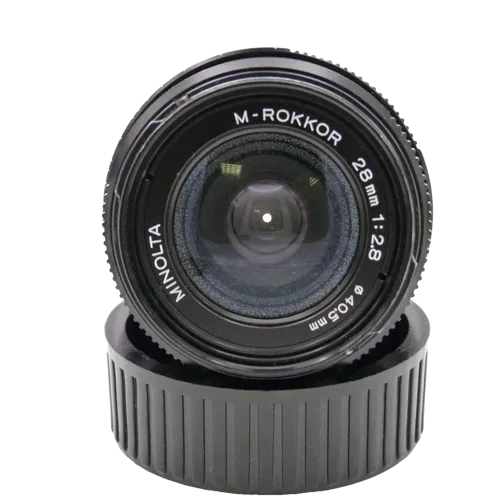
M mount
The Minolta M-Rokkor 28mm f/2.8 is a M-mount lens for Leica rangefinder cameras. As of October 2026, it sells from €338 used across 1 listing, with a 30-day median of €385. Leica price index →
Measured against the 37 other 28mm M-mount lenses in the catalogue.
The M-Rokkor 28mm f/2.8 was one of three lenses Minolta made specifically for the Minolta CLE rangefinder, alongside the 40mm f/2 and the 90mm f/4 [1]. Of the three, the 28mm holds a particular place in the system because it was the only one never offered for the earlier Leitz Minolta CL: that camera lacked 28mm framelines, so the focal length arrived only with the CLE [2][3]. Today the lens is among the more affordable 28mm options in M-mount, which keeps it in steady demand among CLE owners and Leica M users looking for a small wide-angle.
It is a compact, all-metal lens of seven elements in five groups, with a ten-bladed aperture and rangefinder coupling for use on M-mount bodies. Build and finish are praised by reviewers: the knurling, engraved and paint-filled markings, and machined aperture and focus rings echo the look of Leitz M lenses of the period. The focus ring travels roughly 110 degrees from the 0.8 m close-focus point to infinity, and the aperture ring runs in half-stop clicks from f/2.8 to f/22 [4]. The lens carries a 40mm filter thread and uses a dedicated round, vented bayonet hood that is distinct from the screw-in rubber hoods supplied with the 40mm and 90mm lenses. On the CLE it raises the correct 28mm framelines; on a Leica M6 or M10 it brings up the 35/135mm pair, and the frameline preview lever can be used to call up the 28/90mm set instead.
The 28mm exists in effect as a single version. While the 40mm and 90mm lenses appeared first as single-coated optics for the Leica CL and later as multi-coated versions for the CLE, the 28mm was introduced only in multi-coated form with the CLE. Among CLE lenses generally, serial-number placement distinguishes the earlier single-coated barrels (number on the nameplate bezel) from the later multi-coated ones (number on the barrel).
Rendering For a lens conceived as a lower-cost 28mm, its optical performance is regarded as strong. Reviewers report good, even resolution across the frame from f/2.8 on film and digital Leica M bodies, with no obvious midzone dip, while corners on mirrorless adapters such as Sony E or Nikon Z benefit from stopping down to around f/8 to f/11. Distortion is well controlled and chromatic aberration correction is good; stopped-down sunstars are noted as pleasant, while coma correction and vignetting are considered average.
Flare resistance Flare behavior is mixed in the documented record. Some users describe pronounced flaring, ghosting, and reduced contrast in direct sunlight, while others report little trouble when the dedicated hood is kept fitted. Degraded coatings or internal haze can worsen flare and contrast on affected samples.
Bokeh and transitions This is a wide-angle of modest aperture, and out-of-focus rendering is not a strength; reviewers advise against choosing it for background blur.
Development and Launch The M-Rokkor lenses grew out of the technical cooperation agreement Leica and Minolta signed in 1972, which first produced the compact Leica CL of 1973. When Minolta followed with the CLE around 1980, it commissioned a matched trio of M-mount Rokkors, the 28mm f/2.8, 40mm f/2, and 90mm f/4, the 28mm being new to the line because the CLE added 28mm framelines the CL had lacked.
Production Evolution The CLE lenses are documented as multi-coated, distinct from the single-coated 40mm and 90mm that had been supplied for the Leica CL; the later CLE versions of those two retained the same optical schemes but added multi-coating. The 28mm, having no CL predecessor, was offered only in the multi-coated configuration.
Collector Notes The lens is well known for a durability problem: white dots or specks that develop behind the edges of the front element, sometimes accompanied by an oily condensation on the rear of the front group, which can be cleaned but may leave traces and reduce flare resistance. This recurring fault is cited as a main reason prices remain modest, so the front element and internal coatings are worth close inspection before purchase. The relatively long 0.8 m minimum focus distance is a noted limitation. Buyers should also confirm the lens retains its distinctive vented bayonet hood and 40mm filter accessories, since these are specific to the lens.
Good time to buy. The lowest listing is 12% below the 30-day average.
Over the last 18 weeks the median price for the Minolta M-Rokkor 28mm f/2.8 has risen, ranging from €328 to €424 (now €385).
Weekly price (EUR). Median (Good or better) and lowest (Good or better) across 18 weeks. The full figures follow in the table below.
| Week | Median | Lowest |
|---|---|---|
| Jun 1, 2026 | €328 | €328 |
| Jun 8, 2026 | €328 | €328 |
| Jun 15, 2026 | €328 | €328 |
| Jun 22, 2026 | €328 | €328 |
| Jun 29, 2026 | €328 | €328 |
| Jul 6, 2026 | €328 | €328 |
| Jul 13, 2026 | €328 | €328 |
| Jul 20, 2026 | €328 | €328 |
| Jul 27, 2026 | €328 | €328 |
| Aug 3, 2026 | €328 | €328 |
| Aug 10, 2026 | €328 | €328 |
| Aug 17, 2026 | €328 | €328 |
| Aug 24, 2026 | €328 | €328 |
| Aug 31, 2026 | €328 | €328 |
| Sep 7, 2026 | €328 | €328 |
| Sep 14, 2026 | €424 | Unknown |
| Sep 21, 2026 | €422 | Unknown |
| Sep 28, 2026 | €385 | Unknown |
Every shop grades differently. Leica Classic uses letters, Ffordes uses E++ and E+, German dealers write "Zustand B", Japanese dealers write A−. We map all of them onto the one ladder below. Where a shop states its own grade, we print it under ours.
As of October 2026, the Minolta M-Rokkor 28mm f/2.8 sells from €338 used, with a 30-day median of €385, across 1 active listing.
As of October 2026, the Minolta M-Rokkor 28mm f/2.8 is sold by 1 source (1 listing), from €338 used: all compared cheapest-first on this page.
Similar lenses you might be interested in
Comments