Best price Used
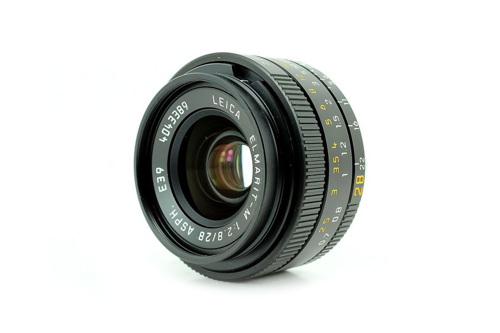
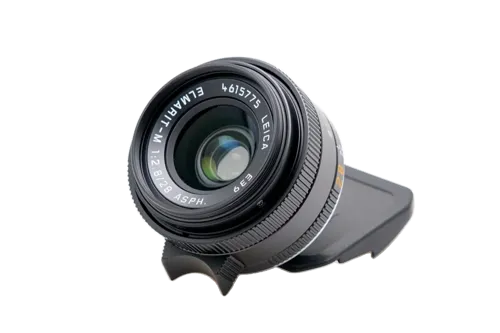
Leica Elmarit 28mm f/2.8 Version II – Early Production, 1972
Sold by Camera Obscura Elburg
€883 ≈ $954
The Leica Elmarit 28mm f/2.8 II (Transitional) is a Canada-built M-mount wide-angle whose redesigned rear cleared the M5 and CL, prized by collectors.
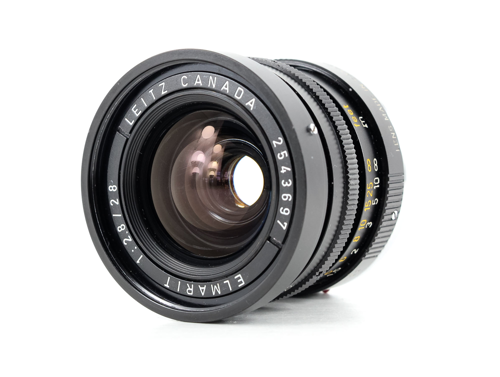
M mount
The Leica Elmarit 28mm f/2.8 II (Transitional) is a M-mount lens for Leica rangefinder cameras. As of October 2026, it sells from €883 used across 9 listings, with a 30-day median of €1,607. Leica price index →
Measured against the 37 other 28mm M-mount lenses in the catalogue.
The second version of Leica's 28mm Elmarit-M solved a practical problem that limited its predecessor: the original 1965 design used a deeply intruding rear element that fouled the metering arm of the Leica M5 and the CL, so Leica reworked the optics for the version introduced in 1972 [1][2]. The redesigned lens removed that deep rear element, which is why it can be mounted on the M5 and CL and other bodies with built-in meters. It was computed by a team led by Walter Mandler at the Midland, Ontario plant and was built there in black-lacquered brass, carrying a Leitz Canada inscription. Production ran through 1979, with fewer than about 7,050 examples assigned across the run, making it one of the less common members of the 28mm Elmarit family.
Optically the lens uses eight elements in six groups, a relatively simple arrangement that kept the barrel reasonably compact while delivering its 76-degree diagonal angle of view on full frame. It is a coupled rangefinder lens on the Leica M bayonet with an eight-blade diaphragm running to f/22, focusing down to 0.7 m, and it takes E48 filters with the matching 12501 hood and 12007 (SLOOZ) finder among its period accessories. Handling follows Leitz practice of the era, with a metal focusing barrel and a conventional aperture ring; framing on bodies without 28mm frame lines was done with the auxiliary viewfinder, since the in-body 28mm frame line did not arrive until later M cameras[3].
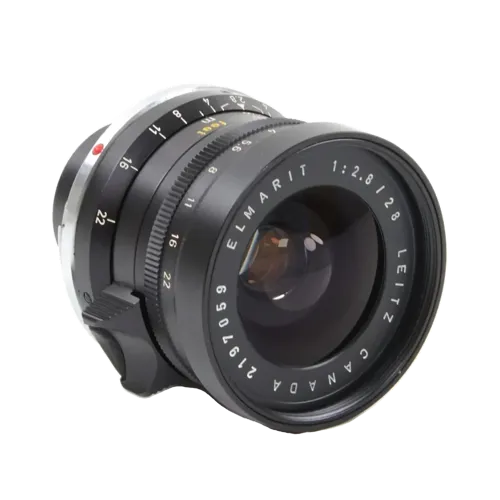
The "Transitional" label that collectors and the Leica Classic store apply to certain examples refers to lenses that sit between the first and second versions, identified by a yellow distance scale and a silver infinity lock rather than the black-painted infinity lock of the earliest first-version barrels [4]. This nomenclature can cause confusion, because the first version is sometimes described as a nine-element design while the second version that followed it is the eight-element optic; buyers should match the element count, the rear-element profile, and the barrel details rather than relying on the version name alone. Within the wider lineage this model was superseded by the later Elmarit-M versions, including the well-regarded compact pre-aspherical design and eventually the aspherical Elmarit-M.
Rendering Documentation of this specific version is limited, and reviewers note that it is a comparatively obscure entry in the 28mm Elmarit line with little written about it. The available user reporting describes a classic 1970s rendering rather than a clinically corrected modern look. On digital bodies, one long-term user notes softness toward the edges and some falloff in sharpness wide open under certain lighting, with results that improve on stopping down. The same source values the lens for its older-style character rather than outright sharpness, observing that later versions such as the third and the pre-aspherical fourth are sharper choices. On Leica digital M cameras the second version can be used, though early examples below a certain serial number lack the support needed for in-camera metering coupling.
Development and Launch The 28mm Elmarit-M originated in the mid-1960s, but its first optical layout intruded so far into the body that it interfered with the metering systems of the M5 and CL. To restore compatibility, Leica brought out a revised version in 1972, designed under Walter Mandler in Canada, that retained the f/2.8 maximum aperture and the 28mm focal length while changing the optical construction so the rear no longer protruded into the camera. This placed the lens as the everyday wide-angle in the M lineup during the 1970s.
Production Evolution The revised lens was produced from 1972 to 1979 under order numbers 11801 and 11802, in black-lacquered brass, with an eight-element, six-group formula and an eight-blade diaphragm. Surviving serial-number records indicate batches across the 1970s totaling fewer than roughly 7,050 lenses, after which the design was replaced by the next Elmarit-M version. Barrels of the transitional examples are distinguished by a yellow scale and a silver infinity lock.
Special editions No widely documented factory special editions, military, or export variants are recorded specifically for this version; it was sold as a standard production M-mount wide-angle.
Collector Notes Because the version names overlap with the rear-element redesign, identification is the main pitfall: confirm the element count and the rear profile, and check the inscription for the Leitz Canada origin. Collectors should verify the infinity-lock color and scale color when a seller advertises a "transitional" example, since these are the cited distinguishing marks. As with many lenses of this era, inspect the optics for haze, dust, and cleaning marks, and confirm the presence of correct period accessories such as the 12501 hood when paying a premium. One discrepancy worth noting is weight: collector references list this version at around 300 g, slightly above the figure recorded here, likely reflecting differences in how barrels and caps were weighed.
Good time to buy. The lowest listing is 45% below the 30-day average.
Lowest price Click a mark to open that listing · arrow keys to step, Enter to open
Price against condition for 9 listings of Leica Elmarit 28mm f/2.8 II (Transitional), €883 to €3,679, median €1,234. Excellent: 1 at €3,679. Good: 6 at €903, €1,038, €1,234, €1,250, €1,586, €1,662. Used: 2 at €883, €1,025. The full table follows.
| Condition | Lowest | Median |
|---|---|---|
| Excellent | €3,679 | €3,679 |
| Good | €903 | €1,242 |
| Other | €883 | €954 |
Over the last 18 weeks the median price for the Leica Elmarit 28mm f/2.8 II (Transitional) has risen, ranging from €1,113 to €1,622 (now €1,607).
Weekly price (EUR). Median (Good or better) and lowest (Good or better) across 18 weeks. The full figures follow in the table below.
| Week | Median | Lowest |
|---|---|---|
| Jun 1, 2026 | €1,109 | €925 |
| Jun 8, 2026 | €1,109 | €925 |
| Jun 15, 2026 | €1,109 | €925 |
| Jun 22, 2026 | €1,109 | €925 |
| Jun 29, 2026 | €1,109 | €903 |
| Jul 6, 2026 | €1,183 | €903 |
| Jul 13, 2026 | €1,183 | €903 |
| Jul 20, 2026 | €1,241 | €903 |
| Jul 27, 2026 | €1,241 | €903 |
| Aug 3, 2026 | €1,145 | €903 |
| Aug 10, 2026 | €1,241 | €903 |
| Aug 17, 2026 | €1,256 | €903 |
| Aug 24, 2026 | €1,256 | €903 |
| Aug 31, 2026 | €1,256 | €903 |
| Sep 7, 2026 | €1,256 | €903 |
| Sep 14, 2026 | €1,256 | €903 |
| Sep 21, 2026 | €1,255 | €903 |
| Sep 28, 2026 | €1,250 | €903 |
Every shop grades differently. Leica Classic uses letters, Ffordes uses E++ and E+, German dealers write "Zustand B", Japanese dealers write A−. We map all of them onto the one ladder below. Where a shop states its own grade, we print it under ours.
As of October 2026, the Leica Elmarit 28mm f/2.8 II (Transitional) sells from €883 used, with a 30-day median of €1,607, across 9 active listings.
As of October 2026, the Leica Elmarit 28mm f/2.8 II (Transitional) is sold by 3 sources (9 listings), from €883 used: all compared cheapest-first on this page.
Similar lenses you might be interested in
Comments