The Carl Zeiss Distagon T* 18mm f/4 ZM is a wide retrofocus M-mount prime, one of the few rangefinder-coupled 18mm lenses and now a discontinued collectible.
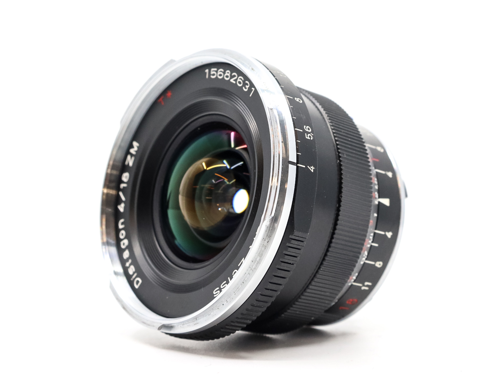
Carl Zeiss Distagon T* 18mm f/4 ZM
M mount
No listings tracked for this lens right now.
The Carl Zeiss Distagon T* 18mm f/4 ZM is a M-mount lens for Leica rangefinder cameras. Leica price index →
Specification
About this lens
Carl Zeiss Distagon T* 18mm f/4 ZM
Among M-mount lenses, an 18mm focal length is a rarity, and the Distagon T* 18mm f/4 ZM is one of the very few rangefinder-coupled options ever offered at this angle of view. It is the second widest member of the Zeiss ZM family and the only 18mm lens Zeiss built for the M mount, even though the company has produced 18mm designs in other mounts over the years [1][2]. Its retrofocus Distagon construction sets it apart from the symmetrical Biogon designs that dominate the ZM wide-angle range, and the lens covers a diagonal field of view of roughly 98 degrees[3].
The optics use ten elements in eight groups, including anomalous partial dispersion glass intended to control chromatic aberration and color fringing, and every surface carries the Zeiss T* anti-reflective coating. The barrel is metal with engraved, paint-filled markings, and handling follows the rest of the ZM line: a focus ring that turns about 100 degrees from the 0.5 m close-focus point to infinity, and an aperture ring with distinct one-third-stop clicks. The diaphragm uses ten blades, which produce the well-defined sunstars the ZM lenses became known for. The lens is rangefinder-coupled, but because of its width it brings up the 28mm and 135mm frame lines rather than offering accurate framing, so reviewers and the manufacturer recommend the optional dedicated 18mm external viewfinder for composition[4]. It is also a comparatively large and heavy ZM lens, and its size causes noticeable rangefinder blockage, more so with the metal tulip hood fitted.
The lens was sold in both black and silver finishes. It has since been discontinued, and at least one retailer reported that the black version was dropped first, leaving only the silver one in distribution while the bundled hood remained black. As an M-mount lens it does not carry electronic contacts or Leica six-bit coding, so on bodies that benefit from lens identification some users manually select a comparable Leica profile, a workaround discussed among owners.
Optical qualities
Rendering The Distagon 18mm is generally regarded as a strong performer with the edge acuity expected of Zeiss optics, though its character depends heavily on the camera it is used on. On a Leica M body it shows high central contrast and resolution wide open, with the extreme corners needing to be stopped down to around f/8 to match the rest of the frame. On thick-sensor-stack mirrorless cameras such as some Sony bodies, the corners can smear at wider apertures, a behavior typical of symmetrical-leaning rangefinder wide angles, and several users report the lens performing markedly better on film and on Leica digital bodies than on those cameras.
Sharpness Center and midframe sharpness are high from f/4, while the corners improve substantially by f/8; the lens shows no focus shift.
Distortion and vignetting Distortion is low but slightly wavy, so lines near the frame edge are not perfectly straight, which can matter for critical architectural work. Vignetting is moderate, around 2.8 EV wide open and easing to roughly 2.2 EV by f/8 on a Leica M10.
Flare resistance Flare resistance is the lens's weaker area. With a strong point light source in the frame it readily produces orange ghosts, and the hood does little to suppress them when the light is within the image.
Aberrations Coma correction is solid, with only mild coma at f/4 that clears by f/5.6. As a retrofocus wide angle it shows lateral chromatic aberration, though this corrects easily in raw processing; longitudinal chromatic aberration and purple fringing are very well controlled, even shooting into the sun.
Digital use On digital Leica bodies the lens can show color cast at the edges, and this varies by camera generation. Reviewers describe it as pronounced on M240 and M262 bodies but minimal on the M10, with later sensors said to be less affected; the cast can be corrected in software or, on monochrome bodies, managed with colored filters.
History
Development and Launch The Distagon T* 18mm f/4 ZM is part of the Zeiss ZM system of M-mount lenses, designed by Zeiss and manufactured in collaboration with Cosina in Japan. It filled an unusually wide slot in the lineup, and its retrofocus Distagon layout was chosen to deliver a near-rectilinear, wide field on rangefinder cameras.
Collector Notes The lens has been discontinued and now turns up mainly on the used market, which has drawn interest from collectors completing ZM sets and from photographers who find few 18mm M-mount alternatives. When buying, it is worth confirming the finish, as both black and silver were produced, and checking that the correct metal bayonet tulip hood and 58mm filter are present, since these are easily separated from the lens over time. Prospective buyers should also test the specific copy on their intended camera, because corner performance and color cast differ significantly between film, Leica digital bodies, and thick-stack mirrorless cameras. One published specification sheet lists a barrel length of 47 mm, which differs from the length recorded here; buyers comparing figures should treat the verified specification as authoritative.
Sources
- Phillip Reeve (Bastian Kratzke). Review: Zeiss ZM 18mm 4.0 Distagonphillipreeve.net →
- Lensrentals. Zeiss ZM 18mm f/4 Distagon for Leicalensrentals.com →
- B&H Photo. ZEISS Distagon T 18mm f/4 ZM Lens (Silver) 1440-731bhphotovideo.com →
- Macfilos. The M Files (11): Distagon revisited, the Zeiss Distagon ZM 18 and 35 mm lensesmacfilos.com →
Where to buy
Related lenses
Similar lenses you might be interested in
Comments