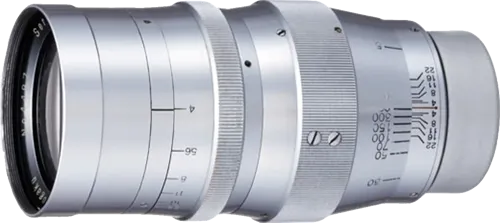
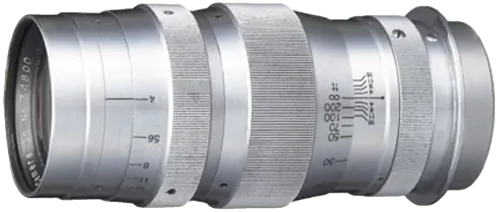
A coupled Leica-thread Angénieux 135mm f/3.5 Type Y2 with four elements in four groups, 1.5m close focus and a scarce black-and-chrome barrel.
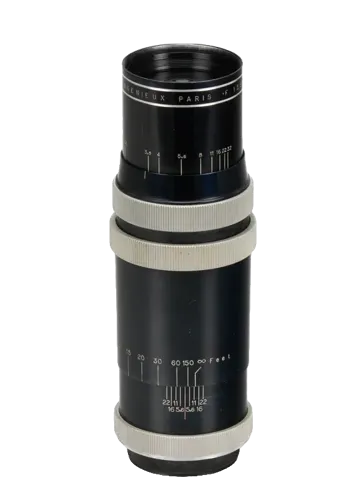
Angénieux Type Y2 135mm f/3.5
LTM mount
No listings tracked for this lens right now.
The Angénieux Type Y2 135mm f/3.5 is a LTM-mount lens for Leica rangefinder cameras. Leica price index →
How it compares
Measured against the 23 other 135mm LTM-mount lenses in the catalogue.
Specification
About this lens
Angénieux Type Y2 135mm f/3.5
The Angénieux Type Y2 135mm f/3.5 is a French rangefinder telephoto documented in a coupled M39 screw-mount barrel. Specialist references describe a four-element, four-group optical construction and a minimum focusing distance of approximately 1.5 metres. The LeicaLensList profile is limited to the rangefinder-coupled screw-mount identity and does not automatically include visually similar Type Y2 lenses made for reflex cameras.
No surviving Angénieux catalogue has established the M39 launch date. One specialist dealer attributes an example to circa 1944, but this is an example-level estimate rather than a confirmed introduction record. Multiple auction records independently confirm the coupled M39 identity.
Optical qualities
Rendering
Published reference data identifies four separate elements in four groups. This relatively simple telephoto arrangement has fewer air-to-glass surfaces than more elaborate designs, but element count alone cannot establish contrast or correction across the frame. No factory performance curves for the coupled M39 version have been located.
The 135mm focal length gives a narrow field suited to portraits, distant details and stage subjects. Its apparent compression follows from camera position and framing, not a unique Type Y2 signature.
At f/3.5
Maximum aperture offers moderate subject separation and demands accurate rangefinder calibration, particularly near the 1.5m limit. A small cam or body error becomes easier to see at 135mm than with a normal lens. Focus agreement should be tested at infinity, an intermediate distance and close range before softness is attributed to the optical design.
Surviving examples may differ substantially because of coating wear, haze, separation, fungus or disturbed element spacing. Claims of a universally soft, glowing or highly saturated rendering are not applied to every copy. A hood may reduce oblique flare, but internal condition remains the more important variable.
Stopped down
Closing the diaphragm increases depth of field and generally improves consistency across the image. Secondary references list a small aperture extending to f/32 for the broader Type Y2 family, but that value should be confirmed on the scale of a specific coupled M39 barrel before cataloguing it as universal. The same caution applies to diaphragm blade counts drawn from reflex-mount examples.
Handling and compatibility
The defining feature of this profile is a genuine coupled M39 focusing mount. Leitz Auction has catalogued more than one Type Y2 as a rangefinder-coupled M39 lens, which demonstrates a repeatable collector identity rather than a single modern experiment. A 135mm accessory finder is required on cameras without a matching built-in frame.
An LTM-to-M adapter allows mounting on many Leica M bodies, but it does not repair an inaccurate cam or infinity stop. Filter size, dimensions and weight remain unspecified because reliable figures for the coupled barrel have not been confirmed and should not be copied from Exakta, M42 or Rectaflex versions.
History
Development and Launch
Pierre Angénieux founded his optical company in Paris in 1935. The firm's official history places its emergence before the better-known Retrofocus and zoom developments that later shaped the brand's international reputation. The Type Y2 belongs to the earlier still-camera prime-lens programme rather than to the later professional zoom era.
A dealer record dates one coupled Leica M39 Type Y2 to circa 1944. Leitz Auction records other coupled M39 examples without establishing a single launch year. Those records support the mount and model identity, but the description does not convert an estimated serial-number date into a precise factory introduction claim.
Production Evolution
The Type Y2 optical family appeared in several mechanical forms. Documented examples exist for Exakta, M42 and Rectaflex applications as well as coupled M39 rangefinder use. Those versions may share the Type Y2 name and basic optical count while differing in focusing helicoid, flange distance, diaphragm controls and camera compatibility.
LeicaLensList therefore treats the coupled screw-mount lens as the relevant identity. A Type Y2 lens head placed in a new helicoid is not automatically an original LTM example. Conversely, repeated auction documentation of coupled M39 barrels means the mount should not be dismissed as a conversion merely because other mounts are more commonly encountered.
Special Editions/Variants
No official commemorative edition has been documented. Metre and feet scales, engraving changes and finish differences may exist, but the available evidence does not establish separate optical generations for the coupled M39 lens. They remain production details unless a factory catalogue or mechanically distinct version proves otherwise.
Collector Notes
Identification should combine the Type Y2 and 135mm f/3.5 engravings with a true Leica-standard screw thread and a functioning rangefinder cam. Check that the focusing barrel, cam and optical head appear to belong together. A clean conversion can be useful photographically, but it should be described as a conversion rather than as an original coupled version.
Test infinity register, intermediate focus and the approximate 1.5m near limit. Inspect for haze, fungus, separation, coating wear, cleaning marks and loose internal groups. Individual serial numbers, auction grades, caps and sale prices are omitted because they do not define the generic model.
Sources
- Angénieux, company history timelineangenieux.com →
- Leitz Auction, Angénieux Type Y2 135mm f/3.5 in coupled M39leitz-auction.com →
- Leitz Auction, Angénieux Type Y2 135mm f/3.5 rangefinder-coupled M39leitz-auction.com →
- JO GEIER, Angénieux Type Y2 135mm f/3.5 in Leica M39jogeier.com →
- AllPhotoLenses, Type Y2 optical constructionallphotolenses.com →
Where to buy
Related lenses
Similar lenses you might be interested in
Comments